Dutch Landscapes: Lands of plenty
A new exhibition of 17th-century Dutch landscapes shows a country gloriously at peace following the ravages of war

For free real time breaking news alerts sent straight to your inbox sign up to our breaking news emails
Sign up to our free breaking news emails
The organisers of the latest exhibition of the Queen's pictures at Buckingham Palace, Dutch Landscapes, seem in two minds as to how much to give George IV credit for their purchase. On the one hand it is 200 years since the Parliamentary bill that made the Prince of Wales the country's Regent in view of his father, George III's illness (viewed as "madness" then). And "Prinny" was a great collector, as an adjoining room in the Queen's Gallery devoted to his taste, shows.
On the other hand, no one seems to want to make too much of a comparison with his present-day successor in the job. The Windsors, despite the artistic patronage of previous occupants of the throne, from Henry VIII and Charles I onwards, have never been noted for their embrace of contemporary taste – not even the present Prince, for all his practice of painting. The emphasis of royal exhibitions in recent years has been increasingly on artistic themes and periods based on the royal collections as a whole rather than particular patronage and monarchs.
But collections by individuals are fascinating in their own right, especially when they are as good as this one. Dutch art by the end of the 18th century had risen in French and British critical esteem to rival and even overtake the Italian painting which had hitherto formed the backbone of the royal collection. George IV himself was probably more favoured of the Dutch tavern and genre scenes of ordinary life, but he took advice, and paid some of the highest prices ever for single paintings, to buy a formidable holding of landscapes, then recognised (not least by British artists of the period) as "high art" in their own right.
As an exhibition of Dutch art of the 17th century, the Queen's Gallery exhibition is not, of course, comprehensive. It aims neither to examine its origins nor its consequences. But as a display of Dutch landscape painting at its apogee it is a real pleasure. Well advised, George IV went only for the best and his (or his adviser's) eye has been amply justified by the passage of time. There are very few duds here and half a dozen true masterpieces.
The 42 works on display mostly come from one period, the 1650s and 1660s, when Holland had just emerged from over 80 years of warfare against Spain to finally claim its status as an independent nation in 1648. The terrible cost of that long and brutal fight is not much in evidence here, although an early Philips Wouwermans of The Furrier of the Camp (c1650) gives an unblinking view of the life of the camp followers of the armies of war.
Most of the works, however, express the postwar sense of relief and a delight in the diurnal and peaceful. Landscape, once the scene (in art as well as reality) of massed armies and billowing gunpowder smoke, now becomes a vision of prosperity and play; even the desolate dune areas of Holland are the setting for hunts and fashion.
There may be something over-idealised in this, but there is also something profoundly Dutch. It's easy to forget now that Holland emerged into nationhood as the most prosperous and most advanced country of Europe, the owner of half the merchant fleet of the continent and much of its overseas trade.
What is fascinating is the effect that prosperity and statehood had on the market for paintings. Where most artistic patronage in Europe at the time was still aristocratic or clerical, the Dutch had become profoundly bourgeois in their habits and in their purchases. Protestantism, combined with merchant wealth, demanded a rejection of excess and a hallowing of the ordinary.
Again and again in these works it is the sky that determines the mood, often taking up half or two thirds of the
picture, almost always with clouds and the sun either rising or setting. It has something to do with the flat land and the horizons of Holland. But it also has something to do with their mood, a mixture of confidence tinged with a sense of God in nature and the smallness of man.
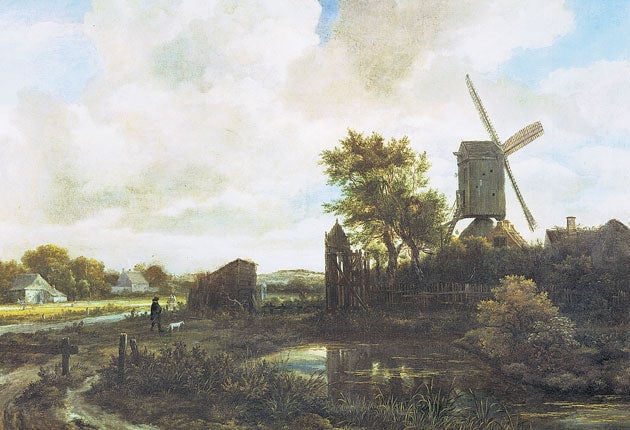
The sense of time passing is most obvious in Jacob van Ruisdael, the greatest of the Dutch landscapists. The exhibition only has one, but it is a stunner. Evening Landscape: A Windmill by a Stream dates from the 1650s. The windmill, dark and forbidding on the right, is balanced by the whiteness of sheets laid out to bleach in the field to the left. Half the picture is taken up by a cloudscape poised between light and raincloud. Melancholy, but also majestic in its sense of past and present.
Most of the scenes collected by George IV are more human. Cows are there in plenty (what else in Holland?) being milked or just contentedly chewing the cud. There's a succession of wonderful Wouwermans – The Hayfield, A Horse Fair in Front of a Town and A Winter Scene with Figures – that develop the great Flemish traditions of rural life into the 17th-century passion with the sky.
But it is with the marine paintings, the lifeblood of Dutch commerce and the subject of so much of its art, that the move from the splendour and drama of the 16th century to the ordinariness and peace of the 17th century is most marked. One moment we are in a world of fighting ships, royal yachts and sea battles. The next we are asked to consider barges, ferries and cargo vessels.
A monumental painting by Aelbert Cuyp, The Passage Boat, is of an ordinary ferry, the drummer boy announcing its arrival, the flags displaying its nationality and the mast and sprit making an obvious cross. Here, says the picture, is what makes Holland special and great. Although the exhibition tries to make something of the religious symbolism of these pictures – the cross of the masts, the breath of God required to turn the windmills and the eternity of the sky – one suspects that it is something less elevated that drives that most down-to-earth of people, the Dutch: an appreciation of the mundane. It's what made them appear too "vulgar" for the refined tastes of the earlier Georgians.
Although the exhibition tries to make something of the effect of travel to Italy, the warm skies of the south never really altered the Dutch way of thinking. They were too Protestant and solid to appreciate the bravura and the volatile. The incomprehension was mutual. But these paintings and others like them in noble houses in Britain did profoundly influence artists here. Turner was an admirer of Cuyp's and took inspiration from the way the Dutch had with the light of the sun. Constable was equally influenced by their way with clouds and haphazard nature of the rural scene.
Curiously, George IV patronised neither of these two great English artists. He preferred more genre scenes and commissioned Sir David Wilkie, his court artist, to make English versions of them (also on display in the adjoining galleries of Royal Treasures). He originally planned to show his Dutch genre scenes along with his landscapes in a picture gallery. It's a pity the Keeper of the curators didn't do the same here. But what they have done is gather together a formidable collection of Europe's finest school of landscapes at its height. And if George IV bought them because they were the paintings to collect in his day, he made an awfully good job of it.
Dutch Landscapes, The Queen's Gallery, Buckingham Palace, London SW1 (020 7766 7301) to 9 October
Subscribe to Independent Premium to bookmark this article
Want to bookmark your favourite articles and stories to read or reference later? Start your Independent Premium subscription today.
Join our commenting forum
Join thought-provoking conversations, follow other Independent readers and see their replies