Mat Collishaw, Tracey Emin and Paula Rego, The Foundling Museum, London

For free real time breaking news alerts sent straight to your inbox sign up to our breaking news emails
Sign up to our free breaking news emails
The Foundling Hospital in Bloomsbury was created in the 18th century by a venturesome sea captain and shipwright called Captain Thomas Coram. It existed to alleviate the appalling suffering of the many wretched foundlings who were abandoned on the streets of London. Captain Coram's hospital took some of them in – alas, not all of them by any means. The great hospital itself was swept away in the 1930s, but there is still a Coram Foundation devoted to the needs of deprived children, and a glorious open space where the hospital once stood called Coram's Fields. One of the most entertaining public notices to be read in the whole of London is displayed at its entrance. This is not a public park, it reads. No adult is to enter unless accompanied by a child. We critics sometimes feel that way about exhibitions of contemporary art, that the sanity of a small child might help to refresh our eye.
And then, right at the back of Coram's Fields and the little public park that abuts it, there is the Foundling Museum, first created in the 1930s – as a penance perhaps for having wantonly destroyed that finer hospital. It is in this building that Coram and his achievements as an exemplary philanthropist are memorialised. Here is panelling from one of the great hospital's rooms, a replica of its picture gallery (complete with pictures), and fine paintings and objects donated by the hospital's many benefactors, among whom were Handel and Hogarth. There is even a Handel Room on the top floor, which contains manuscripts, his books, and other fascinating memorabilia.
For the next couple of months, three contemporary artists have joined the ongoing conversation here about the plight of children by displaying sympathetic works in various parts of the building. And even outside the building. It is often quite difficult to find their contributions. In fact, it proves to be a game of hide and seek, which is sometimes interesting and at other times exasperating. As you walk up the steps of the building, you spot the first artwork – Tracey Emin's tiny bronze cast of a baby's mitten, painted a suitably grubby pink, and folded back as if about to be slipped on to a tender foot. The morning I visited, the sock itself was partially overshadowed by a bullying leaf.
The single most arresting intervention is Paula Rego's huge Oratoria, which sits on the first landing, opposite a bench from which you can sit and contemplate its shockingly arresting display of miseries and horrors. "Ugh, scary!" says a teacher as she hurriedly pushes past me, pulling at the arm of a small child. I couldn't agree more. This is a huge tableau, with opening wings. Painted, papier-mâché figures, life-size and tricked out in 18th-century Foundling Hospital costumes, sit and loll around at its centre; paintings rise up at their back, and on its opening wings. It is just like something tiny grown nightmarishly large. An emaciated, puppet-like child hangs over the knees of a black nurse like some grotesque pieta. The figures have over-large heads; they have a demonic fairy-tale quality about them in common with so much of the work of Paula Rego.
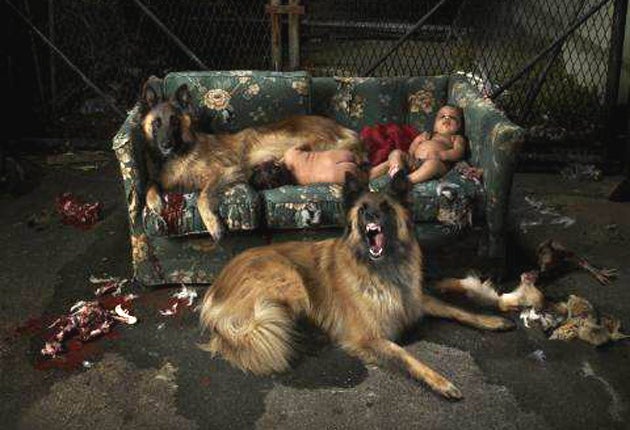
In another room, amid venerable portraits of beaming male benefactors, a rack of baby clothes, courtesy of Tracey Emin, waits patiently for a baby. Mat Collishaw's Children of a Lesser God, a giant, wall-mounted transparency blown up to the size of a portrait of an eminent benefactor, makes the flesh creep. Two wolfish dogs, surrounded by scraps of torn animal skin and animal offal, seem to be protecting two naked young babes inside a wire compound. "An image of paternal strength and pride", interprets the exhibition guide. Hmm.
To 9 May (020 7841 3600)
Subscribe to Independent Premium to bookmark this article
Want to bookmark your favourite articles and stories to read or reference later? Start your Independent Premium subscription today.
Join our commenting forum
Join thought-provoking conversations, follow other Independent readers and see their replies