Roads to Berlin, By Cees Nooteboom trans. Laura Watkinson
This personal chronicle of Berlin captures the restless heartbeat of an "old -new" metropolis

For free real time breaking news alerts sent straight to your inbox sign up to our breaking news emails
Sign up to our free breaking news emails
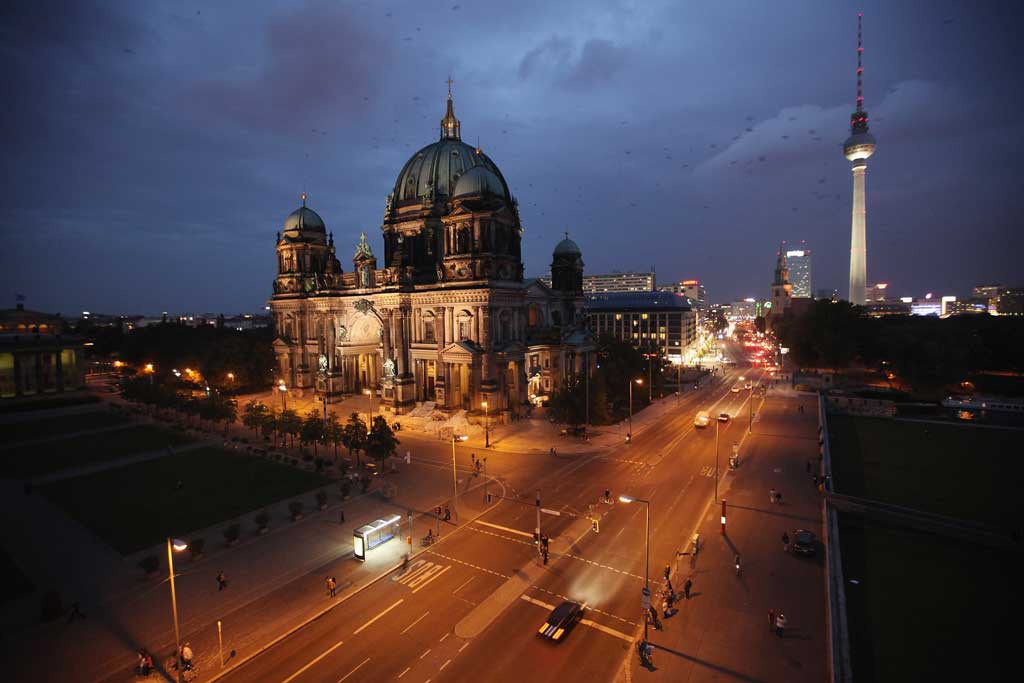
Berlin: the word brings a myriad of associations, whether it's Christopher Isherwood's Goodbye to Berlin that comes to mind, John le Carré's The Spy Who Came in from the Cold, Norman Foster's Reichstag cupola, or Daniel Libeskind's Jewish Museum – most eloquent, perhaps, when empty.
Berlin is that "city of the negative space, the space where something is not, the bombed-out-of-existence, the closed-off, the mysteriously forbidden". It is Brecht's theatre, or the oasis of the French cemetery, or a River Spree frozen in winters shaped by Siberian winds, or that particular sensuality of a Berlin summer when the lushness of trees, bushes, their fruits floating on the surface of the lakes, the meadowlands of the parks, have an almost indecent abandon.
Whether through memories of the revolutionary excitement of 1989 or dark echoes from other footfalls on those wide avenues and shadowy sidestreets, any visitor to Berlin will be familiar with its peculiar blend of tangible History (yes, with a capital "H", insists Cees Nooteboom, just as Time and Memory seem to call for capitalisation in this old-new metropolis) and the restless heartbeat of its constant evolution.
The Dutch author's life as a writer is intimately entwined with Berlin and that wider "enigma", Germany. In childhood – he was seven when the war began – it was the "incredible noise" of the Stukas and Heinkels over The Hague that stole that section of human memory so evocative to Proust and Nabokov. His youngest years are a blank slate; no nibbling of the Dutch equivalent of a madeleine can invoke recollections.
It was later that his encounters with the bewildering land of contradictions were experienced with head and heart. In that patchwork of states, language was both the beautiful idiom of Goethe, Hölderlin, Novalis, and the one used to give expression to regimes unimaginable to those men of letters (not that they were strangers to the thin divide between Gleichgewicht – "balance" – and chaos). In 1963, Nooteboom covered the visit to Germany of Soviet leader Nikita Krushchev, and later, in that watershed year of 1989, he was back for 18 months on a writer's grant. The essay-like chapters of this book of reflections, or "telegrams to myself" from those visits, are evidence of an observer and chronicler: a congenial, erudite and whimsical companion of a rare ilk. As Jan Morris is to Venice or Trieste, as Edmund White to Paris and Claudio Magris to the Danube, so is Cees Nooteboom to Berlin.
He divides Roads to Berlin into four sections. They range from the drama of border crossings in January 1963 – with the winterscape of towers, men in snowsuits with dogs and rifles, travel along "Hitler's Autobahn" at the prescribed 100km per hour – to a tremendous chronicling of surreal or moving detail in the months leading to that new measurement of time in 1989, Before the Wall/After the Wall, and into the 1990s. Nooteboom is "there to see", inviting the reader to exchange a frozen-in-time sense of looking back for a personal perception of the reality.
Nooteboom's perspective is that of the outsider. He captures the state of flux with the clarity of journalism and the slower lens of the poet. When the "present" moves with dizzying alacrity, and the eddy of voices and opinions grows too much, he retreats to the literary world of Goethe's journeys through the Harz mountains, or to the unusual balm of the zoo in the former East of the city, with "the Vietnamese pot-bellied pigs… the Siberian bears, the panther and the heron".
The leitmotifs of these essays are the passage of time; the creation of "History" and its vanishing traces; the sense of the forbidden. Different ages rub shoulders: that of the Prussian kings and Stalin's architecture, of the Third Reich's happenings (those shadow companions on any walk through the city), and the possibility of what some tabloids refer to as the "Fourth Reich". Rather, writes Nooteboom, this is the "gentle face of power" as now embodied by the chancellery – the Bundeskanzleramt; a building not bombastic, modest even – as he ponders Germany's place in the current European "crisis".
He acknowledges the uneasiness in some quarters about the strong player Germany undoubtedly is, inconceivable in the rubble-strewn devastation of 60 years ago, and remembers his own astonishment at the pace of reconstruction over the layers of story in Potsdamer Platz – the sense of "future power". However, he confesses to a "quiet euphoria". Regardless of his "inner archive... I was determined to find everything magnificent. The Deutsche Bahn stole through forests and mountains…"
Roads to Berlin contains a promise of sorts: that, once tasted, you will always find a road back to a city which will be familiar and yet not. Beautifully translated by Laura Watkinson with a helpful glossary and a bibliography to escort the reader on further journeys, this is a delightful book. Sombre (how could it be otherwise?), it has that particular clarity of the "copper sun" picking out details on the façades of buildings and the souls of Berliners, past and present. Masterfully, it listens in to the rhythms of the History of both.
Subscribe to Independent Premium to bookmark this article
Want to bookmark your favourite articles and stories to read or reference later? Start your Independent Premium subscription today.
Join our commenting forum
Join thought-provoking conversations, follow other Independent readers and see their replies