Pop Idol Afghan style
Amid glamour and death threats Pop Idol has landed in the wartorn nation. Now it's the subject of a film. Arifa Akbar reports

Get our free weekly email for all the latest cinematic news from our film critic Clarisse Loughrey
Get our The Life Cinematic email for free
Outside Kabul Wedding Hall, the world turns at its usual speed. Women shop in burqas, rickshaws are stationed on street corners and uniformed guards with Kalashnikovs stand on sentry duty against a backdrop of dilapidated buildings pockmarked by 30 years of war.
Inside, a newly liberated Afghanistan is rapidly taking shape. Hundreds of Afghans have arrived from various corners of the country to jostle their way to a raised dais where a man in a white suit is hosting auditions for a reality TV contest based on Simon Fuller's Pop Idol.
There is the same po-faced panel of judges, the same ear-splitting standard at auditions and a similarly unwieldy demographic of wannabes ranging from young men in baseball caps from Kandahar, Herat and Kabul to wizened Pashtun eldermen in turbans. At a respectful distance sit a small clutch of Afghan women, heads covered, who have dared to try their luck. "First up is our dear sister ..." booms the host, as a demure woman in a yellow hijab makes her way on to the stage.
The British film-maker Havana Marking travelled to Afghanistan in 2007 to film this new cultural phenomenon over four months from the regional heats of the contest to its grand finale at Kabul's Intercontinental Hotel. In her documentary, Afghan Star, which was feted at the Sundance Film Festival earlier this year and opens at London's Institute of Contemporary Arts this month, she captures the people of Afghanistan in a way they have rarely been seen.
What is so remarkable about the contest is not just the immense response from a nation apparently bursting with songs but also the fact that only six years ago, under Taliban law, Afghan citizens were banned from listening to music, dancing or watching television at all.
Nonetheless, politics, religion and factional tensions hang in the air – two out of the three chanteuses face death threats for taking part and the campaign for another Hazara contestant resembles a battle of historical redress for the oppression of his people.
But the show's popularity suggests it has touched a nerve in the nation's cultural consciousness. Two thousand people audition for the chance to win $5,000 – more than 10 times the average annual salary – and it was watched by a third of Afghanistan's population who exercised what the film-makers suggest was one of their first opportunities for voting – by text message.
While the Pop Idol format has been successfully exported across a range of cultures from Scandanavia to Africa, Tolo TV, the channel that airs the weekly show, believes it represents more than the sum of its parts in Afghanistan: that it can "move people from guns to music" and unite a country riven by deep factional enmities.
During the final, when 11 million Afghans tuned in, some openly gathering outside cafés, it appeared to have sprung a moment of national unity. Even the Taliban were believed to be voting for the Pashtun candidates, the ethnic group to which they are often most closely related.

Watch Apple TV+ free for 7 days
New subscribers only. £8.99/mo. after free trial. Plan auto-renews until cancelled
Watch Apple TV+ free for 7 days
New subscribers only. £8.99/mo. after free trial. Plan auto-renews until cancelled
Marking focused on four contestants including two of the three women who auditioned. Firstly, Rafi Naabzada, a clean-cut 19-year-old from Mazar-e-Sharif with boy-band looks. On camera, he says he has no interest in politics but wants his nation's "soul to come alive again". Our people are wartorn," he adds, "but we are tired of fighting. We want a new Afghanistan."
Hameed Sakhizada, 20, is a classical trained singer from the minority Hazara ethnic group, who were persecuted during the Taliban regime. In reaching the final 10, he becomes a hero and his campaign is fought feverishly. One supporter sells his car to help fund it while supporters literally pray to "make him number one".
Lema Sahar, a 25-year-old woman who wears a burqa, comes from the religiously conservative region of Kandahar, recalls how her music teacher smuggled instruments into her home so they could practice.
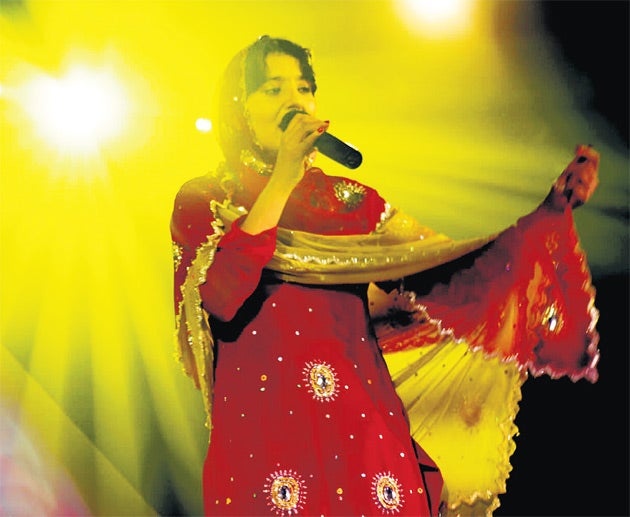
Setara Hussainzada, the only other female to make it to the final heats, is a strong-willed 22-year-old from Herat City who is influenced by Bollywood. We first encounter her having her eyebrows shaped as she talks about her ambitions. "Because I'm an artist, I believe there is no difference between men and women. I just want to be a famous singer. I'm an open-minded person so I'm looking for an open-minded man. But first I want to be a singer so he can understand me."
A key part of the film comes as Setara, dancing, reveals her hair, when her hijab slips. It is an explosive moment – women gasp while men tut and avert their eyes. One man watching her performance with undisguised hostility says: "She will pay a big price". Indeed, it leads to death threats and Setara goes into hiding. A week after her performance, Ismail Khan, a former warlord and ex-governor of Herat sounds a warning over the show and speaks about the "blood of martyrs".
Setara might live in terror, she explains afterwards, but then she has grown up under the Taliban. "It's not new for me to be afraid," she says ruefully. Still, she is evicted from her Kabul apartment and must make the terrifying journey back to Herat under the shadow of the threats. It is on occasions such as this that the show becomes a battleground between the old Islamist guard and those who want to return to the days the liberal Afghanistan of the 1980s. Three weeks before the final, the Ulema Council of Islamic Scholars meet to discuss the "continual fight against the enemies of Islam".
On filming days, the makeshift TV studios in the back of an old Kabul cinema, were surrounded by armed guards and razor wire. Threats to Tolo staff increased after the Ulema called the show "immoral and un-Islamic".
Its host, Daoud Sediqi, is not easily cowed. He says he first learnt the trade by making illegal television sets to sell during Taliban rule. Yet there is a continued threat that hangs over him even now. "There are people telling me what I am doing is not right."
For Marking, the point was to present a different picture of the country: "I was frustrated that you never see or hear about civilians or young people here. This is a country with 60 per cent of the population under 20. They are largely ignored, but clearly they are the future." Yet the battle between the old and new guard has surely already been won, the documentary suggests. Towards the approach of the final, there appears to be a confident new Afghanistan emerging: women lining the vast hall where filming takes place have removed their headscarves and put on make-up. A young girl holds up a pink mini skirt flirtatiously and her friend shouts "The Taliban would shoot you for wearing that". They both giggle, and then go back to watching the show.
'Afghan Star' opens on 27 March
Subscribe to Independent Premium to bookmark this article
Want to bookmark your favourite articles and stories to read or reference later? Start your Independent Premium subscription today.
Join our commenting forum
Join thought-provoking conversations, follow other Independent readers and see their replies