The sounds of Scorsese
As the veteran film-maker releases his concert movie on the Rolling Stones, Nick Coleman applauds a director who's always put music at the heart of the action

Get our free weekly email for all the latest cinematic news from our film critic Clarisse Loughrey
Get our The Life Cinematic email for free
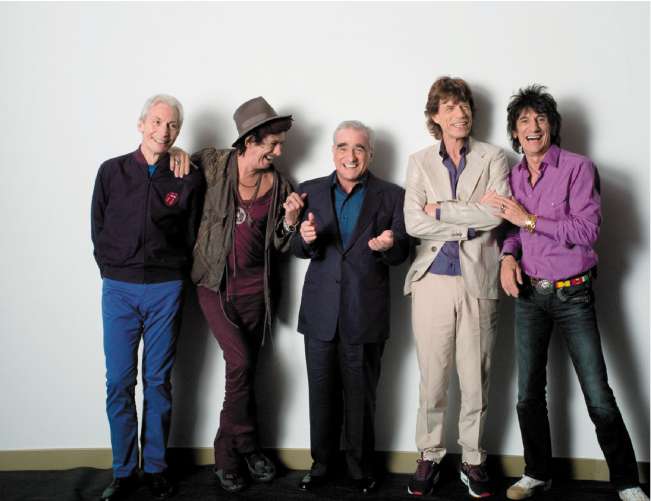
Martin Scorsese has made a concert film of the Rolling Stones. Shine a Light is a record of a single live date in 2006, a benefit for the Clinton Foundation. By all accounts it's a straightforward, linear affair, achieved in high style and with palpable affection.
You can see why Mick Jagger might fancy such a thing. Cinema has not over-dignified the Stones over the years and the group themselves have made no suitable celluloid gift to posterity. Who better, then, to make them look the way they'd want to look in their dotage than the original Rockin' Movie Brat?
It's harder to see why Scorsese might fancy such a project. His artistic legacy is so secure that he no more needs to make an edifice out of the Rolling Stones than he needs to direct an episode of Basil Brush. But it only takes a look at the Scorsese canon to see that Shine a Light was almost inevitable. From the very start it was obvious Scorsese was going to do something like this. He's even done something like it before. In 1976 he recorded the valedictory performance by The Band at Winterland, San Francisco. The Last Waltz is as lapidary and monumental as rock concert films get.
Scorsese has always loved music immoderately. Certainly, no single film director of his clout has made such essentially musical films. Even with the sound turned down, the best Scorsese films shout and shimmy and reach, as if in reflex, for the transcending arc of aria. They are music in film form.
Here's the great New Yorker film critic Pauline Kael on Mean Streets (1973): "The music is the electricity in the air of this movie; the music is like an engine that the characters move to. Johnny Boy, the most susceptible, half dances through the movie... He enjoys being out of control – he revels in it – and we can feel the music turning him on."
We should not expect Scorsese's films to be any other way. He is, after all, the kingpin of the "movie brat" generation that emerged snapping their fingers from the film schools of the Sixties, as much in thrall to hipsterism and its soundtrack as they were to the European New Wave cinema and Forties American films noir.
For Scorsese in particular, the music in a film is not ancilliary to what he has to say, it is, in part, what he has to say. And to say it properly he requires his music to do its work internally, within the world of his cinematic stories. As often as not in Scorsese films, the music emanates from the drama, like a smell. Here's Kael again, on the music in Mean Streets: "[It] doesn't use music, as Easy Rider sometimes did, to do the movie's work for it ... The music here isn't our music, meant to put us in the mood of the movie, but the characters' music."
'Shine a Light' opens on 11 April
Scorsese's greats
Raging Bull (1980)
You want cinematic aria? Cinematic aria with blood and splintering bone? And Madonnas in white dresses? Here's your baby: the story of Italian-American middleweight self-punisher Jake LaMotta in the monochrome America of the Forties and Fifties working out his addiction to being beaten to a pulp by better pugilists than he (not to mention the beatings he takes from the system, the Mafia and as a consequence of his dumb way with women). It's a Stations of the Cross, really, and Scorsese enacts the ritual with a toweringly emotive orchestral score, plus an eclectic mess of the popular music of the era.
Watch the Raging Bull trailer
Taxi Driver (1975)
The last film scored by the great Bernard Herrmann is arguably undermined by the very voluptuousness of that score. Taken on its own, the music is a lush meditation on the snaky-noir jazz of Charles Mingus, all loops and coils, suggesting the serpentine involutions of the city that makes the titular cabbie, Travis Bickle, into the dangerous creature he is. But the New Yorker critic Pauline Kael took exception: "[The movie], with its suppressed sex and suppressed violence, is already pitched so high that it doesn't need ominous percussion, snake rattles and rippling scales. These musical nudges belong back with the rampaging thrillers Taxi Driver transcends." Gorgeous as those ripples are, it's hard to argue with her.

Watch Apple TV+ free for 7 days
New subscribers only. £8.99/mo. after free trial. Plan auto-renews until cancelled
Watch Apple TV+ free for 7 days
New subscribers only. £8.99/mo. after free trial. Plan auto-renews until cancelled
Watch the Taxi Driver trailer
Mean Streets (1973)
Has there ever been a hipper soundtrack? Mean Streets does not have an accompanying score. The music you hear is the music the characters in the story hear, as they ricochet like stray bullets between the hard surfaces of the Mafia underworld and the dark interior of Sicilian Catholicism – the double-helix of crime and self-punishment animated to the sound of The Chantells, The Shirelles, The Chips, The Aquatones, The Miracles, The Marvelettes, Derek and the Dominoes and, yes, the Rolling Stones.
Watch the Mean Streets trailer
The Last Waltz (1978)
Scorsese played a major part in the editing of both Woodstock and Elvis on Tour, so he already knew what it takes to record live music in a concert setting. The Last Waltz is a loving movie, as effective in its rendering of a one-off performance by a legend of rock – in this case The Band – as it is over-fond in its treatment of the group's soi-disant spokesman Robbie Robertson. You'd have to be a frustrated musician to make so plain a film work so musically.
Watch the trailer for The Last Waltz
New York, New York (1977)
If Taxi Driver was a genre piece working its way out of its generic bonds, New York, New York was a meta-musical wondering if it oughtn't to bust its way back in. The music itself is in many ways incidental to this story of love, jealousy and the super-heated career arc, yet Scorsese's passion for the stuff ensures it earns its corn. The robust big band-to-modern jazz routines, and Kander/Ebb's original numbers, which fairly rip off the screen, gave Sinatra a late hit and Liza Minnelli the most suitable songs she ever got to sing.
Watch the New York, New York trailer
The Last Temptation of Christ (1987)
For his solemn treatment of Nikos Kazantzakis's novel about the spiritual racking of Jesus, Scorsese elected to commission an original score by Peter Gabriel. "The brief," says Gabriel, "was to create a landscape that was part ancient, part contemporary, part familiar, part unknown, and very soulful. We both wanted to break away from the traditional choral and orchestral music connected with the Passion story, to create a new canvas. I was concerned whether Marty would respond to the idea of the voice of Nusrat Fateh Ali Khan, bringing his majestic Sufi singing to the Christian story, but he loved the idea." Whether or not the film works as a film, the music certainly works as music.
Watch the trailer for The Last Temptation of Christ
No Direction Home: Bob Dylan (2005)
A labour of love and of almost infinite patience. This is the music doc to end them all, extracting the juice from the fruit that is Bob Dylan and mixing it with a steady flux of archive footage and talking heads. Magnificent, if you like Bob Dylan; still magnificent but a bit slow if you're not fussed. You can imagine Mick Jagger snuggling down with L'Wren Scott and the DVD and the light bulb going on in his head...
Watch the No Direction Home trailer
Subscribe to Independent Premium to bookmark this article
Want to bookmark your favourite articles and stories to read or reference later? Start your Independent Premium subscription today.
Join our commenting forum
Join thought-provoking conversations, follow other Independent readers and see their replies