Leaving (15)
Great Scott, age cannot wither her

Get our free weekly email for all the latest cinematic news from our film critic Clarisse Loughrey
Get our The Life Cinematic email for free
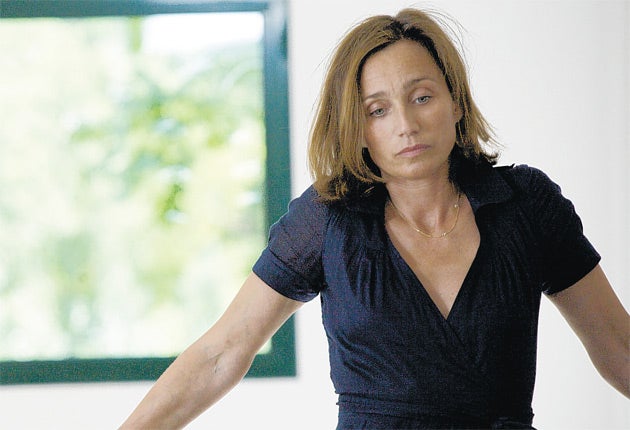
Kristin Scott Thomas, recently turned 50, is doing what few actresses ever manage: blossoming with age.
Like Charlotte Rampling, she is reaping the advantages of doubleness, being as fluent in French as she is in cut-glass English. Hitherto, film-makers have nearly always sought her as a safe decanter of well-born haughtiness and glacial charm, beginning with Brenda Last in A Handful of Dust (1988), then with better-known variations in Four Weddings and a Funeral (1994), The English Patient (1997) and Gosford Park (2001), from which I cherish a particular memory of her aristocratically snapping at Ryan Phillippe ("Take your hands out of your pockets"), before inviting him into her bedroom. It seemed exactly the way a randy upper-class Englishwoman might have behaved at a weekend house party in 1932.
It helps that she's beautiful, of course. But two years ago she was allowed to explore a greater depth and versatility as the star of Philippe Claudel's I've Loved You So Long, playing (in French) a woman returning to live with her sister's family after a long stretch in prison. The outward severity of her character was slowly, and affectingly, pared away to reveal a mother haunted by an irrevocable act of mercy. Now, in Catherine Corsini's Leaving, Scott Thomas fastens her elegant jaw on another meaty role, this time as an Englishwoman named Suzanne, living a comfortable bourgeois life with her husband and teenage children in Nimes. Change is afoot in the family, for Suzanne has decided after 20 years to retrain as a physiotherapist. Her husband Samuel (Yvan Attal) is a successful doctor who's rather mean with his time, and his money: trying to shave costs in converting an outhouse into her office, he hires foreign labour to get the job done.
This would be a burly Spanish émigré by the name of Ivan (Sergi López), who, in his unobtrusive way, becomes an object of curiosity to Suzanne. He fixes an old lamp she was going to chuck out (was there a genie in there?) as well as moving all the junk, and they finish the clear-out with a companionable beer. "You work hard for people who disrespect you," she remarks, meaning people in general, but implying her husband in particular. Having been indirectly responsible for Ivan breaking his ankle, Suzanne offers to drive him back home to Spain for the night to see his young daughter. A friendliness creeps up on them, despite his admission to her that he's an ex-con – "kid's stuff," he says, when she inquires of his crime, though he's still on parole. The writer-director Corsini marks these increments of closeness in Scott Thomas's face, which seems to glow in this man's company. There's a lovely moment when, trying to arrange a rendezvous on the phone without betraying her urgency to see him, she bites her lower lip in girlish anxiety. It's as if she's 17 again, and what impresses in Scott Thomas's performance is the very physical sense of delight that has revitalised this "respectable" woman.
Their coming together feels as helpless and dangerous as a runaway train: "I can't help it," Suzanne says. "It just hit me." Perhaps too used to the transparent spaces inside their angular modernist home, she does a foolish thing and confesses her affair to Samuel, whose immediate question, worryingly, is how many times they've "done it". And, in classic alpha-male fashion, he is initially clueless about her lover ("Who is Ivan?" he asks, having been his employer only weeks before). To be fair, Corsini doesn't disclose a great deal about Ivan, either, though she gives us hints as to why his difference from her husband would be attractive to her. First, Ivan is an exile, like her, so a yearning for elsewhere unites them. Secondly, there is something transgressive in Suzanne's falling for a man not of her class, a touch of the Chatterleys that the irate Samuel is quick to spot: "The lady and the prole! Is that your trip?" he taunts her.
But there is something else, implied at first, that would seem to make Suzanne's estrangement perfectly comprehensible, and it's this: her husband is a shit. Perhaps their 20 years together have inured her to his penny-pinching, his brusqueness with people, his condescension towards her. His reaction to the affair gives us the measure of the man in full, however. When locking his wife in her bedroom like a naughty child doesn't work, Samuel exacts a subtler revenge by impoverishing her: he freezes her account, and refuses point-blank any maintenance. But he does something quite insidious, too, using his contacts (he is an aspiring politician) to block the employment prospects of both wife and lover. His vindictiveness turns out quite breathtaking: at one point Suzanne, marooned with a cancelled credit card in rural Spain, tries to sell her wristwatch to passers-by.
What's remarkable about this marital campaign of attrition is that Samuel – like Soames in The Forsyte Saga – persecutes his wife because he wants her back. "You're useless without me," he tells Suzanne, which in baldly economic terms is close to the truth. A freakish phenomenon, this, the husband who sees no contradiction between loving his wife (if indeed it can be called love) and tormenting her into submission. Why can he not understand that his coercion only makes him hateful to her? Leaving tells the kind of painful story – of passion, betrayal, revenge – we might read about every day in the papers, but it is the cool manner of its telling and an outstanding central performance by Kristin Scott Thomas that sharpen our interest. And it is chilling about the prison that some would make of a marriage.
Subscribe to Independent Premium to bookmark this article
Want to bookmark your favourite articles and stories to read or reference later? Start your Independent Premium subscription today.
Join our commenting forum
Join thought-provoking conversations, follow other Independent readers and see their replies