London River, Rachid Bouchareb, 87 mins (12A)
Five years after the 7/7 London bombings, a reflective film by a Franco-Algerian director sees two unlikely characters brought close by the search for their missing children

Get our free weekly email for all the latest cinematic news from our film critic Clarisse Loughrey
Get our The Life Cinematic email for free
Rachid Bouchareb is a director used to making a splash.
His bravura war film Days of Glory was a polemical epic designed to highlight the role of North African soldiers fighting for France in the Second World War. This year, his Hors-la-loi, about Algerian independence fighters in the 1950s, so ruffled right-wing feathers in France that when it premiered in Cannes, riot police were posted to patrol the red carpet area.
In between these bold-print headline films, Bouchareb made one that is more of a pensive sidebar. London River is about the aftermath of the London bombings of 7 July 2005, a downbeat, low-budget anecdote about two worried people in search of their grown-up children.
A widowed farmer from Guernsey, Elisabeth (Brenda Blethyn) sees TV reports of the bus wreckage in Tavistock Square and calls her daughter Jane for reassurance. Getting no response, she goes in search of her, and the narrative jumps to a world as unfamiliar to Elisabeth as the planet Pandora – Finsbury Park, to her a bewildering forest of halal butchers and shops offering cheap calls abroad. On a railway bridge in the Haringey hinterlands, Elisabeth sees a wall of photocopied A4 appeals to locate the newly vanished. Thereafter, she enters a bleak new galaxy of police stations, hospital wards, morgue waiting rooms, where multi-racial crowds prepare to hear the worst about their loved ones.
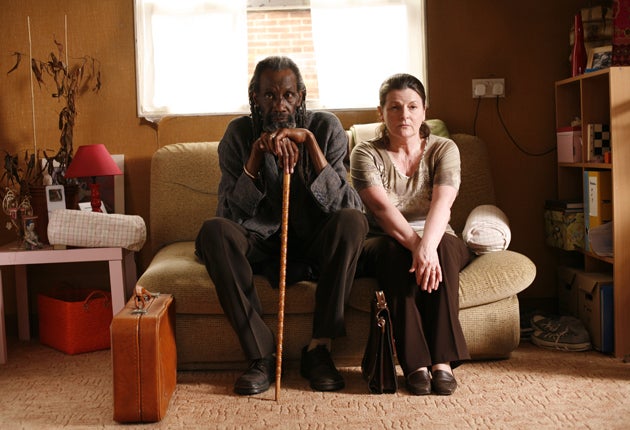
Among them is elderly African forester Ousmane, played by the Malian actor Sotigui Kouyaté, who died earlier this year. Ousmane is looking for his son Ali: he hasn't seen him since the boy was six, but is determined to comb London for some trace of him. For all their differences, Ousmane and Elisabeth are both strangers in this world, united by their quests and, it turns out, by more besides. Their affinity is signalled a little too flatly in the film's opening minutes, as Bouchareb cuts between the two, both tending their lands, both praying.
Yes, there's a bedrock of crunching obviousness at the bottom of London River, and seen strictly as a London drama about an odd couple coming together in adversity ("Diversity in Adversity" could be the tagline), London River looks like a straight exercise in British Loachian realism.
But taken as a French film (the dialogue is French and English, with some Arabic and Malian) by a director of Algerian origin, it's rather more intriguing. Bouchareb might have presented the story from the perspective of Ousmane, the Muslim visitor; in fact, the dominant viewpoint is that of a sheltered and conservative woman who would probably run a mile rather than watch a Bouchareb film. Sympathetic but confused, Elisabeth is far more an outsider in London than Ousmane. She phones her brother in baffled anguish, not just at Jane's disappearance but at the new and, she thinks, hostile world she's found herself in: "This place is crawling with Muslims." It takes a performance as subtle as Blethyn's (and despite expectations of broadness, given her role in Mike Leigh's Secrets and Lies, she is subtle here) to present Elisabeth as just scared and averagely ignorant, rather than an outright racist.
The film could have done with more of Ousmane, and more insight into him – although it's the essence of Kouyaté's performance that he's hard to read. He's a reserved elder, an eternal nomad striding with stick and long grey locks, concerned for the fate of the elms he tends, and resembling a lofty, pensive tree himself. When Blethyn stands beside him, it looks as if a plump British apple has rolled next to a baobab.
When I saw the film in competition in Berlin last year, I was impressed by its unfussy seriousness. Released 17 months later, on the fifth anniversary of the bombings, the film looks less convincing. Films which flourish at festivals can pale in the cold daylight of the marketplace. But I wonder whether the satiric response of Chris Morris's Four Lions has effectively deflated this topic, or the feelings around it, making it harder to depict the bombings fictionally with quite such unalloyed solemnity.
Even so, the quiet, prosaic honesty of London River is hard to dismiss. In the end, the film is less effective as a plea for cultural understanding than as a simple story about two people realising that their children have become strangers to them. Either way, it's a poignant piece, and the sight of the bridge covered with desperate handbills strikingly reminds us that, in time of crisis, human contact reverts to a pre-internet state – with people dependent on word of mouth, mutual compassion and blurry photocopies of loved ones' faces on a wall.

Watch Apple TV+ free for 7 days
New subscribers only. £8.99/mo. after free trial. Plan auto-renews until cancelled
Watch Apple TV+ free for 7 days
New subscribers only. £8.99/mo. after free trial. Plan auto-renews until cancelled
Next Week:
Jonathan Romney gets his mind bent (or not) by Inception, Christopher Nolan's bizarre-looking blockbuster
Subscribe to Independent Premium to bookmark this article
Want to bookmark your favourite articles and stories to read or reference later? Start your Independent Premium subscription today.
Join our commenting forum
Join thought-provoking conversations, follow other Independent readers and see their replies