Alan McGee - The king of indie who'll never look back in anger
The story of Britpop is told in a fascinating film about Creation Records and its maverick founder, Alan McGee
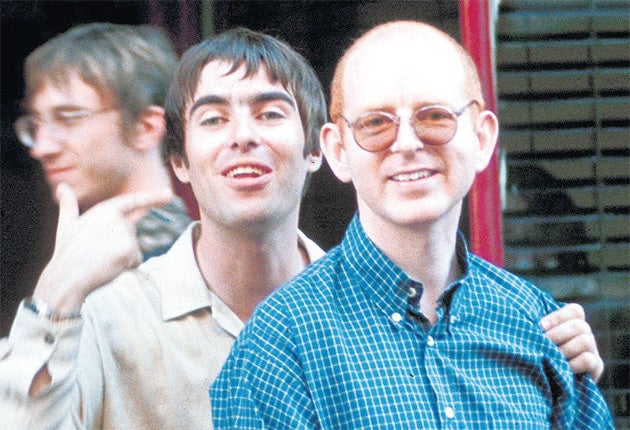
Is it a cautionary tale? Is it a celebration of one of the music industry's most unlikely entrepreneurs? Is it an exercise in Britpop nostalgia? Is it the story of a visionary or the case study of a business run along lunatic lines? All these questions are likely to cross viewers' minds when they see the fascinating new documentary Upside Down: the Creation Records Story (a world premiere at the London Film Festival next week.) The film is as much about Alan McGee as it is about the Creation Records label he co-founded. Creation survived against the odds and sometimes prospered from 1983 until the beginning of the new millennium and brought us (among others) The Jesus and Mary Chain, Primal Scream, The Loft, My Bloody Valentine and, of course, Oasis.
British film-makers' obsession with the country's recent musical past shows no sign of abating. Julien Temple is developing a film about The Kinks, which will follow on from his documentaries about The Sex Pistols, The Clash and Dr Feelgood as part of his grand project to provide "a mini social history of British rebel culture" through its music. Alongside The Creation Records Story, this year's London Film Festival also boasts new documentaries about Mott the Hoople and Lemmy from Mötorhead. In recent years, film-makers have been as preoccupied by the svengalis behind the music as by the musicians themselves. We've had dramas and documentaries about managers and record producers like Joe Meek, Brian Epstein and Factory Records founder Tony Wilson. McGee is a natural choice to follow them. His story has drug addiction, megalomania and plenty of excess. What also shines through is his reckless commitment to talent – and his uncanny ability for identifying it. Once he signed a band, he was far more interested in enabling the musicians to do the best work possible than he was in lining his (or their) pocket. By the mid-1990s, the combustible, red-haired Glaswegian ex-British Rail clerk was the pivotal figure in British indie music. The major labels saw him as the man who "had the key". He despised them, even if he did sell up to them in the end.
Director Danny O'Connor insists that he hasn't made "a fan's film". His fascination was with "the human dynamic" behind the story. In particular, he hones in on the friendship between McGee and his former schoolmate, Bobby Gillespie (later of Primal Scream). Years ago, when they were teenagers, McGee accompanied the younger Gillespie to his first gig – to see Thin Lizzy.
"It was a story beyond music," O'Connor reflects of what led him to spend five years making the documentary, which was entirely self-financed. "It is about boys growing up, doing their thing, falling out and winning and losing. That was the attraction... this to me was a very dysfunctional duopoly."
He describes Upside Down as a very "male" tale – a film about "how we as men are a bit crap at relying on each other". McGee is the key voice in the documentary. "But he is not the key component. Without Bobby, he is nothing... the one couldn't exist without the other."
O'Connor has assembled a formidable star chamber to look over McGee's career. Starkly shot black-and-white interview footage shows figures including Gillespie, Jim Reid of The Jesus and Mary Chain, Noel Gallagher of Oasis and the novelist Irvine Welsh pondering McGee's story. McGee is also on hand too to look back at his younger self.
The director wasn't setting out to judge McGee or to pass his own opinions about the music he helped usher into existence. "The fighting, the egos, the complications, the vulnerability – all those things make a human tale," O'Connor suggests. "There's nothing worse than watching something when you're told what to feel."
At times, the film has an elegiac air. It's not just that the main protagonists of the story are growing so much older. In the documentary, Noel Gallagher argues that Creation Records represented a last stand for the independents. When the label disappeared, so did an old notion of indie rock. This is a thesis that O'Connor partially endorses. "In my mind, what started with Sun Records perhaps ended with Creation," he draws the connection with Elvis Presley's original label. Undercutting his own remark, he points out that he is 44. Older generations are always pronouncing the end of traditions they hold dear. "There is probably someone sitting around who is 18 who doesn't give a toss about Noel or McGee or my film – and why should they?"
There is plenty of comedy along the way. McGee has an air of the artful dodger about him. One of the stranger episodes comes when he belatedly discovers acid house and decamps to Manchester, moving into a £90 a week flat that Tony Wilson finds for him. He is shown being interviewed on Wilson's TV show. As films from 24 Hour Party People to Control have shown, Wilson was a wildly exotic figure but he seems almost straitlaced by comparison with McGee.

Enjoy unlimited access to 100 million ad-free songs and podcasts with Amazon Music
Sign up now for a 30-day free trial. Terms apply.
ADVERTISEMENT. If you sign up to this service we will earn commission. This revenue helps to fund journalism across The Independent.
Enjoy unlimited access to 100 million ad-free songs and podcasts with Amazon Music
Sign up now for a 30-day free trial. Terms apply.
ADVERTISEMENT. If you sign up to this service we will earn commission. This revenue helps to fund journalism across The Independent.
It is fitting that Upside Down is premiering at the same time that David Fincher's The Social Network is released in the UK. Nobody is going to mistake McGee for Facebook founder Mark Zuckerberg but there are obvious similarities between the two films. Like Zuckerberg, McGee was a spiky outsider at the helm of a business that grew and grew. His strategy wasn't taken from any business manual. In his early days of putting on gigs in London, he and his colleagues would drink away profits. He improvised as he went along and ran Creation as a benevolent dictatorship.
The film shows McGee at his most erratic as well as his most ingenious. The Creation boss gives a typically vivid and self-deprecating account of his drug and alcohol-induced breakdown in the mid 1990s. Whatever his foibles, he inspired huge affection and loyalty in his followers. O'Connor is generous in his praise of McGee. "He is very loyal," the director states of the subject of his film. "I adore the man. Not in a 'he taught me everything I know way' but I actually love his fusion of courage and absolute decency. The man would run to the end of the world for the people he values."
McGee left O'Connor to get on with the documentary and didn't try to mould the image the director was presenting of Creation Records. He has since seen the film and given it his blessing – even if he hasn't expressed huge confidence in its cinematic potential. (In one interview, he predicted it would last "two days in the cinema and then do 500,000 DVDs.") O'Connor, at least, is heartened by the speed with which tickets for the London Film Festival screenings have sold. It may be 27 years since Creation Records was founded but it seems the label is in no immediate danger of being forgotten.
'Upside Down: the Creation Records Story' screens at The London Film Festival on 23 and 24 October (www.bfi.org.uk/lff)
Join our commenting forum
Join thought-provoking conversations, follow other Independent readers and see their replies
Comments