Antarctica's ice loss helps offset global warming

Sign up to the Independent Climate email for the latest advice on saving the planet
Get our free Climate email
Global warming has been blamed for the alarming loss of ice shelves in Antarctica, but a new study says newly-exposed areas of sea are now soaking up some of the carbon gas that causes the problem.
Scientists led by Lloyd Peck of the British Antarctic Survey (BAS) said that atmospheric and ocean carbon is being gobbled up by microscopic marine plants called phytoplankton, which float near the surface.
After absorbing the carbon through the natural process of photosynthesis, the phytoplankton are eaten, or otherwise die and sink to the ocean floor.
The phenomenon, known as a carbon sink, has been spotted in areas of open water exposed by the recent, rapid melting of several ice shelves - vast floating plaques of ice attached to the shore of the Antarctic peninsula.
Over the last 50 years, around 24,000 square kilometres (9,200 square miles) of new open water have been created this way, and swathes of it are now colonised by phytoplankton, Peck's team reports in a specialist journal, Global Change Biology.
Their estimate, based on images of green algal blooms, is that the phytoplankton absorbs 3.5 million tonnes of carbon, equivalent to 12.8 million tonnes of carbon dioxide (CO2), the principal greenhouse gas.
To put it in perspective, this is equivalent to the CO2-storing capacity of between 6,000 and 17,000 hectares (15,000 and 42,500 acres) of tropical rainforest, according to the paper.
The tally is minute compared to the quantities of greenhouse gases from fossil fuels and deforestation, which amounted to 8.7 billion tonnes of carbon in 2007.
But, said Peck, "it is nevertheless an important discovery. It shows nature's ability to thrive in the face of adversity.
"We need to factor this natural carbon absorption into our calculations and models to predict future climate change," he said in a BAS press release.
"So far, we don't know if we will see more events like this around the rest of Antarctica's coast, but it's something we'll be keeping an eye on."
The Antarctic peninsula - the tongue of land that juts up towards South America - has been hit by greater warming than almost any other region on Earth.
In the past 50 years, temperatures there have risen by 2.5 degrees Celsius (4.5 degrees Fahrenheit), around six times the global average.
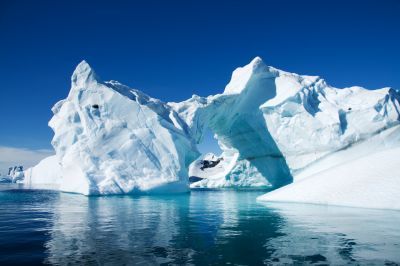
Ice shelves are ledges of thick ice that float on the sea and are attached to the land. They are formed when ice is exuded from glaciers on the land.
In the past 20 years, Antarctica has lost seven ice shelves.
The process is marked by shrinkage and the breakaway of increasingly bigger chunks before the remainder of the shelf snaps away from the coast.
It then disintegrates into debris or into icebergs that eventually melt as they drift northwards.
The Antarctic ice shelves do not add to sea levels when they melt. Like the Arctic ice cap, they float on the sea and thus displace their own volume.
Ice that runs from land into the sea does add, though, to the ocean's volume, which is why some scientists are concerned for the future of the massive icesheets covering Antarctica and Greenland.
Subscribe to Independent Premium to bookmark this article
Want to bookmark your favourite articles and stories to read or reference later? Start your Independent Premium subscription today.
Join our commenting forum
Join thought-provoking conversations, follow other Independent readers and see their replies