A badge of honour: the fight to save the whale
In the third part of our series marking 50 years of the green movement, Michael McCarthy examines whether anything has ever emulated the success of the first global eco-campaign

Sign up to the Independent Climate email for the latest advice on saving the planet
Get our free Climate email
Let's take the obvious first. If there is one victory of the Green Movement in its 50 years of existence that is most symbolic, most heartening and most immediately understandable to the world at large, it's the whaling ban. Save the whales, said the lapel badges in the 1970s and 1980s – it was the first memorable green slogan – and you know what? They did. In 1982 the International Whaling Commission brought in a moratorium on commercial whaling, effective in 1986, and from the latter date centuries of organised hunting of the world's largest creatures came to an end – more or less.
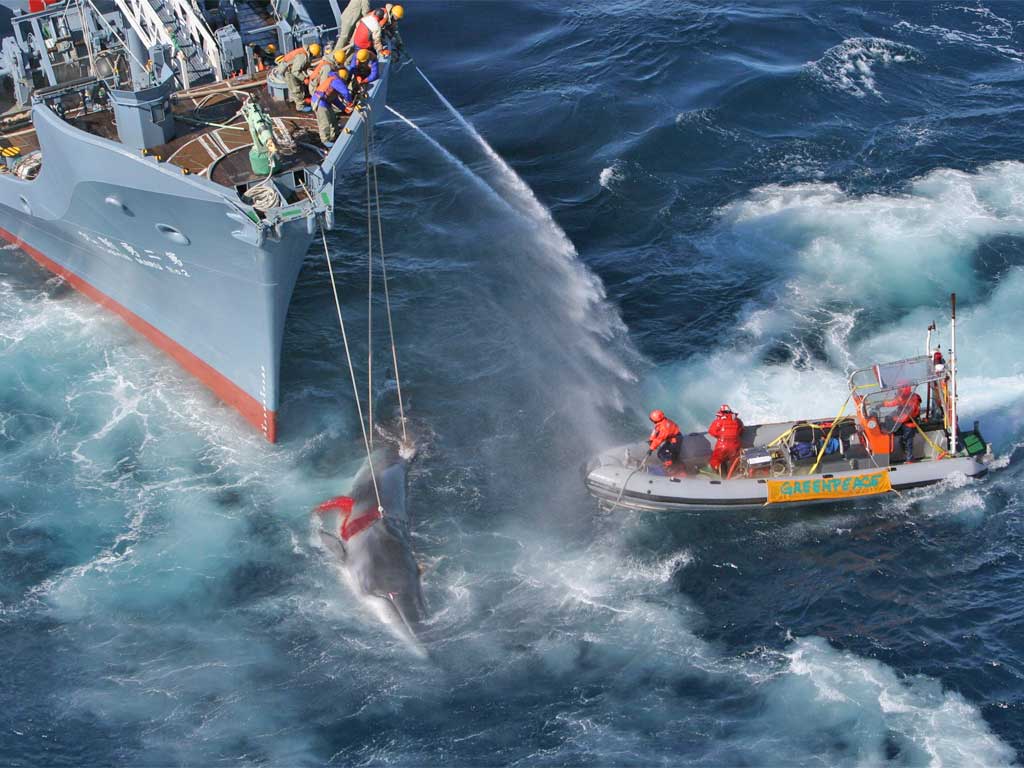
The ban was agreed by national governments, yet it was essentially the work of Greenpeace, which had been founded in 1971 as an anti-nuclear organisation but soon branched out into an anti-whaling campaign that introduced to the world a new character – the eco-warrior.
From 1973 the group began confronting whaling fleets on the high seas and young activists in rubber boats began to put themselves between the whalers' harpoons and the whales that were their targets.
They caught the world's imagination at once. They were warriors indeed, but non-violent ones – their weapon was publicity and through their actions images of whaling, and of the enormous violence necessary to subdue a living creature weighing perhaps 70 tons, began to flicker on to the TV screens of the world. The ban they eventually brought about was timely because, quite apart from the cruelty issue, the hunting that had become so much more deadly and efficient with mid-20th-century technology, such as fast catcher boats and explosive harpoons, was decimating the great whale populations. Humpbacks, sei, sperm and Pacific gray whales had all suffered precipitous declines in numbers and the total population of the blue whale, the world's largest creature, was thought to be down to 5,000 or fewer.
The 1982 moratorium, even though it is flouted still by the Japanese (with the fiction of "scientific" whaling) and by the Norwegians and occasionally the Icelanders, has allowed these stricken populations to recover.
There is no doubt that it was a significant victory for the environment movement. But how significant – in terms of the threats to the planet as a whole?
We can perhaps understand that best by thinking of it as a tactical victory in environmental terms, rather than a strategic one; it was a battle won, but not a war. The threats to the planet remain and many would say they are increasing. Yet what is surprising, if we look back over the Green Movement's 50 years since the publication of Silent Spring in 1962, the book that awoke the consciousness of the threatened planet, is just how many tactical victories there have been. For example, Peter Melchett, the head of Greenpeace UK in the 1980s and 1990s, lists a long series of campaigns to prevent the sea being used as a dumping ground between 1985 and 2000, all of which succeeded. Again using direct action – intervening in small boats, at considerable hazard to themselves – the group stopped the dumping at sea of British industrial waste, chemical waste, nuclear waste, sewage sludge, decommissioned nuclear submarines and oil rigs that had come to the end of their natural lives. The main issue in these years was blessedly simple: pollution. There was an awful lot of it going on, spewing out of factories in a tradition dating back to the industrial revolution. And an awful lot of it was stopped by green activists, either directly or through putting pressure on governments to act in different ways: Friends of the Earth, for example, was largely responsible for getting people to think about a strange new practice called recycling.
In fact, two issues of air pollution represent the biggest of all the green tactical victories: acid rain and the depletion of the ozone layer, topics on every young environmentalist's lips 25 years ago that are possibly unknown to their children today, so completely have they dropped off the agenda.
Acid rain was caused by the emission of sulphur dioxide from power stations, which became sulphuric acid in the atmosphere; when it fell it harmed plants and aquatic life, often hundreds of miles from its source (acid rain from British power stations fell on Scandinavia, enraging the Norwegians and Swedes).
It was ended when power station chimneys were fitted with expensive "scrubbers" to take out the SO2, after overwhelming pressure from green groups.
The problem with the protective layer of ozone gas in the stratosphere – it protects us from the worst effects of the sun's ultra-violet rays – was that it was being depleted by the chemicals used in spray cans, chlorofluorocarbons (CFCs). In 1985 it was discovered that a massive "hole" in the ozone layer had formed over Antarctica. The long process of mending it began when the world's governments, again under pressure from environmentalists, quickly agreed to a worldwide phasing out of CFCs in an international treaty, the Montreal Protocol of 1987.
And so the list of tactical victories goes on. But what of strategic triumphs – have there been any? The environment movement's thinkers would say definitely yes and the main one would be raising public awareness of the environment to the extent that the issue has become part of our politics. "The Green Movement has done an excellent job of putting environmental issues on the political agenda and mobilising public support for action," Caroline Lucas, Britain's first and so far only Green MP, says. The former director of Friends of the Earth (FoE), Tony Juniper, defines the success as "taking it from a fringe issue to be mainstream, putting it at the heart of society."
Andrew Simms, of the New Economics Foundation, says: "It might have been underfunded, institutionally marginalised in government compared to finance and industry... but the movement won the argument that nature cannot be taken for granted."
And Tom Burke, another former FoE director, says: "Environmentalists have initiated or shaped a raft of major environmental legislation over the past 40 years."
Additional research by Tim Greiving
Success story: The world wildlife fund
Another success of the Environment Movement, broadly defined, has been wildlife conservation. What might be called the first green pressure group – although it started out as a fundraising body – was the World Wildlife Fund, now known by its initials WWF, which predates Silent Spring by a year (it was founded in 1961). Its giant panda logo is one of the world's best- known environmental symbols.
Anybody looking at the steady rise in threatened species and habitats, at the rapidly declining numbers of orangutans in Indonesia, say, or of frogs in Central America or the recently confirmed extinction of the baiji, China's Yangtze river dolphin, might question the idea of conservation as successful.
But it is certainly the case that without the efforts of conservationists over the last half-century, things would be very much worse as development pressures have remorselessly gobbled up the natural world.
The idea of protected areas is now universal, even if some poorer countries can only afford to pay lip service to it. And the idea of caring for biodiversity, life in all its forms, has taken over from just looking after cuddly mammals and resulted in a UN treaty to protect it.
We might have lost the baiji, but a whole series of endangered creatures has been brought back from the brink, from the Mauritius kestrel to the kakapo, the giant nocturnal flightless parrot of New Zealand. Even Britain has brought back the sea eagle, persecuted to extinction a century ago.
Subscribe to Independent Premium to bookmark this article
Want to bookmark your favourite articles and stories to read or reference later? Start your Independent Premium subscription today.
Join our commenting forum
Join thought-provoking conversations, follow other Independent readers and see their replies