Christmas gifts: You shouldn't have...
Gift-buying is a minefield – and austerity makes matters worse. So why do we still insist on getting into debt for often unwanted presents? We should learn our limits, says Harriet Walker

Stay ahead of the trend in fashion and beyond with our free weekly Lifestyle Edit newsletter
Stay ahead of the trend in fashion and beyond with our free weekly Lifestyle Edit newsletter
I have started asking for vouchers at Christmas. As a rather unpredictable, impulsive and only slightly snooty fashion journalist, friends and family have given up on buying me clothes, jewellery, perfume or make-up because they know I will probably have already formed some kind of blinkered opinion about whatever they might choose. Far better, then, to hand over an envelope of thinly disguised cash that I can spend at John Lewis on posh pillows, or down the Odeon on the VIP seats, or at Asda in the booze aisle. For me, this is the best present of all: the chance to do living well on the cheap.
"But it doesn't feel very Christmassy," complain my parents, aka Santa. "We'd like to get you a treat." And it's only when I'm explaining why, for the seventh time, this really is my preferred form of treat, that it occurs to me that the spirit of giving at Christmas has been all but killed off. That we don't really understand giving gifts any more. That the buying, wrapping and handing-over of presents has become some bizarrely tokenistic version of what it used to be – there's no longer the idea of just getting someone something nice, more that it has to be something they desperately want or need. The more we spend, the more we feel we have to justify doing so. And it takes the surprise and the sentiment out of Christmas.
I always used to be scornful of book tokens and record vouchers as presents for the uninspired; they were only just below a shower gel set from the Body Shop on my list of Dull Presents That I Wouldn't Want to Give or Receive. Now I see them as the pragmatic modern choice in a society where everyone everywhere is bombarded from all sides with tat that they can do without. A recent survey found that British shoppers spend on average £49,000 in their lifetime on things they later regret buying. It's almost £70 per month – mostly spent on clothes, techy gadgets and shoes, the survey warns – at a time when the prevailing outlook, in terms of money and standards of living, is gloomy at best.
Christmas presents this year fall into one of two extremes: you can either choose to spend money as if it's going out of fashion to allay some of the bleakness (while making the most of the shops before January's VAT hike), or you take the thriftier route, channelling some of the make-do-and-mend spirit, the nu-austerity that has taken hold of so many contemporary minds.
"Christmas presents are part of a ritual that we do every year," says Nigel Marlow, director of business and consumer psychology at London Metropolitan University. "So there's a level of expectation. My daughter and I agreed not to send each other presents, but I have done anyway. It's very difficult to block what people expect – and there's a paradoxical sense that the more you spend on someone, the more you love them."
And while there is definitely a trend for price-capping Christmas presents (my sisters and I have agreed on £10) or for declaring an amnesty beyond buying each other a drink or going for a pizza (the former, my colleagues; the latter, my friends), there are more and more offers in shops, more early discounting, more emphasis on spending than ever before.
"By early October, we were 140 per cent up on sales from last year," says Jonathan Field, managing director of John Lewis in Brent Cross. "People are very much spending money; there may well be austerity measures in place, but not so as you'd notice. Last week was a record week for the business – we took £100m, despite the awful weather. Customers just went straight online. And it's the earliest we've ever posted those sorts of figures."
High-end stores, high street shops and online retailers alike report that money is being spent in three distinct areas: toys, which are always best-sellers at Christmas for the obvious reasons; winter-warming items, such as cashmere jumpers, blankets and gloves; and electrical equipment, such as televisions and games consoles. "The fall of Lehman Brothers [in September 2008] was pivotal for us and that year, sales were very difficult," Field adds. "But it was a record Christmas for us last year, and it looks set to be the same again."
It's true that, for every warning of how difficult 2011 will be, there are another 10 exhortations to go and grab one of Heston Blumenthal's Christmas puddings before they sell out; to buy three gift sets instead of two because the cheapest is free anyway; to gift your loved one a family-sized fridge this year because she won't be able to afford one in the new year. "Most people are in debt," Nigel Marlow points out. "People with huge debts on their credit cards have nothing to lose, so why not splash out? They know the end of the world is coming but sod it, what can they do? 'Let's get down to the shopping funfair,' they think."
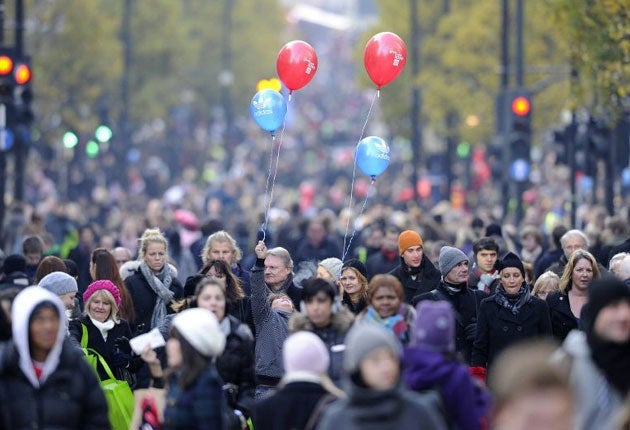
But is there something to be said for cheering ourselves up with a bit of retail therapy? Goodness knows, there doesn't seem to be much else to look forward to. "We always see a fair amount of self-gifting too around Christmas time," says Jace Tyrrell, director of communications at the New West End Company, which takes in Oxford Street, Bond Street and Regent Street. "While footfall is down 10 or 15 per cent on last year, sales are up 8 per cent, which means the people who are coming are spending more – the average spend of a British shopper in our area is £200."
"The West End is different from the rest of the country, because we see a lot of private-sector workers and tourists," he continues, "but it seems like people have had enough of having squeezed Christmases; they know the cuts are coming. You see people with a Selfridges bag in one hand and a Primark bag in the other."
Of course, we're all much more sophisticated than we used to be. In 1994, the biggest craze in kids' Christmas presents was for those Magic Eye optical illusion books. Yawn. This year, little Jimmy will be expecting a Kidizoom video camera (£59.99) at least, if not the Lego City Airport (£84.99). I used to draw pictures to give to people when I was little, but parents are now reporting that they feel the need to buy presents for their children to give to other people. There's an obvious element of metatheatre to all this: Father Christmas is dead, long live Father Christmas. My older sister made everyone pomanders a couple of years ago in a bid for an austerity Christmas; we all thought they were lovely, but whenever I mention it, people glaze over and assume she must be some charming eccentric or a starving artist.
"It's an existential question, really," Nigel Marlow says. "If you're happy with less, you'll be fine. You can live your life without material stuf. And let's face it, Christmas is really naff. 'Gifts for her, gifts for him'. At the end of the day, most men do their shopping at the petrol station on Christmas Eve."
But with the rise of online shopping, the crumpled flowers and squashed box of Matchmakers from Lidl is less common. Websites such as Firebox.com hire up to five times as much customer service staff for the Christmas period, and they use 10 times as much warehouses to store orders. "We're 30 per cent up on last year," PR manager Claire Wood says, "which is more than we've ever done, and we're getting around 11,000 orders a day. What we're selling most of is around the £30 mark, and the more expensive gifts tend to be practical things." On a website devoted to quirky, novelty gifts, "practical" items include a magic wand remote control (£50) and a slanket, a blanket with sleeves that can be worn while watching telly (£24.99). Its best-sellers include the Addictaball, a spherical 3D maze puzzle, and the Screaming Flying Monkey – which doesn't require much explanation.
It all goes to show that we're more divided than ever between the haves and have-nots, the savers and the save-nots. Were Dickens to write A Christmas Carol now, we'd be the anti-Scrooges, flinging money at the spectre of Austerity Yet to Come, and Bob Cratchit would have bought Tiny Tim an Xbox Kinect on tick. "Unrestricted satisfaction of all desires is not the way to well-being, nor is it the way to happiness," philosopher Erich Fromm wrote in 1976's To Have or to Be? It's unlikely that our Christmas haul will stop us grumbling or suffering in the months to come – but no doubt, we'll find out when David Cameron does his happiness survey.
In the meantime: to Oxford Street, James, and don't spare the horses.
Subscribe to Independent Premium to bookmark this article
Want to bookmark your favourite articles and stories to read or reference later? Start your Independent Premium subscription today.
Join our commenting forum
Join thought-provoking conversations, follow other Independent readers and see their replies