Why your sustainable fish may not be as guilt-free as you think
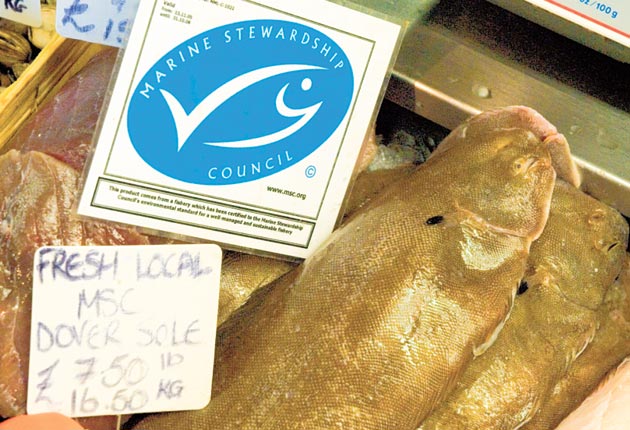
Since its establishment more than a decade ago, the reputation of the Marine Stewardship Council (MSC) has been as spotless as the consciences of shoppers who buy fish bearing its blue "tick" logo in the expectation it has been sustainably caught. Until now.
In a trenchant attack on the world's biggest certifier of ethical fish, a group of six marine experts have accused the MSC of giving in too readily to the demands of big trawler organisations and endorsing fisheries racked by overfishing. Unless the organisation takes more care over its approval process, it risks losing credibility, they warn.
Making their case in an opinion piece in the journal Nature, headed "Seafood stewardship in crisis", the authors point to steep falls in MSC-certified fisheries, such as pollock in the eastern Bering Sea off the US, whose total estimated biomass fell by 64 per cent between 2004 and 2009, and the Pacific hake, which was awarded certification last year despite its population plummeting by 89 per cent since the 1980s.
They also question why the MSC is certifying the catching of wild fish ground up into feed for domesticated livestock, and why it tolerates bottom trawling, which can damage the seabed.
"Scores of scientists (including ourselves) and many conservation groups, including Greenpeace, the Pew Environment Group and some national branches of WWF, have protested over various MSC procedures or certifications. We believe that, as the MSC increasingly risks its credibility, the planet risks losing more wild fish," wrote the authors, who include Jennifer Jacquet and Daniel Pauly of British Columbia University and Paul Dayton and Jeremy Jackson of the Scripps Institution of Oceanography at the University of California.
David Ainley, a marine ecologist in California, and Sidney Holt, a marine ecologist from Umbria in Italy, were the other signatories.
The MSC, which has been backed by major seafood producers and retailers including Marks & Spencer and Waitrose, and examined the problems of overfishing in the docu-film End of the Line, has vigorously denied the criticism. "Every fish certified to the MSC standard is sustainable and well-managed and fisheries are not, as the authors assert, certified before they can demonstrate their sustainability," it said, adding that the scientists had chosen peaks in naturally fluctuating fish populations from which to draw their sharp populations declines.
The MSC did not mind what purpose the catch was used for, it added, so long as the fishing was sustainable; something which did not necessarily preclude bottom trawling.
The attack is of particular relevance to the UK because Britain has 13 MSC-certified fisheries, including Hastings Dover sole and South-west handline mackerel, more than any other country except the US, which has 25. British shops have enthusiastically adopted the programme.
Founded by the Anglo-Dutch food and household giant Unilever and the environmental group WWF in 1997, the non-profit-making organisation is based in London. Globally it certifies 94 fisheries, which account for 7 per cent of the global catch, a share worth around £1bn a year. A further 133 fisheries are currently undergoing certification.
Stewards of the seas
The reputation of the Marine Stewardship Council is vital to ensure that shoppers prevent over-fishing by buying sustainably caught fish.
It was founded in 1997 by Unilever, which at the time owned Birds Eye, one of whose major products was fish fingers, which used disappearing cod, and has grown rapidly to become the world's biggest certification body for fish.
Now run independently on a non-profit-making basis, it certifies 94 fisheries globally. In order to be approved, a fishery has to score over 60 for sustainablity according to guidelines laid down by the United Nations Food and Agriculture Organisation.
If the score is between 60 and 80, it must rise to 80 over time to keep its certification. Once certified, the fish and accompanying products such as pies and fish fingers can carry the MSC logo.
Walmart, for instance, has pledged to source only MSC fish in the US by next year.
There are currently 731 MSC-certified products in UK shops.
Join our commenting forum
Join thought-provoking conversations, follow other Independent readers and see their replies
Comments