Danger: early iPhone adopter
Being at the front of the queue for the new model may have given you geeky street cred, but owning a new gadget before anyone else isn't always the best option, warns David Crookes

Sign up to our free weekly IndyTech newsletter delivered straight to your inbox
Sign up to our free IndyTech newsletter
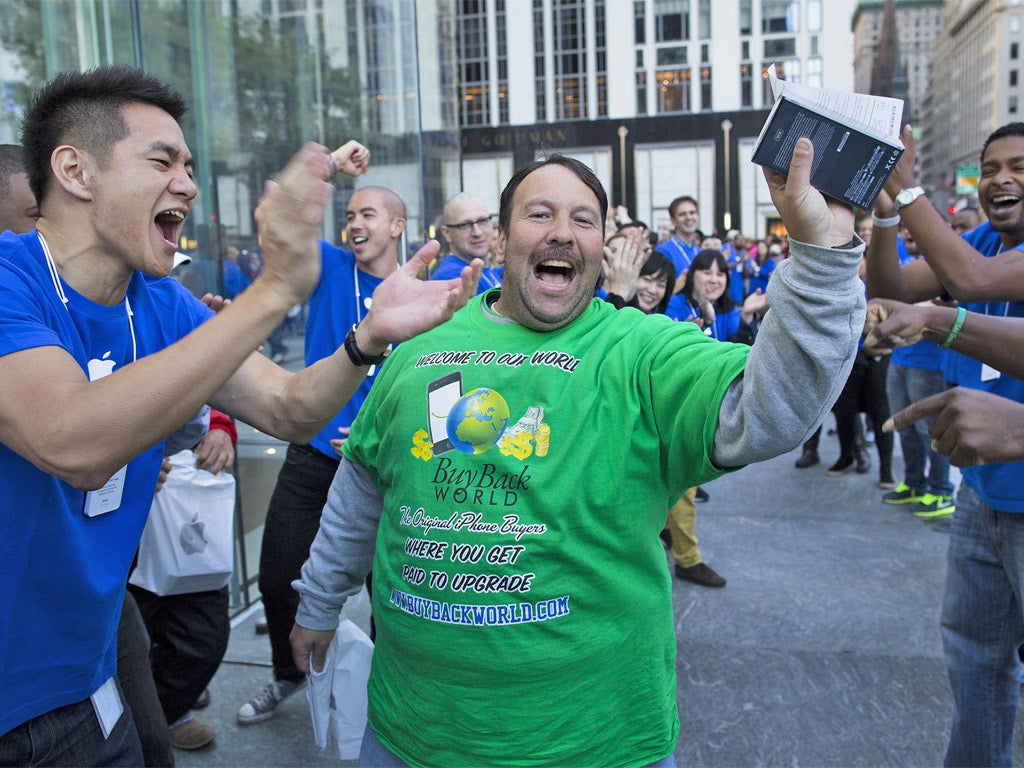
Luddites should look away now. Failing that, they should reach for a pen and paper and scribble down their thoughts. Last Friday witnessed that time again when otherwise rational people do all they can to secure the tech object of their dreams. In this case, a phone. The one by Apple which prompts people to queue up for days beforehand to buy.
My money was already set aside for this phone and it had been for months. Then again, I just had to have the iPhone 5, primarily because the jamming home button on my iPhone 4 had been causing me no end of finger ache.
The resale value – and the knowledge that a new handset was likely to arrive this month – had been the only thing that had prevented me from throwing it across the room. It just hadn't crossed my mind that my current faulty model should perhaps make me look for a different manufacturer.
But what if my phone was in perfect working order? Well, I would still have bought the new one.
Like most of those people who were in the squillion-mile queues outside Apple stores across the world, it is clear that prices of these devices tend to fall, that the item being bought has a finite lifespan, that hours will have been spent irrationally trying to buy something before much of the population has had time to open their box of Cornflakes. But in this instance I didn't care.
Some buy gadgets on day one because they love new technology and features. Others enjoy having their friends, family and work colleagues look at them with jealousy as they show off a device which makes them appear more wealthy or higher in status. For these people, the time and money spent is of immense worth and the Facebook and Twitter chatter will speak volumes.
"For early adopters, possessing new products with fancy features may be similar to a fashion statement," says Jay Pil Choi, Professor of Economics at the University of New South Wales, Australia, who has written a paper on such herd behaviour. "The success and attractiveness of these products are also determined by how many other people also adopt the same products, the so-called network effect."
Borat neatly sums up the drive to keep up with the Joneses rather well in his film. "He is pain in my assholes," he says of his neighbour. "I get a window from a glass, he must get a window from a glass."
It was in the 70s – 1976 to be exact – that British professor Roger Mason observed conspicuous consumption. He said people were preoccupied with acquiring status goods that boosted their relative social standing and prestige and certainly, over the past few decades, people have defined themselves by their possessions. But while the rise in consumerism has seen an increase in social mobility, it also puts pressure on people – and their pockets – to fund the next big thing.
Yet early adoption can be a costly business since there is no way of telling what technology will take off in the long term. AC was deemed better than DC and the audio cassette triumphed over 8-track. VHS beat Betamax but this was less to do with the tech quality and more to do with the inability to squeeze enough porn on a 60-minute Betamax tape.
Within months, the £399 Blackberry PlayBook was retailing for less than half that cost. Similarly, the Nintendo 3DS dropped from the pre-order price of £229 to as little as £115. Nintendo compensated early adopters with free games but subsequently created a larger-screen version of the glasses-free 3D handheld games console.
The Dreamcast became Sega's final machine when sales of the rival PlayStation eclipsed it. And despite the Gizmondo handheld games console being backed by F1 driver Jenson Button and a host of other celebrities, it sold just 25,000 units. Some of the management team were later found to have a criminal past; one of the founders, Stefan Eriksson, lost control of his $2 million Enzo Ferrari sports car and almost died, and the company ultimately filed for bankruptcy having gobbled up $300 million.
And so to this Christmas when Sony will pour more money into the festive line-up for its Sony Vita handheld as it did at the launch in a bid to boost flagging sales. Ryan King, editor of Play magazine, which covers Sony's console range, says there is no magic formula to working out when – or if – you should buy a gadget. "If there was an answer to this, every hardware manufacturer would be doing it," he says. "Ultimately if it's something you think you'll enjoy, then it's probably worth buying. The life of all technology is finite, it's only a question of when it's replaced in favour of something else, not if."
Early adoption, however, is crucial to the success of a product, says Professor Choi, since it gets the ball rolling and attracts others to the party. "There is a virtuous cycle," he explains. "Taking the iPhone as an example, if more people adopt it, then it becomes more profitable to develop apps for it and this makes iPhones more attractive. A vicious cycle explains the demise of failing products because it works in reverse."
Marketing, he adds, is key. "The management of consumer expectations becomes crucial for marketers because expectations are self-fulfilled," he says. "The whole interdependency of these products also confers a huge advantage for the first mover who creates a successful eco-system."
As if early adoption of readily available goods is not enough, crowd-funding websites such as Kickstarter are seeing a scramble to buy into items that, in the majority of cases, are months away from arriving and may not have even got to a prototype stage.
The Ouya games console, which runs using the Android operating system, is due out next March but it has proved so popular that, despite asking for $950,000 on Kickstarter, the makers walked away with a cool $8.6 million. In return for their investment, most backers were promised to receive the console before it hits shop shelves.
The games development company HandyGames handed over $10,000 for Ouya. Its CEO Christopher Kassulke said he did so because he felt the machine was innovative and open, allowing independent developers to produce games for it without the costs involved with creating for other consoles. But while his decision was business-based, others do it for the love.
"I enjoy being an early adopter because it suits me. I do not want to be one, I just am one," says Mihaita Bamburic, contributor the website BetaNews. "I honestly don't think it's a matter of preference or want – it's just 'I have to do that'. As for crowd-funding, I think deep down there is a need for people to make their mark on a product to which they can relate to and secretly claim that it is their own."
And we should be grateful for such people. Those who aim to be ahead of the curve are rather like guinea pigs. They test the product, make the investment so that those who prefer to keep their powder dry as a consumer can wait until they can not only assess how successful it is likely to be, but get it cheaper too.
"The technophile two per cent accounts for most of the initial launch market of a new product in the first few weeks," says Ian Pearson, BT's futurologist. "They are savvy enough to make it work, want it desperately enough to pay the higher initial prices and they also help iron out lots of the launch bugs.
"Companies then fix these and the products become better quite quickly. Waiting even a few months after a product first appears means you'll pay less for a better product. You don't get the street cred of being the first on the block with the new gadget, but neither do you pay through the nose in cash and extra difficulty. For the 98 per cent, though, it's the path that makes sense."
Subscribe to Independent Premium to bookmark this article
Want to bookmark your favourite articles and stories to read or reference later? Start your Independent Premium subscription today.
Join our commenting forum
Join thought-provoking conversations, follow other Independent readers and see their replies