The awful secret that destroyed our family
In the wake of the Jimmy Savile scandal, Ettie Spencer and her sisters realised they had to speak out about the abuse they suffered as children, and its catastrophic impact on their lives

Sign up to our free Living Well email for advice on living a happier, healthier and longer life
Live your life healthier and happier with our free weekly Living Well newsletter
The exposure of Jimmy Savile has given rise to a great flood of revelations and the unburdening of victims of child abuse. Those of us that grew up in the great silence of the 1950s and 1960s are suddenly free to speak, it seems, and along with this there are some big questions that can now be asked. Why were we silent? How many victims are there? Do we know what the real damage was or is, and can we learn from this? Are we prepared to acknowledge the role that institutions play in allowing such things to happen to the vulnerable? Maybe these institutions do not protect us; in fact it would seem they are hotbeds of all kinds of perversions.
We have watched with horror just what has gone on in our health service, in our children's' homes, in the church, and in the BBC. We have learned to question what teachers, scout leaders, politicians and policemen are up to and to question their motives. And all this is before we even begin on the fundamental institution of the family and indeed our communities. There is another institution that has not yet had the finger pointed at it in this regard – the armed forces. We are all aware of war atrocities, bullying, rape and pillage that go with this territory – but what of child abuse?
My father was an officer in the British Army. Although we were not exceptionally well off, you could say we lived a life of some privilege. Various staff were employed to look after our family over the years. Many were based in our house, both when we lived in the camp and later when we moved to a rented house outside the town.
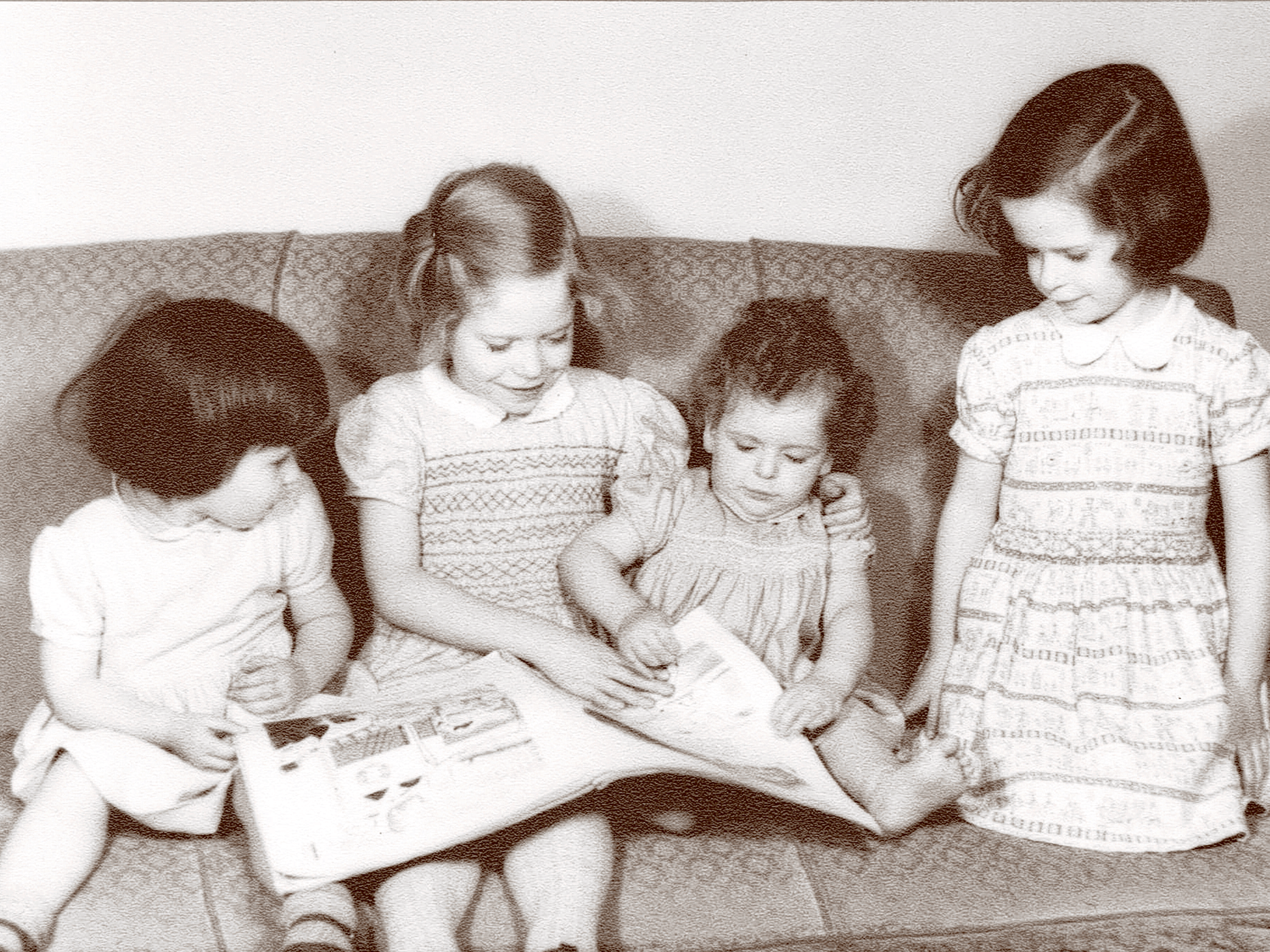
In common with many such families, our parents were concerned with, but quite detached from our everyday lives, and consequently had no idea that for a number of years three of my sisters and I lived with a child sex abuser in our midst.
We were then all under the age of 12 and not until we were in our late teens did one of my sisters tell all. Even then, we were told that, as my father had then left the army and this was all in the past, it had been decided to do nothing in order to spare us the trauma that would result if this was pursued.
Nothing, of course, could spare us the trauma of having lived with what I now remember as the heavy black cloud that hung menacingly over us every day. The fear and the dread and the lack of safety that we could never speak of, not even amongst ourselves, was just how it was.
The room where this monster lurked has all my life been the image that can pop up and haunt me.
This silence came at a catastrophic price. My clever, very beautiful and talented older sister, after a number of very troubled years struggling with low self esteem and bouts of terrible depression, took her own life at the age of 23. Another sister suffered from severe anorexia all through her 20s. Another, who has moderate learning difficulties, suddenly had a break down as a young adult, which involved various suicide attempts and then she disappeared completely, living rough and without benefits or support, for some 25 years. When she was eventually found it emerged she had been –living in hedges and church porches, hiding and near to starvation. She was diagnosed as paranoid schizophrenic and had apparently believed all those years that she was "not good enough" and was "not wanted", forcing her to be in a different place every day in case she contaminated the area.
Like many people who are now "coming out" as victims of abuse, I believe that I should have spoken sooner. Later in life and very frail, my mother asked me what I thought was wrong with our family and why we had such a high casualty rate. How could I say what I had been tempted to say so many times over the years? Indeed, should I name and shame a person who must surely be dead by now? Should I hold the army to account? Does it still place unchecked individuals into households with young families? Can I even now put my siblings through further trauma by exposing the whole sordid saga? Notably, after the army my parents went on to have two more children who have lived in ignorance of all this and who have suffered no mental illnesses.
These questions and more, I have struggled with all my life. Indeed, I have no wish to burden my children with such troubles as, needless to say, their welfare is paramount to me.
However, I very much believe that the telling of these horror stories is essential so that we can at last ask some of the big questions.
Writing this is undoubtedly therapeutic for me, even though I came off more lightly than my sisters. Because I was such a timid child I was hard to catch, and mostly suffered only the witnessing of so many unmentionable things.
It is now emerging that child abuse cannot be ignored by those concerned with the health of the nation. Author and psychologist Oliver James, giving a recent talk, indicated that research now shows that a significantly high number of people suffering from severe mental illness have been victims of child sexual abuse.
This is something that has seemed obvious to me, but now surely this has to be taken seriously. We also need to take a careful look at our traditional institutions and at how perceived power and celebrity status allows such things to happen.
We need to liberate adults and children to be able to speak and to be believed.
As for so many people, it has taken recent events to liberate me from "the silence" and I now feel I owe it to my sisters to speak out.
I urge everyone who has suffered in this way to speak too and with the force of a tidal wave perhaps ensure that we do now ask the questions, finally.
Subscribe to Independent Premium to bookmark this article
Want to bookmark your favourite articles and stories to read or reference later? Start your Independent Premium subscription today.
Join our commenting forum
Join thought-provoking conversations, follow other Independent readers and see their replies