Health & Families

1° London Hi 8°C / Lo 5°C

Lactose intolerance: 'Is sourdough bread the cause of my lactose intolerance?
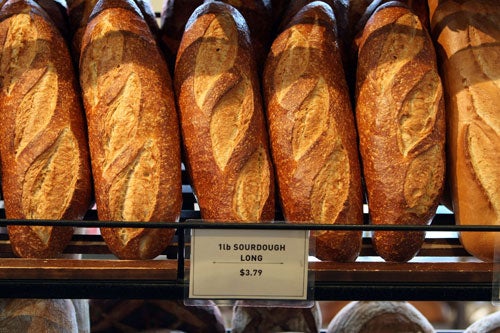

Justin Sullivan/Getty Images

Sourdough bread: does not contain lactic acid

"Having read your answer about lactose intolerance, I wonder if I am suffering from it. I am getting abdominal pain, cramps and gas after I eat sourdough bread (which I bake myself). I do not eat dairy products, but I have heard that sourdough bread contains lactic acid. Could this be the cause?"

Dr Fred Kavalier answers your health question:

Lactose is a natural sugar that is broken down in the small intestine into two other sugars – glucose and galactose – which are absorbed into cells. If you are lacking in lactase, the enzyme that breaks down lactose, then the lactose will remain in the intestine. When it reaches the large intestine it begins to ferment, leading to the production of gases that cause wind, cramps and other symptoms. Sourdough bread does not contain lactose, so your symptoms must have another cause.

Please send your questions and suggestions to A Question of Health, The Independent, Independent House, 191 Marsh Wall, London E14 9RS; fax 020-7005 2182; or email health@independent.co.uk. Dr Kavalier regrets that he is unable to respond personally to questions.

Post a Comment

View all comments that have been posted about this article.

Offensive or abusive comments will be removed and your IP logged and may be used to prevent further submission. In submitting a comment to the site, you agree to be bound by the Independent Minds Terms of Service.

Comments

Another modern 'condition'
[info]deeflymaster wrote:
Monday, 11 May 2009 at 09:01 am (UTC)
'Lactose intolerance' is a 'condition' that has only appeared since pasteurisation and homogenisation of milk. Those who drink raw milk get lactase and also the enzymes that digest casein, a milk protein. Change to raw milk - if you can get it - and your symptoms should disappear almost immediately. Lactose intolerance is another science caused problem that humans naturally don't have. It is unknown in societies that do not pasturise or homogenise their milk but drink it straight from the beast.
Re: Another modern 'condition'
[info]marieco wrote:
Wednesday, 13 May 2009 at 06:52 am (UTC)
Lactose intolerance is common in countries where the cow is not used for milk and dairy is not a large part of the diet. It is widespread in china, africa and south-east asia. Often lactase expression, which naturally declines in humans post-weaning, can be induced by consumption of dairy products during later life. In some individuals lactose cannot be induced and they remain lactose intolerant. For some reason goats and sheeps milk causes intolerant people fewer problems, but they should be consumed in only limited quantities. It has nothing whatsoever to do with the pastuerisation of milk. Raw milk, when produced hygienically is probably fine, but under some conditions can become contaminated with pathogenic bacteria and result in moderate to severe illness, that is why pastueurisation was adopted in the first place.
Lactose intolerance
[info]mirandadf1978 wrote:
Wednesday, 13 May 2009 at 03:02 pm (UTC)
As a sufferer of multiple food intolerances I understand your pains, would be really good to know the exaxt recipe of the bread - e.g does it contain yeast.

Lots of yeast free recipes and advice here:

http://www.fussyfoodie.co.uk/foodie/category/yeast-free/

[info]robinsmith120 wrote:
Wednesday, 25 November 2009 at 12:54 pm (UTC)
Lactose intolerance is the body's inability to digest lactose-containing foods, such as milk and milk-products. There are three types of lactose intolerance:

- Primary lactose intolerance: It is experienced when the body decreases production of lactase with age.

- Secondary lactose intolerance: It is experienced as a result of illness.

- Congenital lactose intolerance: It is hereditary and very rare when a baby is born with lactose intolerance.

For getting more information about this Click Here.


Free gym pass

Get fit for summer with Fitness First gyms in London

Download a free gym pass from Fitness First today

Article Archive

Day In a Page

Sun | Mon | Tue | Wed | Thu | Fri | Sat

Select date