How changes in weather can give you a headache
Scientists discover why weekend warm spell may have given you a migraine
Did you get a headache at the weekend? If so, scientists think they know why – it was the weather.
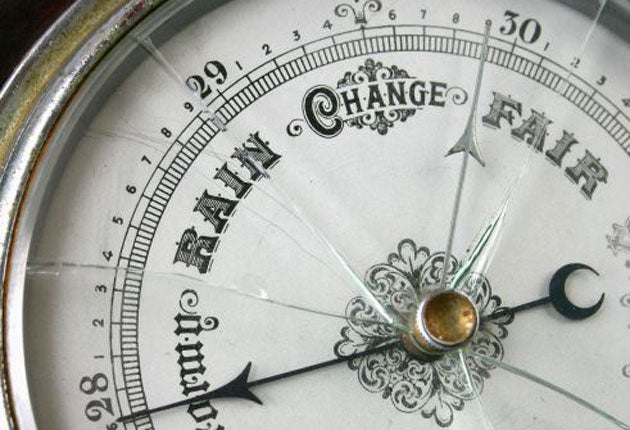
A rise in temperature or a fall in barometric pressure, which often accompanies a thunderstorm, may trigger a headache or migraine.
After a cold spell last week the temperature rose to 13.8C in London on Saturday, more than 5C warmer than on Thursday – explaining why some people found themselves in pain. Headache sufferers have long suspected that changes in weather can trigger an attack.
Now they have scientific backing for their claims from one of the largest studies of the link. Researchers who monitored 7,000 patients with headaches serious enough to make them seek treatment at a hospital A&E department found the main trigger was a rise in temperature in the previous 24 hours.
The risk of a severe headache rose by 7.5 per cent for every 5C rise in temperature. Falls in barometric pressure in the previous 48 to 72 hours also had an effect, though to a lesser extent. But other effects such as humidity and air pollution had no impact, the findings revealed.
The results of the study, by scientists at the Beth Israel Deaconess Medical Centre in Boston, in the United States, help put a piece of clinical folklore on an evidential base. But they do not explain the link, or what mechanism may lie behind it.
Kenneth Mukamal, who led the study published in Neurology, said: "Our results are consistent with the idea that severe headaches can be triggered by external factors. These findings tell us that the environment around us does affect our health and, in terms of headaches, may be impacting many, many people."
About 18 per cent of women and 6 per cent of men suffer from migraines, which are more common among the young than the old, and impose a huge drain on the economy from sickness absence. Migraines are known to be set off by triggers, including certain foods, alcohol, stress and hormones. But controversy has surrounded the supposed link with the weather. Dr Mukamal added that patients should try to identify the triggers that lead to their headaches.
Although weather-related triggers cannot be avoided, doctors might be able to prescribe drugs to prevent the effects.
Peter Goadsby, the director of the University of California, San Francisco's Headache Centre and a professor of neurology at the Institute of Neurology, in London, said: "An interesting study that confirms earlier research from Canada that barometric pressure change – and here, increased temperatures – can precipitate migraine. The challenge for clinical science is to link this seemingly odd trigger to the brain mechanisms involved in migraine."
Dr Andrew Dowson, the chairman of the medical advisory board of the British charity Migraine Action, said: "The study ... recognises three main problems: that the doctors did not diagnose as per the International Headache Society guidelines; that the temperature was not that personally experienced by the patient but rather a central reading for the geographical area; and that the timing of the onset of headache was not accurate (the time of hospital contact was recorded). In addition of course we must recognise that most people with headache do not attend casualty or even call a doctor but simply self medicate and rest.
"I am sure that migraineurs will be interested in these results, which will likely confirm personal observations more often than surprise."
This week, Friday is forecast to be the day with the sharpest temperature rise in the capital – to 14C – and could push more to reach for their medication.
Join our commenting forum
Join thought-provoking conversations, follow other Independent readers and see their replies
Comments