Can smart meters counter high bills and energy use?
As Which? warns of consumer chaos, firms insist evidence supports their faith

For free real time breaking news alerts sent straight to your inbox sign up to our breaking news emails
Sign up to our free breaking news emails
Eleven billion pounds, millions of households and a decade to finish the job. No it's not high speed rail two but the roll-out of smart energy meters in every home across the UK.
The meters will allow consumers to see precisely how much energy they are using minute by minute and end the much disliked practice of estimated billing. Seeing how much energy is being using and its cost is meant to prompt us to go easier on the gas and electric. Do your bit to save the planet and cut your bills at the same time, that's the big idea.
But the scheme, which has already started to a limited extent – over half a million homes have had the meters installed in the past year according to our research – is under fire, with a leading consumer group calling for at least a major rethink or for it to be strangled at birth.
Meanwhile, a recent Public Accounts Committee report sounded alarm over the high costs and uncertain benefits of a scheme likely to disrupt the lives of millions.
"This scheme is a recipe for expensive chaos," says Richard Lloyd, the executive director of consumer group Which?. "We will have representatives of energy firms – which are less trusted than even the banks – visiting every home in the land to rip out the existing meter to install a smart one. Apart from the practical and security difficulties who will pay for this? The answer: the consumer."
But, according to the Department for Energy and Climate Change (DECC), costs won't be passed on to the consumer because of competition between providers, a point echoed by Elliot Grady, from British Gas.
"Customers will save in two ways. First, by seeing their energy usage they should be able to alter it to lower their bills. Second, accurate billing will save us a lot of time and money dealing with customers who have a wrongly estimated bill. In a competitive energy market this should be passed on in the form of lower bills."
However, with Ofgem, the energy regulator, currently investigating providers for potential price fixing and criticism over higher bills, can consumers really rely on competition to fix it for them? "The officials at DECC must be the only people in the country who believe the market is in any way competitive," says Mr Lloyd.
He also has serious doubts over the theory that smart meters will even lead to reduced energy usage.
"Remember that the people who have been trailed are the most interested in the area of energy saving and are bound to react proactively to the information they get from the smart meter readers," says Mr Lloyd. "However, who is to say that most households will not either ignore the information or perhaps just make usage cuts for a couple of weeks and then return to their old ways?
"And will providers not increase per unit pricing if they find that usage falls? It could be £11bn wasted."
Yet providers say that the evidence supports the idea that smart meters change behaviour: "Of the customers we've surveyed that have smart meters installed, 80 per cent say it has changed the way they use energy, and 64 per cent said it prompts them to make energy efficiency measures," Mr Grady says. Official estimates put bill savings through smart metering at between 5 and 10 per cent.
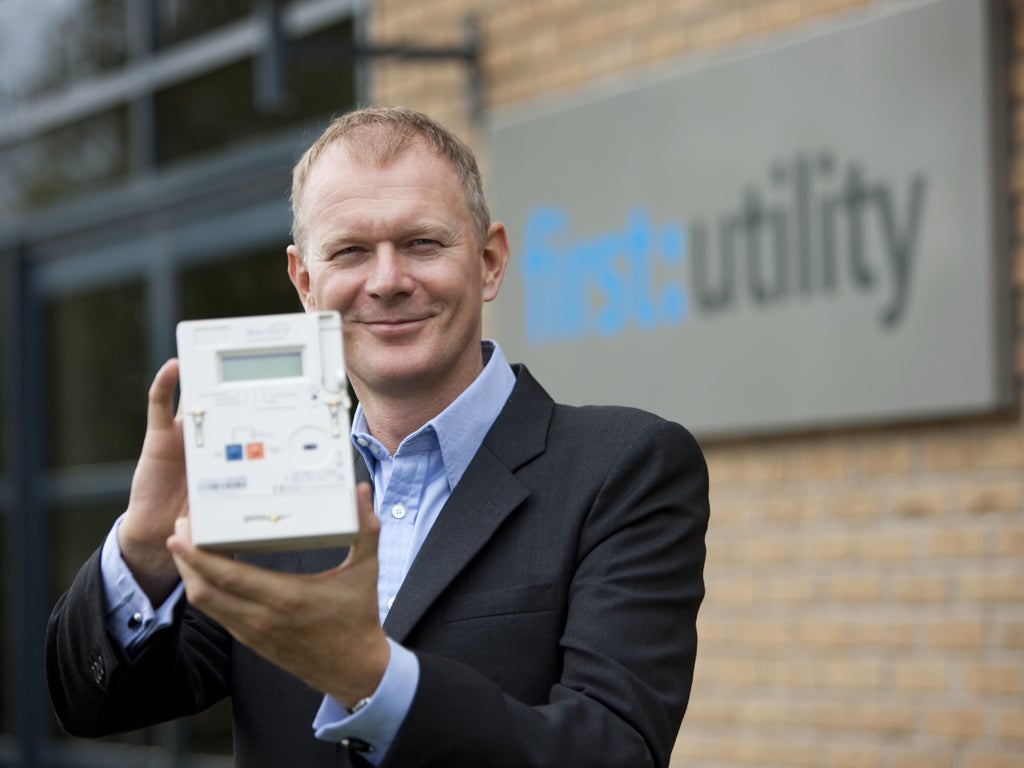
Likewise, First Utility, a smaller provider which since it was founded in 2008 by Mark Daeche, has specialised in smart meter technology says 56 per cent of its customers have changed how they use energy after installation and, crucially, the technology can be built upon.
"By providing the right tools, such as an online portal where customers can see in more detail when they are using energy, it can empower them to make changes and therefore reduce their costs," says Jonathan McGregor, First Utility's head of marketing. "The UK's energy infrastructure is badly outdated – many people have meters which have not been changed for decades and updates are needed. A lot of the anger regarding the cost of the roll-out is arguably because consumers don't feel they are getting a good deal from the Big Six firms here in the UK," Mr McGregor adds.
There are also gathering concerns that utility firms will use installations to push other products and services while in consumers' homes. Last year, The Independent on Sunday highlighted how British Gas was advertising for installers partly paid through sales commission. To date only a few providers have signed up to the Which? "Don't sell just install" code of conduct.
Above and beyond this, the consumer group says customers with smart meters have reported being unable to switch between providers: "They are being told that the provider they wish to move too cannot effectively read their meter remotely, therefore they can't switch.
"This sort of technological hitch has to be sorted quickly if the scheme isn't going to fall into disrepute as it has in Australia, where the state government of Victoria has halted the scheme."
Case Study
Claire Stone, Shopworker from Aberdare, Mid Glamorgan
Ms Stone had a smart meter installed by First Utility last July
"It's a great aid. I am able to keep an eye on what I am using and spending, plus which household items cost more," she says.
Claire also likes that smart metering means an end to estimated bills. "I'd always find myself overpaying and having to go back to the energy companies for a refund time and again." She even uses the smart meter as an educational tool for eight-year old Joseph: "I have been showing him how much power we're using and the need to turn things off at the wall rather than leave it on standby."
Claire has noticed a small reduction in bills but is concerned about how the costs of installation will be passed on: "I have been lucky with First Utility but you can imagine the providers will pass on the cost to customers and if usage falls the unit price will no doubt rise ."
Subscribe to Independent Premium to bookmark this article
Want to bookmark your favourite articles and stories to read or reference later? Start your Independent Premium subscription today.
Join our commenting forum
Join thought-provoking conversations, follow other Independent readers and see their replies