Business

5° London Hi 12°C / Lo 6°C

Off the rails: Rethinking Britain's train services

The railways are creaking under the current franchise system. Sir Richard Branson wants a revamp. Sarah Arnott reports
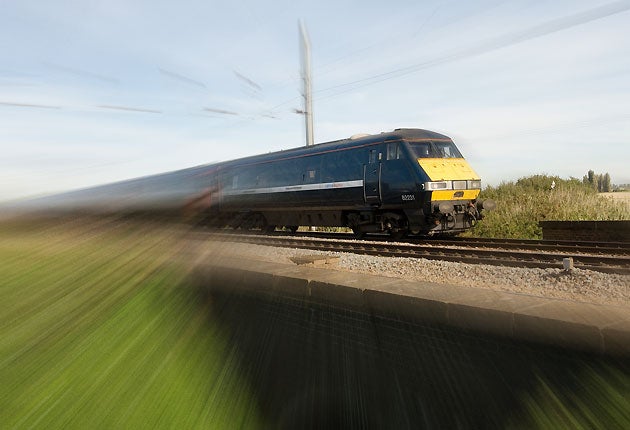

Eniviromentally friendly trains could take on carbon-intensive flights from London to Glasgow in as little as four years if the Government rethinks the rail franchising system, according to Sir Richard Branson.

The current model – under which train operators pay a premium based on projected passenger volumes to be allowed to run services on a given route – is coming under increasingly heavy fire, not just from Sir Richard. National Express's East Coast line has the most high-profile problems. But it is not alone. The majority of the current crop of 17 franchises were signed in the past few years, just before the plunge into recession. With 80 per cent of costs fixed, and bailout clauses unlikely to kick in for the first four years, operators are increasingly exposed (see below).

Sir Richard says the system is to blame. "Negotiations are simply about who promises to pay the taxpayer the most money for the franchise," he said. "Instead we need to create new services and bring private sector investment into rail."

In practice that means a strongly capitalist vision, junking central planning of timetables and rolling stock procurements in favour of much longer franchise agreements – of at least 20 years rather than less than 10.

"Sizeable investment is needed to tackle the issues that will put pressure on the rail network in the future: rising passenger numbers, lack of track capacity, ageing tracks, ageing train fleets, and truly antiquated stations," Sir Richard said. "Competition on the infrastructure side would be healthy and would get more value out."

To some extent, he would say that. Virgin Trains bid unsuccessfully for CrossCountry in 2007, pushed out by a more lucrative rival – although the Government said it turned down an even higher bid. Virgin was also pipped by National Express for the East Coast, and Sir Richard has made no secret of his intention to bid again if the beleaguered franchise comes back on the market. But, vested interests notwithstanding, there is a point to be made. The current phase of contracts are commonly only seven years long, providing operators with little incentive to invest in long-term infrastructure that will almost immediately be handed over to someone else, often before it has even started to pay itself off. Instead, upgrades are left to Network Rail.

There is also some evidence to back up calls for longer deals. The only 20-year franchise that currently exists – Chiltern Railways – has made major infrastructure investments. Virgin Trains itself also talks a good game. With just £1bn of extra investment to upgrade the track on its West Coast Main Line route, the operator reckons it could run trains at 140 miles per hour, enabling a service leaving London for Birmingham every 15 minutes, and a journey of just 3 hours 40 minutes from London to Glasgow. The scheme will even pay for itself, according to Virgin. The company's calculations put passenger numbers up by 25-30 per cent, revenue up by as much as £100m a year, and the railway competing with domestic airlines on the Scotland route. All within four years.

Tony Collins, the chief executive of Virgin Trains, said: "There is a big opportunity to drive passenger growth to fund the investments. The key is to make the rail industry demand-driven, rather than taxpayer funded, by laying the foundations to keep growing passenger volume."

More than anything, Virgin's argument is carefully timed. With so many franchises struggling, the Government faces lower payments than expected, even if no deals are handed back. Network Rail is supposed to be spending £35bn over the next five years, a growing proportion of which is to come from passengers' fares. But contribution levels were based on growth at 3 per cent per year, and passenger numbers are now expected to fall both this year and next.

Even without the dire economic climate, the balance of the franchise system was not working. Christian Wolmar, a transport industry expert, said: "The franchise structure at the moment doesn't make any sense. There is no intellectually coherent reason for it because it doesn't attract investment from private sector operators."

To some extent, the problems are historical. The system was devised by a Conservative government as a way to reduce state subsidy of what was believed to be an obsolete method of transportation. But fuel prices, congestion and the green agenda have breathed new life into it, doubling passenger numbers in 15 years.

What Sir Richard's vision does not include is a response to the unanswerable problem, illustrated so perfectly by the slew of recession-induced franchise problems, which is what to do with revenue risk. With projections of passenger volumes proving so unreliable over just a few years, trying to extend the forecast out over two decades looks laughable. But without risk, the franchise is little more than a management contract. Balancing the two leads back to politics. "Whatever franchise model is used, you get into the intellectual problem about purpose," Mr Wolmar said: "The problem is, what is the role of the private sector here?"

Failing franchises: Recession has exposed the system's flaws

More and more train operators are struggling to meet their payment terms as recession exposes the flaws in the franchise system.

National Express's East Coast Main Line deal, signed in August 2007, agreed to pay £1.4bn by 2015. But passenger numbers have been hammered by the economic downturn, and with another two years before loss-easing subsidies kick in, the company is desperate to renegotiate. The Government says no.

Until recently, threats to walk away – which would also forfeit the profitable East Anglia and c2c networks – carried little weight. But while one operator's departure would be inconvenient, several would threaten the whole system.

And National Express is just one on a growing list. Stagecoach is disputing its £1.2bn South West Trains franchise. FirstGroup has already claimed £50m in subsidies for its Great Western network, and is threatening to walk away after seven years rather than extending to 10 as expected. Arriva is facing heavy losses on CrossCountry. Analysts are speculating that both Arriva and South West could be handed back.

MPs said this week that the Government must have contingency plans for multiple failures, and the rot is also seeping into potential deals. Four companies entered the race for the South Central franchise, which includes the London-to-Brighton route, in February: Govia, the incumbent, Stagecoach, National Express and NedRailways, the Dutch state operator. But NedRailways is understood to have dropped out, while Stagecoach and National Express clearly face problems of their own.

Post a Comment

View all comments that have been posted about this article.

Offensive or abusive comments will be removed and your IP logged and may be used to prevent further submission. In submitting a comment to the site, you agree to be bound by the Independent Minds Terms of Service.

Comments

Another irrational solution
[info]loftwork wrote:
Wednesday, 20 May 2009 at 08:31 am (UTC)
With respect to Richard Branson, who on earth thinks that his primary concern is the travelling public or the beleagured taxpayer?

The fundamental issue is that a national transportation policy requires more than a patchwork quilt of conflicting priorities, short-term interests, opaque and interdependent responsibilities and erratic regulation. The whole scheme made no sense at first and less now.

Rail PFI promised to solve all of the old problems. Instead it has created an unimpressive and disjointed farrago of increasingly uncomfortable and overcrowded train services at the hghest price in Europe. The solution is not more of the same. The solution is to rebuild a national rail system based on public investment in UK manufacturing and technology. Or does all the public money have to go to the banks or foreign businesses developing nuclear warheads and ID cards?
Off the rails
[info]wing_a_a_prayer wrote:
Wednesday, 20 May 2009 at 08:39 am (UTC)
20 yrs ago there were 11 flights a day, each way, from Paris to Lyons.
10 yrs ago there were 2 flights a day each way.
That was demand driven. It is relatively cheap to travel by rail in France, because they are always full!
The train totally outplayed the plane - because someone (Fr min of trsnpt) knew how to do it.
It needs someone from that background to organise the British to get it right.
Branson is right though - it needs 20 yr franchises.
Once your into govt subsidies (tax money) your on a loser.
JS
Bring back British Rail!
[info]ra77 wrote:
Wednesday, 20 May 2009 at 08:44 am (UTC)
As the railway house of cards shows every sign of imploding on itself with all the talk of franchises collapsing, ATOC dithering over electrification, the saga of the new InterCity Express project and relentless fare increases, the ideologically motivated politicians see fit to keep on throwing money down the bottomless black hole that is the privatised railway.

However bad British Rail was in the eyes of a lot of people - it was at least one single, coherent organisation that was running a very tight ship in the latter years of its existence, making a little subsidy go a long way. We are now pouring billions more into a system that still isn't any appreciably better than it was under state ownership - punctuality isn't any better, customer service is just as dismal, there has been next to no expansion (apart from HS1, which is only any use to people in the South East) and the average age of rolling stock is just the same as under BR.

When will we go to the rational railway where it is all run by just one single company? Like on the Continent for example?
Nothing new....
[info]al1980 wrote:
Wednesday, 20 May 2009 at 08:50 am (UTC)
The West Coast Upgrade that's already in place was meant to be privately funded, but has ended up being almost entirely paid for by the taxpayer and has shored up Branson's bank account in vast compensation payments from the DfT because of late delivery. Handing over the intercity links between most of the UK's major cities to a 30 year monopoly just asks for high fares and abuse of the position in high fares and maximising profit, rather than economic and social benefit from the railway. The 20 year Chiltern franchise is a classic example of having high fares and much of teh inestment put in on their network has been from public funds.
The franchise system currently in place is a poor half-way house, but the solution is for a publicly owned body to dictate fares and timetables to the benefit of all rail users and hire whichever company to run the service at the best value to the public purse.
Branson should retire
[info]tominlondon wrote:
Wednesday, 20 May 2009 at 08:53 am (UTC)
we want LESS of Branson, not MORE.

FACT: The railways are costing us, the taxpayer, about 5 times more than they cost us when they were nationalised.

So nationalise them.
Re: Branson should retire
[info]tominlondon wrote:
Wednesday, 20 May 2009 at 09:07 am (UTC)
Branson should go up in a balloon and never come down again.
Wrong way
[info]redbirdpete wrote:
Wednesday, 20 May 2009 at 09:04 am (UTC)
Unfortunately, Sir Richard Brannon does not understand the railway network, in particular, the network part. If the railways are to form an alternative to car travel - much more important than the few journeys where it competes with air - there must be a network of planned connections, and the trains must cater for people travelling with luggage and other encumbrnces. At the other extreme, low fares must be available for those that need to travel at short notice, or who cannot predict their return journey. In short, the inherent advantages of rail over air and road must be exploited, rather than trying to compete directly on their own terms.

Virgin, it seems, are only interested in catering for business passenger4s on the most direct routes in trains that emulate some of the worst features of air travel - this diminishes the role of rail transport rather than enhancing it.
why do we never look to the exemplary rail services all around us
[info]nicholson007 wrote:
Wednesday, 20 May 2009 at 09:16 am (UTC)
France, Germany, Scandanavia, Italy and event the former communist block all ran very succcesful rail infrustructures in their day. Germany's was considered one of the best in the world. France follows close behind.

The road and car lobby dominate our thinking in the UK.
First - stop talking about tax payers costs. We pay huge taxes within the motor vehicle sector but we refuse to give the country a rail infrusture by diverting that tax charge, prefering to continue to encourage greater road use and even more road building. The politics behind this is very deep. The car manufacturing sector provide many jobs. The colapse of their lobbying power in favour of the rail would be huge. Many jobs could go. This is why government has been steadily behind the road lobby.

Rail development hasnt yet been able to offer that kind of politically attractive promise of large scale employment and industry to incoming governements. Consequently there has been no political will to back it's development. But it's time may be approaching.


A good British compromise...
[info]portmuthian wrote:
Wednesday, 20 May 2009 at 09:21 am (UTC)
Nationalise the lot. Hand back the railways, not to British Rail Mark II, but to four or five companies limited by guarantee. That makes for larger business units.

Nationalisation in all but name - a British solution which most people can live with.
The railways solution is simple.
[info]collin_brown wrote:
Wednesday, 20 May 2009 at 10:06 am (UTC)
Re-nationalise the railways now. Put them back under state ownership and neuter any union involvement that could lead to service interruption for passengers. Lower the cost of ticket prices to encourage greater usage. Do not provide rail staff with state pensions - let them take out private pension schemes.

The BNP have already made similar suggestions in their manifesto. Isn't it about time more of you read BNP policies before describing that party as a bunch of knuckle dragging neanderthals? You might just learn something. Or is ignorance bliss?
Railways
[info]cynic48 wrote:
Wednesday, 20 May 2009 at 11:58 am (UTC)
But isn't it nice not to be hearing stories of privatised industries making obscene profits.

It sounds like the team that draws up the franchises should do seminars for the MOD.
More Bransonomics
[info]rwthplb wrote:
Wednesday, 20 May 2009 at 12:22 pm (UTC)
There is little doubt that existing franchise contracts are 'sub-optimal' ho ho. But is was obvious from day 1 that was the case. Any competent businessman would factor that in to their risk calculations and correct the expected rate of return on that basis. They could then make a rational decision on whether to go ahead or not.

But no, the bulk of franchise holders were stupid, they could not see the risk because their greedy eyes were fixed on what looked like easy money. An lo - they have been caught out and lo again, they come crawling to the taxpayer with the message 'we'll screw you in the good times provided you cover us in the bad'. Let them hand back the franchises and go back to a rational rail network.

If Branson and his fellow swine wish to hold the country to ransom, they can be prosecuted under a number of current laws, and in fact as I expect that Virgin hold most of their money offshore to avoid paying tax into the UK, recently used anti-terrorism legislation (for terrorism it shall be) of the form used against Iceland recently can be employed.

I am sick of b****s like him who want to (a) have their cake as well as (b) eating it at the same time as (c) selling it on at a profit.
I read he says BEND your knees. Wine, women and cigarettes Why?
[info]famulla wrote:
Wednesday, 20 May 2009 at 01:05 pm (UTC)
Sarah.
Off the rails: Rethinking Britain's train services. Where are the sandwiches?
The railways are creaking under the current franchise system. Sir Richard Branson wants a revamp. Do you have no lubes? I hate the train noise. My house is near the wooden bridges and the trees that go this way and that way with the wind. Then comes the train and Air India. All make more noise, but Brown and black , Pakistan and Ceylon not hears, They are too far. I always carry my Samsonite case that Sir Richard Branson advertise in CNN and many TVs,. Is that good? I read he says BEND your knees. Why? Simplecase Luggage Blog Samsonite Collections
You are currently browsing the archives for the Samsonite Collections category. ... the line's business nature Samsonite was able to bring Sir Richard Branson, ... This line of luggage and cases backpacks, messenger bags, packing cases ...
blog.simplecase.net/category/samsonite-collections/ - 19k - Cached - Similar pages
Profile Richard Branson: Wine, women and cigarettes - The ...
For a man who is rarely out of the public eye, Sir Richard Branson has proved remarkably ... "Bend your knees," he says cheerily, "in case I fuck this up.YOU MEAN THE CASE??? TA HIM BAD MAN I SEE. Playboys are better... ... world traveller (as described by the marketing people at Samsonite luggage). ...
www.encyclopedia.com/doc/1P2-5088075.html - 50k - Cached - Similar pages
Virgin King: Inside Richard Branson's Business Empire.(Brief ...
In Lord Hanson's case, it unleashed a series of huge takeover bids; in Mr Branson's it brought . ... Sir Richard Branson Celebrates 21 Years of Virgin Atlantic. ... traveller (as described by the marketing people at Samsonite luggage). ...
www.encyclopedia.com/doc/1G1-15885324.html - 50k - Cached - Similar pages
More results from www.encyclopedia.com »
My dad tells me not to climb on virgin. Mom does not want to listen to this. Virgin's argument is carefully timed. What do you suggest is the right time? Do I get free ticket if I marry? No marry him. He fucks in plane he says.
I thank you
Firozali A.Mulla
Who thinks Branson cares?
[info]kuma2000 wrote:
Wednesday, 20 May 2009 at 01:45 pm (UTC)
The only thing Branson cares about is money. If he paid his taxes this would be a worthy investment back into the public transport system. It never fails to rile me when weasly, beardy men like Branson put on this phony display of caring and charity; he makes the MPs look like rank amateurs.
Virgin's trains may be a little newer but you have to pay even more to use them than the already extortionate prices; is it sensible to push our rail system into the hands of a company who treats rail travel as the domain of the wealthy and not something for all?
But the government fail to see these concerns as a way to start bringing the railways back under state ownership, a system that is hugely successful around Europe; instead they plan to instigate the same disaster as before. No wonder we hate them.
Maggie Thatcher hated railways
[info]old_green wrote:
Wednesday, 20 May 2009 at 02:15 pm (UTC)
I always thought the Conservatives plan for breaking the railways into fragments wasn't really about privatisation, but about killing the railways.

It's hard to see why Labour poured money into something like this, except to boost corporate profits.

If they had really wanted to improve railways, as they claimed, they would need to improve the structure, to make it capable of receiving investment.
Conservative transport policy: a pile of poo
[info]robertclondon wrote:
Wednesday, 20 May 2009 at 03:01 pm (UTC)
Not many Conservatives posting here. Probably because this 'extending franchises' nonsense is the only Conservative transport policy in existence at the moment and when it is explained what it really means, people realise what a pile of poo and a complete vote loser it is, especially for the commuter belt around London.

Come on, what have you got to say for yourselves?
Rail collapse
[info]victhebrit wrote:
Wednesday, 20 May 2009 at 03:03 pm (UTC)
Duh! What seems to be the problem here? Too little profit for the rail operators? Not enough money flowing into the Exchequer pocket? Rail travel was meant to be the green alternative to intercity car driving.
All we get now is the blame game, while all the time the price of rail travel climbs through the roof and more and more people switch to a car because it's cheaper.
Britain! Everyone here in Japan is laughing at your transport policy - Europe can't for the life of them understand how can you get it so wrong! You people couldn't organise a piss-up in a brewery.
rail network woes
[info]jockmoron wrote:
Wednesday, 20 May 2009 at 10:39 pm (UTC)
As this article suggests, the UK rail system was not set up with any particular long term vision, but as a convenient and cynical expedient of getting rid of a publicly owned rail system which was seen as an albatross by the then Conservative government, and a third best option for transport after cars and planes, which would likely go the way of canals in the near future. In this the UK shares its lack of vision with Australia, New Zealand, Canada and the US, all Anglo-Saxon countries mired in privatisation and laissez-faire economics.

Unfortunately for these Anglo-Saxon countries the age of cheap and abundant oil , which supported car and plane transport, is coming to an end, and without a functioning rail system, the outlook for transport in these countries is looking pretty dire. Continental Europe, Japan and other countries, by resisting the extremes of these policies, have continued to invest heavily, over many years, both publicly and privately, in not only a very fast and efficient rail network but much better local public transport options too, properly integrated into other transport modalities. It requires vision, planning and commitment, all words that don't seem to exist in the English language any longer.

Until there is a sea-change in political philosophy in the UK, which basically means abandoning the cherished notions of the automatic superiority of private capital vs public investment, of leaving things to the market vs planning for the future, there is no answer to the UK's transport woes. Indeed, in the UK , there is now no longer any effective industrial base to support such investment. it has almost atrophied to nothing, and what remains is mainly concentrated in the manufacture of armaments.

It will literally take a generation to reverse this failure. The only problem is, has the UK and the US left it just a bit too late? I can see not even the glimmering of understanding in either of the major parties parties in this matter.

Corruption in government takes many forms, what we are seeing with the expenses scandel is one very obvious one, but there's an even deeper corruption that hasn't even been acknowledge, and that is the corruption of the status quo, of vested interests, of naive and destructive belief in simplistic nostrums, of an intellectual, emotional and ethical investment in a previous way of doing things, and an inability to change. This is not disimilar to the state of the world before the First World War, or the French Revolution for that matter, and the results are likely to be just as dire. The UK's transport woes are the unavoidable consequence, among many others , of this institutional corruption.