Most UK toddlers 'cared for out of home'
Majority of mothers go back to work within year of giving birth, Unicef says

Sign up for a full digest of all the best opinions of the week in our Voices Dispatches email
Sign up to our free weekly Voices newsletter
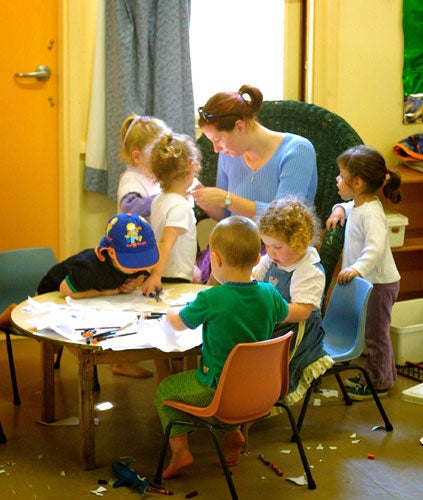
A childcare revolution has meant the majority of toddlers in the UK are for the first time cared for outside the home before they reach the age of one, according to a major international study published today.
The report, by the children's charity Unicef, concludes: "The care of very young children is now becoming, in significant degree, an out-of-home activity in which governments and private enterprise are increasingly involved. In the United Kingdom, for example, a majority of mothers are now returning to full or part-time work within 12 months of giving birth."
As a result, children from poor homes are likely to face a "double disadvantage" – their parents unable to afford quality childcare or resist the economic pressures to seek work so soon after their child is born.
The report, The Childcare Transition, warns that children need the attention of a caring adult more in their first year than at any other time of their life if they are to develop communication skills. "Neuroscientific research is demonstrating that loving, stable, secure and stimulating relationships with caregivers in the earliest months are critical for every aspect of a child's development," it adds.
It also warns that poor childcare could increase the gap in performance between the haves and have-nots in later life. "In the absence of specific and large-scale action to give special emphasis to high-quality early childhood services for at-risk children, 'double disadvantage' is likely to become the norm and the childcare transition will become a new and potent source of inequality. If this is allowed to happen, a historic opportunity will be lost."
The UK is almost alone in switching from early childhood education to compulsory schooling by the age of five, the report goes on to note, arguing that earlier "schoolification" does not appear to benefit British children. "Finland and Sweden, for instance, despite rejecting the 'schoolification' of the early years and delaying the beginning of primary school education until the age of seven, regularly top international league tables for academic achievement at age 15," it adds.
"Finnish 15-year-olds outperform the students of every other industrialised country in average levels of proficiency in maths and science and are outperformed in literacy only by pupils in the Republic of Korea."
The UK is near the bottom of 24 countries in the OECD for infant mortality, coming 20th out of 24, with a death rate of 5.1 per 1,000 births. It is 20th for babies with low birth weight, with 7.5 per cent below 2,500 grams (5lb 8oz), and 23rd out of 24 for immunisation coverage.
Annette Brooke, the Liberal Democrat children's spokeswoman, said: "The poorest families are still not able to access high quality childcare. Sub-standard provision can hinder a child's development and standards must be dramatically improved."
Maria Miller, for the Conservatives, added: "Urgent action is needed to ensure the poorest families access high-quality pre-school services so the cycle can finally be beaten."
However, the Government disputed Unicef's findings, saying latest figures showed that only 18 per cent of children under one used formal childcare, while 24 per cent used informal childcare, mostly by grandparents.
Subscribe to Independent Premium to bookmark this article
Want to bookmark your favourite articles and stories to read or reference later? Start your Independent Premium subscription today.
Join our commenting forum
Join thought-provoking conversations, follow other Independent readers and see their replies