Murray Walker: My Life in Media
'When I said things like "there's nothing wrong with the car, except it's on fire", thank heavens people found it amusing'

For free real time breaking news alerts sent straight to your inbox sign up to our breaking news emails
Sign up to our free breaking news emails
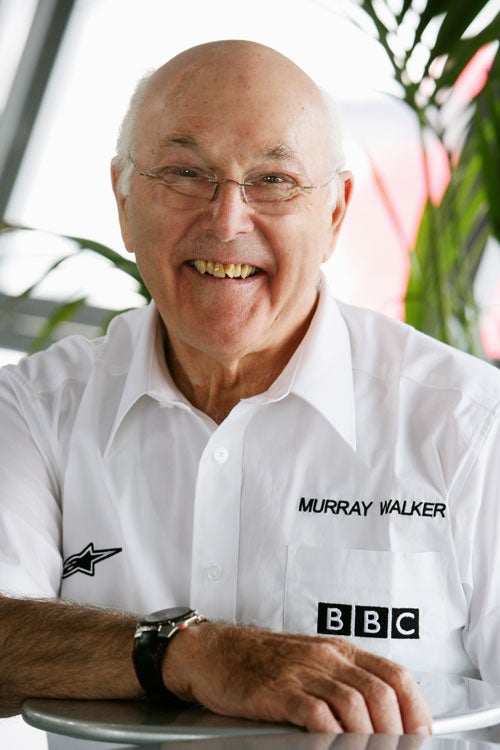
Murray Walker, 84, is Britain's best-known motor sport commentator. He started his career in radio, covering the Isle of Man TT races, and graduated to become the voice of Formula One, first for the BBC and later ITV. Known for his unique commentary style and a voice that seems to rise and fall in tone along with the revving of engines, Walker dovetailed his media activities with a successful career in advertising before he retired to concentrate on his hobby, motor sport, in 1982. A quarter century on, Walker is still a motor sport pundit. He lives with his wife near Salisbury, Hampshire, and drives a BMW 330d.
What inspired you to embark on a career in the media?
My father was my inspiration. He rode in the TT motorcycle races from 1920 until 1935, and when he retired he edited a motor biking magazine. As a result of that, and being very eloquent, he became the BBC radio motorcycle commentator. I suppose subconsciously I was trying to be like him. When my own attempt at being a bike racing driver didn't meet my expectations I turned my hand to commentating.
When you were 15 years old which newspaper did your family get, and did you read it?
My parents always used to get the Daily Mail but I can't say I was really bothered with the papers at that age.
And what were your favourite TV and radio programmes?
Television wasn't around when I grew up but obviously I've always loved any programme on motor sport. Nowadays I'm a massive fan of Top Gear, I think what Jeremy Clarkson and the rest of them do is fantastic. The fact they have 350 million viewers worldwide is testament to that.
Describe your career.
I worked alongside my father from 1949 until 1962 as the junior BBC motor sport commentator and when he died I slotted into his position. In those days we only did motor bike racing but from 1979 the BBC started to cover the Grand Prix properly and they asked me to commentate. Back then I was travelling a lot in the UK. There was a period in the Sixties when I think my wife and I had a record of about 36 weekends in one year on the road, as well as the day job in advertising. As the years went by I spent a lot more time abroad as more events were added to the Formula One calendar. So right up to 2001 when I stopped Formula One, I was flying long haul regularly as well as writing columns for the News of the World and the Daily Express as well as most of the motor sport industry press. Now I am in semi-retirement things are more relaxed so I'm able to be a lot more selective in the broadcast work I do and concentrate on my book writing.
What's the first media you turn to in the mornings?
The Today programme. I'm a Radio 4 man.
Do you consult any media sources during the day?
If I'm out in the car I'll always tune into The World at One on Radio 4.
What is the best thing about your job?
I've been lucky enough to make a fantastic career out of my hobby.
And the worst?
The downside has been that I commentate on an extremely dangerous sport and inevitably people have been killed. Four people died before my eyes. Undoubt-edly the worst moment for me was the death of Ayrton Senna at the San Marino Grand Prix in 1994.
How do you feel you influence the media?
I'd be awfully big headed to say I influence the media, but I hope the media respects my professionalism.
What's the proudest achievement in your working life?
Receiving my OBE from The Queen.
And what's your most embarrassing moment?
I feel mildly sad that my image at times has been of a slightly bumbling foot-in-the-mouth bloke. I'd like to be seen as someone more professional that that. I regard myself as very professional, a person who goes to enormous trouble over doing the right research and knows what they're talking about. When I said things like: "There is nothing wrong with the car, except it's on fire," thank heavens people found it amusing. But it's not something I lose sleep over.
What is your Sunday paper? And do you have a favourite magazine?
The Sunday Telegraph is my usual Sunday paper but I do try other newspapers to get a more balanced view. Saying that, every time I try The Observer I end up foaming at the mouth, so maybe it doesn't work. I read everything that is printed about Formula One including, F1 Racing, Autosport, Autocar, Auto Express, Motor Sport Magazine, Bike and Motorcycle. By the time I have finished with them all, the next lot arrive.
Name the one career ambition you want to realise before you retire.
My one great ambition, which I had always thought was unattainable, was to interview the great Enzo Ferrari. I achieved it in 1988 when I went to Italy to interview him for the BBC.
Who in the media do you most admire and why?
The two people I most admire and really hope continue to succeed in the future are Steve Rider and Martin Brundle. They have the two most important qualities for broadcasting: enthusiasm and application.
The CV
1942: Served in the Royal Scots Guards during the Second World War
1947: Joins Dunlop Tyres' advertising department and begins covering motorcycle events on BBC radio with his father
1949: Commentates on his first Grand Prix
1979: Begins covering Formula One for BBC television
1996: Awarded the OBE for services to motor sport and broadcasting
1997: ITV wins the rights to broadcast Formula One and Walker moves to the channel
2001: Commentates his final Formula One Grand Prix for British television
2002: Publishes autobiography Unless I'm Very Much Mistaken
2008: Will publish Murray Walker Scrapbook on May 2
Murray Walker is the curator of 100 Years on the Roads, a photographic history of the Isle of Man TT races, which is at the Getty Images Gallery, London, W1, until 19 April.
Subscribe to Independent Premium to bookmark this article
Want to bookmark your favourite articles and stories to read or reference later? Start your Independent Premium subscription today.
Join our commenting forum
Join thought-provoking conversations, follow other Independent readers and see their replies