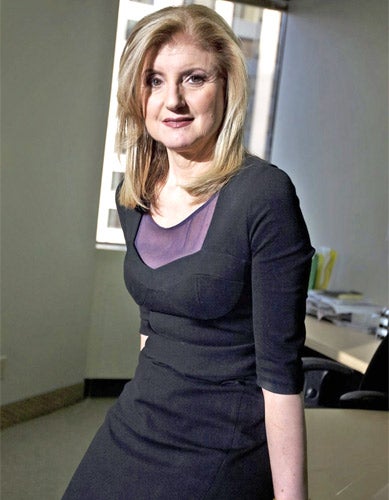
Some famous internet start-ups began life in a garage, others in a college dorm. But when Arianna Huffington decided to launch a website in the spring of 2005, many of her most crucial telephone calls were made from an expansive desk at her home in the leafy Los Angeles suburb of Brentwood.
Over several days, the energetic socialite called several hundred people in her well-thumbed Rolodex. She had a proposition: would they like to join a stable of amateur bloggers who would use the liberal-leaning site to volunteer occasional thoughts, opinions, and humourous anecdotes from their daily life?
"Arianna was totally evangelical about it," recalled one person. "She would ring once or twice a week, saying 'everybody's blogging! Are you? You must! Did you do your yoga today? Did you say your prayers? Did you blog? It should be part of your routine!' Arianna's a philosopher, or at least she once studied it, and her big catchphrase was that blogging makes you feel better."
The pitch worked. Within a few weeks, The Huffington Post had become the preferred pulpit of scores of influential public figures, from Hollywood movers and shakers such as Barry Diller and David Geffen, to political figures (Hillary Clinton and John Kerry), to tub-thumping celebrities such as Alec Baldwin, Jamie Lee Curtis and Mia Farrow.
Where the celebrity class goes, civilians follow. Soon the site boasted a thriving community of approximately 9,000 bloggers, whose contributions were published alongside news, gossip and recycled viral content, creating a sprawling and exponentially popular internet forum. By 2010, The Huffington Post was attracting 15 million readers a day and selling advertising that helped turn an annual profit of around $30m (£18.5m).
This February, Huffington cashed in her chips, selling her firm to the internet giant AOL for $315m. She became "head of content" for the newly merged tech giant. Her day job is now in New York, though she often commutes back to LA (sometimes via private jet) for the weekends.
But with every success comes backlash. News of Huffington's megabucks deal sparked discontent among the unpaid writers who provided content for the suddenly valuable site. Where, they began asking, was their share of the wealth? On Tuesday, one of their number, Jonathan Tasini, decided to get even. He filed a class-action lawsuit against Huffington and AOL seeking $105m in damages, to be shared among the 9,000 bloggers who (as he sees it) have been "mistreated" by not being financially rewarded for their work.
The case rests on allegations of "deceptive business practices". Although The Huffington Post's bloggers were never promised payment, Mr Tasini's lawyers, Kurzon Strauss, argue that the contributors did not expect the site to generate an enormous profit. Since their content has subsequently proved to be hugely valuable, they should now be entitled to retrospective compensation.
"Ms Huffington is acting like every robber baron CEO who believes that they, and only they, should pocket huge riches, while the rest of the peons struggle to survive," Mr Tasini, a prominent journalist and trade-union activist, said. Her conduct, he argued, is firmly at odds with her cuddly left-leaning politics.
"Arianna Huffington is a hypocrite. While reaping money and building her 'brand' based on books and speeches decrying the growing divide between rich and poor [she] is precisely acting to impoverish bloggers and create a blogger plantation, where her slaves work to build her fortune."
Mr Tasini won a different, highly prominent case against The New York Times a few years ago, persuading the Supreme Court to award $15m to freelance journalists whose work had been carried on the paper's website without their consent. But a fresh precedent will have to be created for his new lawsuit to succeed – and most legal experts are sceptical about its chances.
A spokesman for The Huffington Post called the suit "wholly without merit", saying the site provides a valuable free service to bloggers by allowing their pieces to reach a vast audience. Sources added that blogging now only accounts for about 15 per cent of the site's readership; most traffic comes from its news operation, which has mastered the dark art of "harvesting" clicks from aggregators such as Google News.
The big question, though, is what effect the controversy might have on The Huffington Post's image. Mr Tasini is calling for unpaid contributors to boycott the site, describing people who continue to blog there as "scabs".
Legal battles and PR wars are expensive. Regardless of how Huffington fares in court, the case could see her lose in the court of public opinion.
Join our commenting forum
Join thought-provoking conversations, follow other Independent readers and see their replies
Comments