The evil that reality television contestants do
If somebody told you to inflict a potentially fatal electric charge on an unseen victim, would you comply? A spoof French programme did just that – with shocking results

For free real time breaking news alerts sent straight to your inbox sign up to our breaking news emails
Sign up to our free breaking news emails
Most people would kill for the right to appear on a reality television programme. Literally so, if you believe a documentary which was broadcast on French television last night.
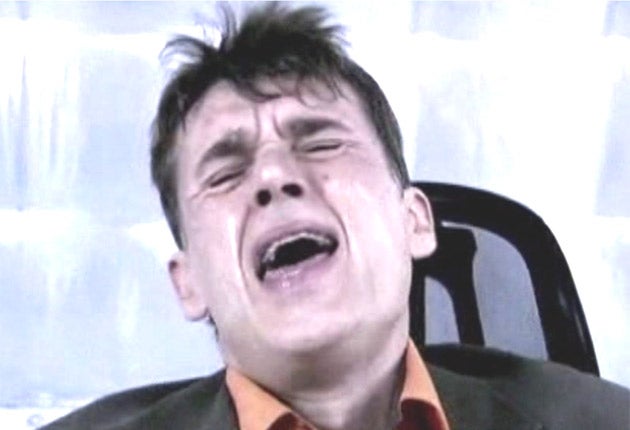
The programme – "Le Jeu de la Mort", or The Game of Death – followed 80 contestants who believed they were taking part in a pilot for a new reality TV show, La Zone Xtrême. They were urged by a baying studio audience and a well-known TV hostess to give electric shocks, up to fatal levels, to an unseen, screaming contestant if he gave the wrong answer to a question.
However, they did not know that the pilot show was a spoof and that the screaming contestant was actually an actor, who was identified as "Jean-Paul". Sixty-four of them – 80 per cent – administered the fatal dose of 460V, even when the "victim" begged for mercy or fell silent. The makers of the programme said it provided disturbing evidence of the power of television and, in particular, the debilitating influence of reality TV shows.
Critics, however, lambasted the documentary for using precisely the same brainwashing and televisual distorting techniques it claimed to expose. The experiment, they pointed out, was based on an approach first used by the American social psychologist Stanley Milgram in 1963. In an attempt to comprehend the behaviour of genocidal Nazi death camp guards, Mr Milgram created a bogus authority which ordered volunteers to administer electric shocks of increasing severity to an unseen person who answered questions wrongly. Two thirds of the volunteers obeyed orders to deliver the potentially fatal doses.
Critics said that last night's documentary – although it conceded its debt to the Mr Milgram experiments – suggested that television was somehow uniquely capable of brainwashing people into committing murder. The original experiments, which are often replicated, suggested that the real problem was something deeply rooted in the human psyche: the incapacity of a large majority of people to resist authority or to refuse to follow a crowd or mob.
The programme, shown on the France 2, the main state-owned channel, was made by Christophe Nick, a celebrated French filmmaker of shock or investigative TV documentaries. The narrator made it clear that the principal target was mass television culture.
"For 10 years, most commercial channels have used humiliation, violence and cruelty to make programmes which have become more and more extreme," said a disembodied voice. "How long before we have murder in prime time?"
Mr Nick said that, in starting work on the documentary, he had "no idea that the telly could have such authority over people.... We were amazed to find that 81 per cent of the participants obeyed."
Even the TV audience, cheering on the contestants and urging them to "punish, punish, punish", had no idea that the whole thing was a spoof, he said.
"People are not equipped to disobey," he said. "We don't want to do it. The [contestants] tried to convince the authority figure that they should stop, but they didn't manage to." One contestant, Sophie, interviewed for a book about the programme, said she had agreed to torture the victim to "death" despite the fact that her Jewish grandparents had been victims of the Holocaust. "Since I was a little girl, I have always asked myself why they [the Nazis] did it. How could they obey such orders?" Sophie asked. "And there I was, obeying them myself." Another volunteer said: "I was worried about the contestant. At the same time, I was afraid to spoil the programme."
Critics, including journalists who had witnessed the spoof reality TV sessions, expressed grave doubts about the accuracy and honesty of the documentary. They said that it was evident that many members of the studio audience, at least, suspected that the whole thing was rigged, because they assumed that television programmes were always rigged.
"There were elements of manipulation from the start," said Jacques Semelin, a psychologist and historian who studies genocide. "[The contestants] were obedient, but it was more than mere obedience – there was the audience, the cameras everywhere."
Laurent Bègue, a professor of social psychology at Grenoble university, dismissed the programme as "superficial" and an attempt to exploit simplistic "moral panic" about popular television. The reaction of the contestants was disturbing but utterly predictable, given the results of past experiments, he said. "[The documentary shows] that submission to authority applies to different contexts, including television," he said. "But this programme was, itself, more of a media stunt than a scientific experiment."
Alexandre Lacroix, the editor of Philosophie Magazine, said that he had been invited to take part in the pre-recorded discussion programme which followed the documentary last night. When he tried to criticise the documentary and the "coercive" and uncritical nature of the discussion which followed, he claimed the presenter, Christophe Hondelatte, ordered him off the set and said: "I'm in charge here".
Subscribe to Independent Premium to bookmark this article
Want to bookmark your favourite articles and stories to read or reference later? Start your Independent Premium subscription today.
Join our commenting forum
Join thought-provoking conversations, follow other Independent readers and see their replies