Charles Percy: Politician hailed early in his career as the Republicans' answer to John F Kennedy

For free real time breaking news alerts sent straight to your inbox sign up to our breaking news emails
Sign up to our free breaking news emails
Today, Charles Percy's moderate politics and his readiness to work across the aisle with Democrats would consign him to the Republican Party's outer darkness. Back in the 1960s and early 1970s, however, those views chimed with the liberal mood of the era, and many thought the young Senator from Illinois was destined for the Oval Office.
His background was picture-perfect. The son of a bank clerk, he won a scholarship to the University of Chicago and served in the Navy in the Second World War. He entered politics on the back of a dazzling business career at Bell & Howell, a photographic equipment company which he joined in 1941. By 1949 Percy had become chief executive; during his 14 years at the helm, sales multiplied 12-fold to $160m.
But by 1960 his political ambitions – encouraged by, among others, the outgoing president Dwight Eisenhower – were evident. That year Percy was given the important post of chairman of the platform committee of the Republican convention in Chicago that nominated then vice-president Richard Nixon. After an unsuccessful run for the Illinois governorship , Percy was elected to the Senate in 1966, gaining a surprise win over a respected Democratic incumbent.
His campaign, however, was overshadowed by tragedy – the savage and mysterious murder of his 21-year old daughter Valerie at the family home in Chicago's northern suburbs. The police kept the case open for two decades, but it was never solved.
In Washington Percy made an instant impact. His youth, energy and good looks had many hailing him as the Republican answer to John F Kennedy, and he quickly carved out a niche as a leading "Rockefeller Republican", on the moderate wing of the party led by Nelson Rockefeller, the New York governor. By late 1967, when Percy had been a senator for less than 12 months, one poll showed him beating the incumbent Lyndon Johnson in a putative match-up.
Percy, though, decided to pass on 1968 and set his sights on 1976, but the premature downfall of Nixon – whom Percy had enraged by calling for an independent prosecutor over Watergate – upset his plans. In August 1974 Gerald Ford was elevated to the presidency, and once Ford had made it clear he would seek election in his own right, Percy abandoned his campaign, and the window of opportunity slammed shut. Ford was defeated by Jimmy Carter and the Republicans moved rightward to embrace Ronald Reagan.
Percy's ascent on Capitol Hill none the less continued and in 1981 he became chairman of the Senate's powerful Foreign Relations Committee. Three years later his political career was over after a defeat in his bid for a fourth senate term whose implications for US politics linger to this day.
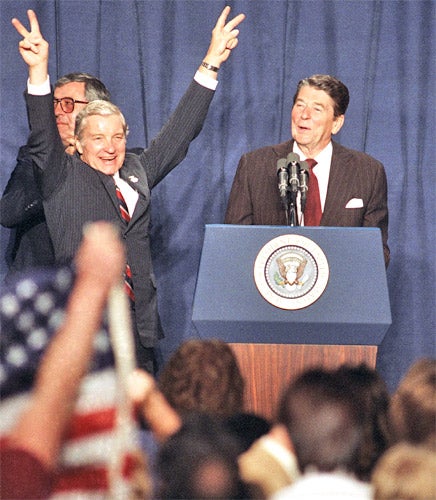
By any standards 1984 was a vintage Republican year. A hugely popular Reagan won re-election by a landslide, and the party picked up 16 seats in the House. But even though Reagan came out in person to campaign for him, Percy was narrowly beaten in Illinois by his opponent, the Democratic congressman Paul Simon.
Many simply put the loss down to voters' disaffection with an increasingly remote figure, focussed on international affairs and oblivious to the problems of the struggling Illinois economy. For others, though, the surprise result remains Exhibit A in the case that the pro-Israel lobby in the US wields such political influence that even the mightiest member of Congress falls foul of it at his peril.
Percy's sins on this score were manifold. He had criticised Israel for missing opportunities to negotiate with the Palestinians, he had described Yasser Arafat as a "relative moderate", and had twice voted for controversial sales of US arms to Saudi Arabia, opposed by both Israel and AIPAC, the main Israel lobbying group in Washington.
Large sums from Jewish groups and pro-Israeli interests flowed into the coffers first of Tom Corcoran, Percy's Republican opponent in the primary ("Can You Name Israel's Worst Adversary in Congress?" read one Corcoran flier) and then of Simon in the general election. Whether this effort made the difference, it is impossible to say. But AIPAC certainly thought so. "All the Jews in America, from coast to coast, gathered to defeat Percy, and American politicians – those who hold public positions now and those who aspire – got the message," Tom Dine, the group's president, said in a speech afterwards. Congress's lockstep and virtually unanimous support of Israel since suggests he may have had a point.
Rupert Cornwell
Charles Harting Percy, politician: born Pensacola, Florida 27 September 1919; married 1943 Jeanne Dickerson (died 1947; one son, one daughter, and one daughter deceased), 1951 Loraine Diane Guyer (one son, one daughter); died Washington DC 17 September 2011.
Subscribe to Independent Premium to bookmark this article
Want to bookmark your favourite articles and stories to read or reference later? Start your Independent Premium subscription today.
Join our commenting forum
Join thought-provoking conversations, follow other Independent readers and see their replies