Meles Zenawi: Divisive Ethiopian leader who became one of the West's staunchest allies in Africa

For free real time breaking news alerts sent straight to your inbox sign up to our breaking news emails
Sign up to our free breaking news emails
Meles Zenawi, Ethiopia's Prime Minister and one of Africa's most powerful and divisive leaders, has died in a foreign hospital from an undisclosed illness. Speculation about his health mounted, including rumours of cancer, when he missed an African Union summit in the capital, Addis Ababa, last month.
Credited over the last 21 years with Ethiopia's rapid economic growth, turning it into one of Africa's fastest-growing economies, Meles was also a "good friend" and strong security partner of the US on its "war on terror", receiving hundreds of millions of dollars in aid over the years, and hosting the US military drones that patrol East Africa. However, he was also viewed as an authoritarian strongman whose critics suffered persecution, imprisonment and torture – and he was often berated by human-rights protests from within and from the international community.
Meles was undeniably central to everything in Ethiopia, the good and the bad. Having dominated Ethiopian public life since the Nineties and influenced the fortunes of his neighbouring countries, Meles's death has created a potential power vacuum in the volatile Horn of Africa, with many worried that Ethiopia might be fragile and that ethnic violence could be a threat. Kenya's Prime Minister, Raila Odinga, said, "We need a seamless, peaceful, transition of power. The region, the Horn of Africa, needs stability."
During his reign, Meles, a hardline, self-styled Marxist-Leninist with an impressive intellect, was responsible for the introduction of a form of ethnic nationalism and went to war with neighbouring Eritrea, which had seceded in May 1992.
The conflict was over the border town of Badme, which was deemed by an international court to belong to Eritrea. Meles refused to withdraw his troops and the war, from 1998 to 2000, resulted in tens of thousands of deaths and huge population displacement. The countries remain sworn enemies and the town has been the source of festering discontent between the two nations ever since. Therefore, Eritrea will be watching developments closely.
Ethiopia won international plaudits for twice sending troops into Somalia to fight militants linked to al-Qaeda. In the first sortie in 2006, his well-equipped troops were forced to withdraw in the face of guerrilla attacks. He sent Ethiopian troops back into Somalia in 2011. Meles also played a key role in brokering peace efforts between newly independent South Sudan and its former civil-war foe, Sudan.
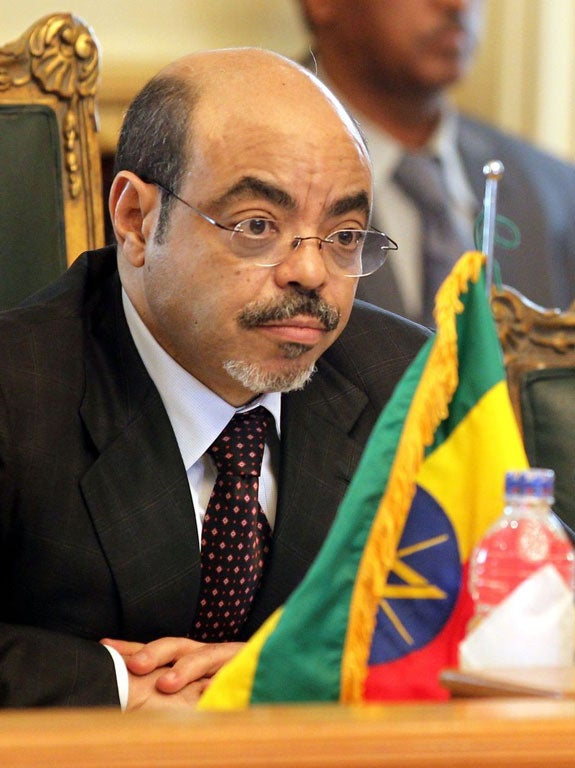
Over the last decade, Meles, the diminutive leader, with his characteristic goatee and arched eyebrows, presided over a seven-year run of double-digit economic growth, advocating a mix of heavy state spending and private investment. In 2008, the International Monetary Fund said that Ethiopia's economy had grown faster than any non-oil exporting country in sub-Saharan Africa. Meles was widely commended for ploughing money into infrastructure, but criticised by some for selling off swathes of land to foreigners. Although he forged closer business ties with China, many Ethiopians complained that this had not resulted in more domestic employment.
Despite those gains, Ethiopia remains heavily dependent on agriculture, which accounts for 85 per cent of the country's employment. Per capita income is only about $1,000, or roughly $3 a day. Under Meles, Ethiopia saw a strong rise in education, with the construction of new schools and universities. Women gained more rights, albeit slowly.
One African observer noted, "While life remains a struggle for many Ethiopians, millions of others have been lifted out of abject misery in just a generation. Anyone who has visited the country more than once notes the transformation taking place constantly as infrastructure is built out, and will remark on the dynamism of the people."
However, Leslie Lefkow, the deputy director for Human Rights Watch in Africa, believes that the ruling party has been too focused on building its own authority in recent years, instead of building up government institutions. She said, "On the human-rights side, his legacy will be much more questionable. The country remains under a very tightly controlled one-party rule and this will be the challenge for the new leadership, to take advantage of the opportunity that his death presents in terms of bringing Ethiopia into a more human-rights friendly style of leadership."
Meles was accused of gross abuses against minorities, including Ethiopia's ethnic Somalis in the Ogaden region, where rebels have fought a long-running insurgency.
During the 2005 election win, both Meles's iron fist and austere approaches were seen. When it appeared that the opposition was likely to make gains, Meles tightened security across the country, and on the night of the election he declared a state of emergency, outlawing any public gathering as his ruling party claimed a majority win. Opposition members accused Meles of rigging, and demonstrations broke out. Security forces moved in, killing at least 200 people and jailing thousands more. Some Ethiopians argued that he did what was necessary to stabilise the vast, ethnically diverse state.
In 2009, he introduced a much criticised anti-terrorism law, which rights groups have said was far too vague and has been used to quash freedom of speech and peaceful political dissent. It has also seen multiple opposition figures and journalists, including two Swedes, jailed for lengthy terms.
In 2010, Meles won another five years in office while receiving a reported 99 per cent of the vote in an election that the US and other international observers said did not meet international standards. His victory cemented his position in the small club of African rulers in power for more than 20 years.
Born in the northern town of Adwa on 8 May 1955, Meles was one of his father's 13 siblings from different women. Upon completing his elementary schooling, he won a scholarship and moved to Addis Ababa. Aged nearly 20, Meles abandoned his studies to join the rebel Tigray People's Liberation Front (TPLF), which waged an armed struggle against the Communist military dictatorship of Mengistu Haile Mariam in the 1970s and 1980s which was responsible for the deaths of hundreds of thousands of people.
After taking over the TPLF's leadership, he forged a broader coalition with other regional movements to establish the Ethiopian People's Revolutionary Democratic Front (EPRDF), now the country's ruling party. Backed by the US, the EPRDF ousted the Communist junta in 1991 and Meles became President of the transitional government and then Prime Minister in 1995, a position that is both the head of the federal government and, crucially, the armed forces.
Government spokesman Simon Bereket was quick to assure citizens and insisted that Ethiopia, Africa's second most populous the country, is stable and promised "continuity as charted" by the late Prime Minister. According to Ethiopia's constitution, the Deputy Prime Minister and Foreign Affairs Minister, Hailemariam Desalegn, will be sworn in to "act on behalf of the Prime Minister in his absence."
Meles is survived by his wife, Azeb Mesfin, an MP, women's activist and businesswoman, and three children.
Meles Zenawi, politician: born Adwa, Ethiopia 8 May 1955; married Azeb Mesfin (three children); died 20 August 2012.
Subscribe to Independent Premium to bookmark this article
Want to bookmark your favourite articles and stories to read or reference later? Start your Independent Premium subscription today.
Join our commenting forum
Join thought-provoking conversations, follow other Independent readers and see their replies