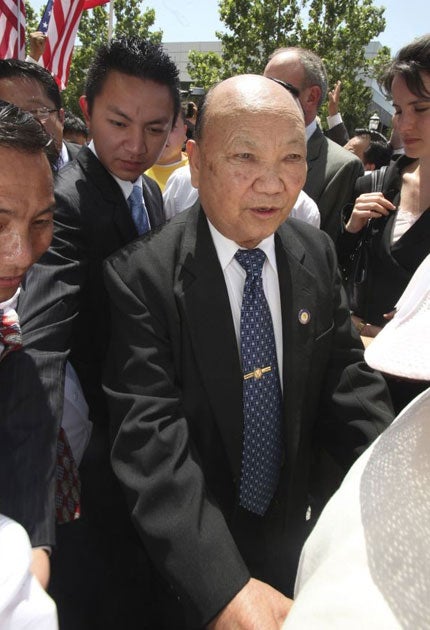
Vang Pao Soldier whose leadership of Hmong fighters led to his description as ‘the biggest hero of the Vietnam War’

For free real time breaking news alerts sent straight to your inbox sign up to our breaking news emails
Sign up to our free breaking news emails
Vang Pao was a fabled Hmong war veteran who led by example and exuded bravery, fighting a covert CIA-sponsored war against Laos Communist insurgents and Viet Minh in Laos during the Vietnam War. The General, once described as the "biggest hero of the Vietnam War" by the former CIA Director William Colby, went on to become the revered leader of the Hmong exiles in the United States.
Born in 1929 in the Hmong village of Nonghet, in northern Laos near the Vietnamese border, Vang had six years of sporadic schooling and then worked on the family farm. The Hmong are an ethnic group from the mountainous regions of China, Vietnam, Laos, and Thailand. As a teenager during the Second World War, he worked as an interpreter for French colonial forces and fought against the Japanese.
In the 1950s, French authorities recruited Vang as a lieutenant to fight the Communist Viet Minh during the First Indochina War. In 1954, following the French defeat at Dien Bien Phu, and with it the end of the war, Vang remained in the army of the newly independent kingdom of Laos. His exploits in fighting the Viet Minh earned him a reputation for bravery and as a skilled military strategist. He quickly advanced to Major-General in the Royal Lao Army, the highest rank held by a Hmong soldier, and with it gained widespread admiration among his people.
In the lead-up to the Vietnam War, Communist Vietnamese forces cut tracks through the Laotian jungle, creating the supply route known as the Ho Chi Minh Trail, and Washington sought someone capable of engaging them without the need to commit American troops. In December 1959, Bill Lair, a CIA adviser based in Thailand, met Vang, and arranged to provide weapons and training.
Vang spent the next 15 years heading this CIA-backed operation to disrupt the Viet Minh's network of trails in northern Laos. As the fighting grew, the role of Vang's fighters expanded not only to keeping the Communist forces at bay but also overseeing the Ho Chi Minh Trail, rescuing downed American airmen and protecting navigation sites for the US bombing of North Vietnam.
Much of the fighting took place in Laos' remote north-east, and in the mountains the Viet Minh were no match for Vang's irregulars. US bombing of the Ho Chi Minh Trail and support of the Hmong made Laos the world's most heavily bombed country, and the legacy of unexploded ordnance is still felt today.
Vang's forces grew to almost 40,000 and provided a backbone of resistance against the Communists. Vang's strength was in his army's mobility. Although outnumbered, his guerrilla army could sweep his territory before the North Vietnamese became entrenched. As criticism of the Vietnam War increased, the US pressured Vang to abandon his guerrilla tactics and engage the Viet Minh in more conventional warfare, for which they were unsuited. Their losses were enormous and by the late 1960s the Hmong were forced to recruit boys as young as 13.
Vang's forces were unable to defeat the Pathet Lao Communists, who took control the country in December 1975, months after the Vietnam War's end. Vang, his family and Hmong leaders were evacuated by the Americans to the US, but at least 50,000 fighters and their families were left behind; they fled to the mountains and Thailand. Vang's loyalty to Washington paved the way for thousands of Hmong to resettle in the US, mainly in California, Minnesota and Wisconsin. It was a reward for his devoted service. There are now an estimated 200,000 Hmong in the country.
Colby later told Congress that Vang's fight in Laos kept 70,000 North Vietnamese from deploying in South Vietnam. The war killed 35,000 of Vang's countrymen. In 2008, Lionel Rosenblatt, President of Refugees International, put it bluntly: "General Vang Pao's Hmong were put into this meat grinder, mostly to save US soldiers from fighting and dying there."
Vang's career was not without controversy. He oversaw US-funded aid programmes for his fighters and their families, including agricultural training. But accusations were raised about opium trafficking by Vang and his officers, allegedly to pay for his troops when CIA funding stopped in 1974, but also to enrich themselves. There were accusations of CIA aircraft being used to transport the opium. This was denied by Vang and CIA officers who worked alongside him.
From exile, Vang organised the United Lao National Liberation Front to attract attention to human-rights violations against Hmong in Laos and garner support for continued Hmong resistance. That resistance has since dwindled to between several hundred and a thousand bedraggled fighters and their families in the North-eastern and central mountain regions. They have kept fighting, partly for survival, but also at the behest of Hmong groups in the US, who encourage them while living comfortably in exile.
In 2007, after a lengthy investigation known as Operation Tarnished Eagle, Hmong was arrested for plotting to topple the Laotian government. He was charged under the US Neutrality Act, which prohibits actions on American soil against foreign governments with whom Washington is at peace. Prosecutors alleged that Vang and colleagues were funding guerrilla fighters in Laos. Vang never denied the charge but countered that the CIA was aware of his plans to send American weapons to his former comrades- in-arms. The case against him, which drew outrage, was later dropped.
The US government did not officially recognise the Hmong contribution until 1997, when the Clinton administration authorised a plaque at Arlington National Cemetery saying that their valour would never be forgotten. However, with the US's post-Cold War objectives in the region having changed, Vang represents a historical chapter which the US and its regional allies are keen to see closed. The Laos Communist government's response to his death was muted: "He was an ordinary person, so we do not have any reaction."
Vang was taken ill with pneumonia in California on his way to deliver his traditional message at the Hmong International New Year. He had fathered 32 children and had 40 grandchildren.
Vang Pao, soldier: born Nonghet, Laos December 1929; died Clovis, California 6 January 2011.
Subscribe to Independent Premium to bookmark this article
Want to bookmark your favourite articles and stories to read or reference later? Start your Independent Premium subscription today.
Join our commenting forum
Join thought-provoking conversations, follow other Independent readers and see their replies