Helen Browning: A woman who won't be cowed in the war against titan farms
The Soil Association has been threatened with a libel action for its opposition to a giant new pig factory. Its new head tells Jerome Taylor why this is a battle worth fighting

Sign up to the Independent Climate email for the latest advice on saving the planet
Get our free Climate email
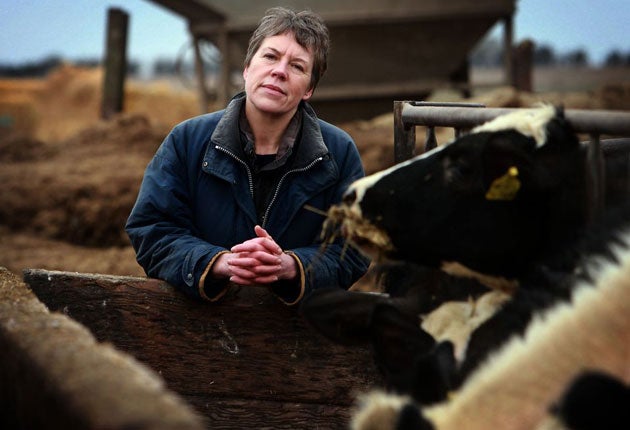
On a muddy hill above a Wiltshire farmhouse, sows are giving birth. Hordes of newborn piglets scamper between the hutches, chased by their exhausted-looking mothers.
The mothers are British saddlebacks, a once common breed that has fallen out of fashion. "We breed them with a large white," says farmer Helen Browning. "That way the piglets have all the wonderful taste of saddlebacks, but less fat."
Ms Browning, 49, herself is something of a rare breed. In the increasingly mechanised world of modern farming, she has been devoutly organic for more than 25 years. She is as comfortable lobbying politicians in Westminster, or delivering lectures on soil efficiency, as she is mucking out a pig sty.
Ms Browning, who runs this 1,300-acre farm outside the Wiltshire village of Bishopstone, is at the forefront of the furious debate over farming methods that will define British food and agriculture for decades to come. In March she will begin a daily commute to Bristol where she will take up the directorship of the Soil Association.
On one side of the argument are those who see the future in terms of US-style factory farms, enormous mechanised food production centres where tens of thousands of animals live under the same roof. The sales pitch is pretty basic: cheap food. For the organic lobby and farming traditionalists, such plans provoke horror.
The argument is already turning nasty. Earlier this month the Soil Association received a letter from the law firm Carter Ruck acting on behalf of Midland Pig Producers, a firm that wants to build a pig factory for up to 25,000 animals in Derbyshire – one of several so-called "titan" pig farms that are in the planning stage in Britain.
The Soil Association had submitted an objection to the planning application, raising concerns in general terms about disease, antibiotic resistance and animal welfare in such large herds. In response, Carter Ruck, acting on behalf of Midland Pig Producers (MPP), threatened the charity with libel proceedings, arguing that the Soil Association's objections to the planning application are defamatory and should be withdrawn, and that a planning application was not the appropriate forum to raise such concerns.
"We were really taken aback," Ms Browning says, knowing full well that this debate could come to dominate her time at the Soil Association. "If you can't have that debate in a planning process where can you put it?"
The pig company MPP and Carter Ruck deny they are trying to stifle opposition to these farming methods, saying their main concern was that the debate over the planning application should be accurate. But Browning is concerned that they resorted to threatening libel action.
"I'm not someone who is paranoid about the way the world works, but when that sort of thing happens I become much more so," she says. "I think most people are trying to make their way in life the best way they can, with different views and perspectives on things. But when I start to see people start to try and silence other people's views I start to feel rather queasy. It makes you more convinced that you have to keep putting that other perspective on the table."
Does she think there is any room for large intensive farms in the British market? "I don't think big is always bad," Ms Browning insists. "But it's a little bit analogous to what's happened to retailers. Once you start to get enterprises of such scale, it makes it really hard for anyone not at that scale to survive."
Her predecessor Patrick Holden retired after 15 years in charge of the Soil Association, overseeing a period where organic food has gone from being a niche choice for a few idealists to a ubiquitous part of mainstream food culture."The last 15 years has been a tremendous success story," Browning says. "But we still have a long way to go."
The organic farming industry was only worth £105m in 1993. It now brings in £1.84bn and more than 3,000 farmers are certified organic. But in the midst of a recession it has proved hard to sell the organic dream. Sales of organic food dipped 12.9 per cent last year, and the number of new organic farmers has remained stagnant.
Pop into Sainsbury's and a 200g pack of Helen Browning's organic sausages will set you back £2.99. A larger 300g pack of Sainsbury's premium own-brand sausages is just £2.64. "I would love to see the best food available to everyone at a price they can pay," admits Ms Browning. "I think it's a fundamental right. So my aim is to make sure price is not a barrier. Especially as the people who most need the benefit of a great diet are the ones who can least afford it."
She is adamant that the price gap between organic and non-organic food will narrow. But this is largely because non-organic farming is beholden to the costs of fuel and fertiliser that, being finite resources, are rising year on year.
The price a farmer gets for beef and lamb, she explains, is now nearly the same whether it is organic or not. That the organic meat tends to be more expensive on the shelves is largely down to the supermarkets rather than the farmer. "We need to tackle that," she says. Organic poultry and pork still tend to be significantly more expensive to produce because they are grain eaters and, despite the success of the organic movement, there is a shortage of organic grain in the UK.
"All food will inevitably get more expensive over time, and while this will reduce the price differential between organic and non-organic, I have concerns about the implications for those on low incomes," she says.
In conversation Ms Browning comes across as a chameleon: part-academic, part-lobbyist, part-foodie, above all a farmer who loves farming. It easy to see why she's had two jobs for the best part of 20 years (her family also runs the village pub).
She still farms the same farm her father did, rented off the Church of England. As a student she trained at agricultural college, but found herself disagreeing with modern farming conventions. When she returned to her father's farm she resolved to do things differently.
"A lot of the old farm hands were a little resistant to change," she recalls. "Here was this 24-year-old woman with different ideas on how to do things. But when they saw the difference, saw how biodiversity on the farm increased, how the animals were happier and healthier, they soon got used to the idea."
We could all, she says, get better at sticking to one of the most fundamental tenets of organic farming: recycling. "This macho mindset that says if we can just mechanise a little bit more, dominate the natural world, put concrete over it, we'll be OK – it's just not a tenable world view."
Take phosphate, one of the three key nutrients needed to sustain plant growth. Most of the world's phosphate is mined and, like other resources, is running out. "People are starting to talk about 'peak phosphate' in the way they talk about 'peak oil'," Ms Browning says. "Phosphate is one of those things we've used willy-nilly."
Those who dismiss organic farming see it as a middle-class luxury, something only those with enough money can get excited about. But a growing body of research pushes it as a way to sustain the unprecedented population growth the world will go through in the next 40 years.
2011 is the year that the world's population hits seven billion. By 2050 the UN estimates there will be as many as 9 billion people. That's a lot of extra mouths to feed and scientists are battling to find ways of doing so sustainably. Two major reports from the French government earlier this month concluded that the world would be able to feed those extra mouths only if we embrace and export farming methods that encourage natural fertilisers, energy saving techniques and recycling.
Post 2050, most demographers predict that global population growth will slow dramatically as developing nations improve access to contraception and female education. Which is why organic advocates such as Browning argue that the farming methods we chose over the next few decades could decide the future of the environment.
"We need to get through the next 30 to 40 years and come out the other side," she says. "We can't risk irrevocably damaging biodiversity and fundamental resources like soils, and we can't run out of water. Our job is to show that you don't need to wreck the environment, you don't need to accelerate the use of finite resources, to feed people."
A life on the land
Helen Browning, 49, was educated at Harper Adams Agricultural College, Shropshire. She took on her father's 1,350-acre Eastbrook Farm, just outside the Wiltshire village of Bishopstone, in 1986.
Since, she has made the farm entirely organic and founded Eastbrook Farm Organic Meats and the Helen Browning's Organic brand which provides pork products for Tesco, Sainsbury's,and Budgens. The business also includes event catering and her village pub, The Royal Oak.
Ms Browning is currently Director of External Affairs at the National Trust. She has held a number of public appointments, including the the Meat and Livestock Commission (1998-2008). She has been chair of the Food Ethics Council since 2002 and in 1998, was awarded an OBE for services to organic farming. She was a trustee of the Soil Association between 1993-2003, and chair from 1997-2002 and in March, will take up the directorship.
Subscribe to Independent Premium to bookmark this article
Want to bookmark your favourite articles and stories to read or reference later? Start your Independent Premium subscription today.
Join our commenting forum
Join thought-provoking conversations, follow other Independent readers and see their replies