Mervyn King: At the top of his game
Only the Governor of the Bank of England would dare to tell Gordon Brown that the country could not afford to borrow any more money
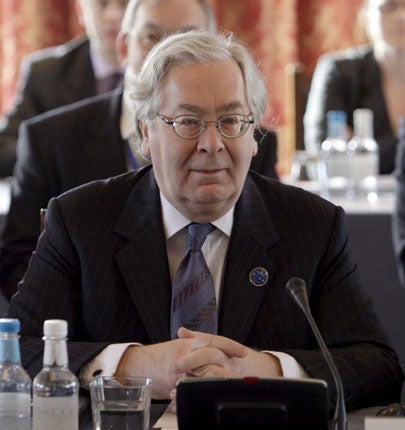
It was often said of Enoch Powell that an index of his vast intellect and supreme literacy was his ability to speak in perfectly formed sentences, paragraphs even, without a fluff or stumble. You could say much the same about the Governor of the Bank of England, Mervyn King, who, like Powell, enjoyed some academic distinction before turning to public service, and is a very clever man, though not always right.
Powell was the local MP when King was at Wolverhampton Grammar School, but there the parallels really ought to stop, although it is just worth adding that King is now developing the sort of public profile that is usually enjoyed by the more single-minded type of backbencher. Certainly his colleagues in the bank regard King's eloquence and command of his brief as formidable assets at a time when the bank is experiencing unprecedented pressure.
King is fond of quoting one of the bank's crustier mottoes: "Keep the press out of the bank and the bank out of the press." Times change. The bank has been a "player" ever since it was granted operational independence over monetary policy a decade ago – but only in these troubled times have its activities become of such vital interest to everyone. With a weak incumbent at No 11, and public faith in the occupant of No 10 running low, the Governor finds himself with a duty he never actively sought: to tell us the unalloyed truth about the economy in a way that politicians cannot.
Recently King has recognised his new status by explaining to television viewers why the country is in deep recession and what the bank was going to do about it. King, with his pebble glasses and vague resemblance to Penfold, the companion of cartoon hero Danger Mouse, did his best to soothe: "There is the assurance that the British people can take that they have a central bank that will neither allow inflation to become too high ... nor that we will have inflation too low and see a recession continue for longer than is necessary. We are taking steps to bring inflation back to our target, to increase the amount of money in the economy, to ensure that we see the beginnings of an economic recovery as soon as we can."
His public appearances are increasingly headline grabbing. Last week, in front of the Treasury Select Committee, King simultaneously hijacked next month's Budget and pulled the rug from under Gordon Brown's feet when he expressed the view that the Government was borrowing quite enough already. As soon as the words dropped from the Governor's lips, the chances of Brown persuading the rest of the world to indulge in a policy that his own central bank governor had publicly disowned evaporated. It was, as the shadow Chancellor George Osborne pointed out, a defining moment. King sees himself as accountable – but to Parliament rather than the Treasury or Downing Street. He is virtually impossible to sack. The scope for friction is obvious.
Some say it has already started. There is a school of thought in political circles that awards King poor marks indeed. He neglected the financial stability part of his brief, so the argument runs, in favour of the more intellectually stimulating challenges of monetary policy, and turned the bank into a sort of think tank. Thus King was too slow to wake up to the enormity of the Northern Rock crisis, and too tardy as well in recognising that recession rather than soaring inflation was the looming problem for the economy as 2008 wore on.
It must be a little embarrassing for all concerned that an external member of the bank's Monetary Policy Committee, David Blanchflower, got things right and the bank, with all its resources and brainpower, got it wrong and kept interest rates too high, with grim consequences for unemployment. Conformation of King's second five-year term as Governor last year seemed to take for ever to arrive from Downing Street, a signal of some dissatisfaction (and the usual dithering) at the top of government. King has since consistently underestimated the severity of the downturn. The forecasting record is not impressive, for whatever reason.
Still, listening to the Governor at a Treasury Select Committee, say, or the set-piece press conferences he chairs at the Bank of England, you are struck by the flawlessness of his speech and lulled by the confidence in his voice. Perhaps because of the preparation he puts into these events – including some rehearsals – he is rarely unsettled, and he obviously enjoys the proceedings. The King of Threadneedle Street treats his listeners – MPs, journalists, staff – as if they were promising but not fully formed students of economics at one of the many universities he taught at before joining the bank as chief economist in 1991.
Having a "King" as Governor is appropriate: sometimes the Bank of England seems more like Buckingham Palace than anywhere else, complete with doormen in pink frock coats and top hats and deference and tradition everywhere. When he went for his audience with the Queen last week, King must have felt quite at home. No wonder King is an unusually confident individual, something of a Sun King who always outshines his colleagues (they rarely get much of a show at their "joint" appearances) and dazzles the audience.
Well, not quite. Recently King has been subject to more of a barracking at his press conferences, with demands for him to apologise for mismanaging monetary policy. One hack even compared King's strategy to the Maginot Line constructed by the French to keep the Germans at bay before the Second World War. (The Germans, of course, just went round the side, through Belgium, just as deflation escaped round the back of Mr King's interest rate policy.) King was uncharacteristically rattled by the barrage, as if he'd never been spoken to like that before.
King was not born to this near regal status. The son of a railway clerk from Buckinghamshire, his early inclination towards social science can be judged from a favourite anecdote: "My first memories of Leeds are from a wet summer in 1958. I was 10 years old, we lived on the moors above Hebden Bridge, and my father took me to my first Test match – England against New Zealand at Headingley. It rained all day on both Thursday and Friday, and, when play started in mid-afternoon on Saturday, on a drying wicket New Zealand were bowled out by Laker and Lock for 67. So I became a slow bowler. I was taught to bowl – slow left arm – at Old Town primary school by the headmaster, Alfred Stephenson. During the morning break he would mark the wickets in chalk in the playground, and draw a small circle exactly on a length. If we could pitch the ball within that circle he would give us a farthing. As we improved, and the payout of farthings increased, the morning break became shorter and shorter – my first lesson in economic incentives, or what is known in the trade as "moral hazard'."
There's an obvious clue here as to one of the things that seem to keep King sane – his love of sport, with easy references to football, especially Aston Villa, and cricket littering his utterances.
Second, King seems to enjoy a comfortable, supportive home life, his time split between a flat in Notting Hill and a converted oast house near Canterbury. In 2007, he married his partner of some years, a Finnish interior designer named Barbara Melander, in front of a few family and friends in Helsinki. She is very slightly older than Mr King, is a divorcee and has two daughters. Mervyn and Barbara met more than 30 years ago, but they got together only after Barbara split from Finnish businessman Jarkko Nieminen in 1996. He has since died.
One former acquaintance of King says of him: "He adopts a very intellectual approach, and always did. He is a serious person, particularly when it comes to policy, but he has a lighter side as his frequent references to sport in his speeches shows." Now "Merv the Swerve" has to become less of an intellectual and more of a politician.
Wisely, given the current mood on banking pay and bonuses, King recently declined to take a £125,000 pay rise this year, and has condemned the way the banks' pay structures encouraged recklessness. King is showing signs of being clever enough to understand the political game as intimately as he knows football and cricket.
A life in brief
Born: Mervyn Allister King, 30 March 1948, Chesham, Buckinghamshire.
Family: Son of Eric King, a railway clerk, and Kathleen Passingham. Married long-time partner Barbara Melander in a private ceremony in 2007.
Early life: Grew up in Wolverhampton, attending Wolverhampton Grammar School before gaining a first-class degree in economics from King's College, Cambridge in 1969. He then completed a masters at St John's College, Cambridge and studied as a Kennedy Scholar at Harvard University.
Career: Taught economics at Harvard, Massachusetts Institute of Technology, Cambridge and Birmingham Universities before becoming an economics professor at the London School of Economics in 1984. At MIT he shared an office with Ben Bernanke who is now chairman of the US Federal Reserve. By 1990 he was a non-executive director at the Bank of England before becoming the chief economist and executive director in 1991. He was made deputy governor of the bank in 1998 before succeeding Sir Edward George as the Governor five years later.
He says: "Given how big the deficits are, I think it would be sensible to be cautious about going further in using discretionary measures to expand the size of those deficits."
They say: "I think, if you ask Mervyn King, he will say that we have got to be ready to take action that is ready to restore growth." Gordon Brown
Join our commenting forum
Join thought-provoking conversations, follow other Independent readers and see their replies
Comments