Richard Adams: Forever animated by the life of animals
The author of <i>Watership Down</i> has reached his 90th birthday and still finds himself caring deeply about the world he learned to love as a child. Paul Blezard meets Richard Adams
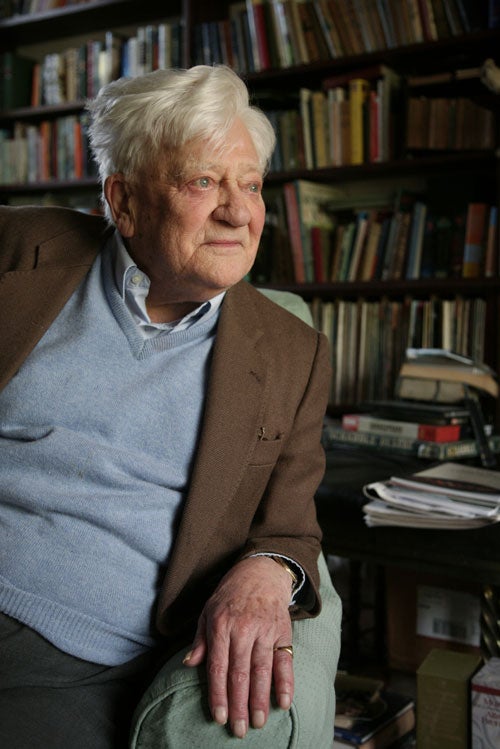
At home in the heart of Hampshire, Richard Adams blows out the candles on a huge chocolate cake. His publisher has decorated it with Maltesers which look for all the world like outsize rabbit droppings. He chuckles at the similarity and raises a piece to his mouth. For a moment the kitchen falls silent, only the cawing of the rooks from the spinney across the lane disturbing the comfortable peace.
He is reminiscing about his idyllic childhood as the youngest son of an Edwardian rural doctor. Memories of events that occurred over eight decades ago bubble to the surface with extraordinary clarity. The first time he walked with his father to the River Kennet and saw the trout rising to the fly – his father pointing out the herons and other wildlife and getting him to name them. "You couldn't just say 'Oh look, there's a bird.' He wanted me always to say what the bird was."
He remembers watching the adults and teaching himself how to behave politely at the dining table. He recalls being able to read and write at the age of six, immersing himself in Beatrix Potter's books while sitting on his mother's knee at bedtime and "living" in Hugh Lofting's Doctor Dolittle. He distinctly remembers identifying with Peter Rabbit – "being" Peter Rabbit as he puts it.
He also remembers acutely feeling sorry for Eeyore when reading Winnie the Pooh. "I couldn't put it into words then of course, but I always felt it unfair that his character didn't change. Eeyore was what was he was and he didn't improve. But in real life he could have improved." Asked if the development of characters was important to him when writing Watership Down, he fixes me with his pale forget-me-not blue eyes and surprisingly firmly says: "You bet."
The concept of self-improvement was an early lesson well learned it seems. He ascribes the development of Hazel and Bigwig from fugitives to co-operatives in his first and most famous novel to two officers he was with in the war when he served as a parachutist with the Royal Army Service Corps. One, a daredevil exhibitionist captain; the other a calm, polite commanding officer who in his quiet way said what was going to be done. The two were a "match for each other", as Adams puts it, helping each other to be better.
It was while loading the car before a long journey in the early 1970s that Watership Down had its beginnings. His two daughters, Juliet and Rosamond, used to him making up stories for them at bedtimes, demanded a new story from him that would last the journey. He recalls Juliet saying: "Now, Daddy, this afternoon you've got to tell us an original story, one that we've never heard before, to last out this trip." He remembers saying: "You've put me on the spot," before starting to improvise the "story about the rabbits" as he calls it, beginning with the timid Fiver having a vision of a field covered with blood.
The tale not only lasted the journey but also subsequent days of school runs between their then home in Islington and the girls' school in Highgate. When it was finished it was again Juliet who said: "You ought to write it down, Daddy. It's too good to waste."
Despite Adams' protestations that to do so would take over a year, Juliet insisted, and during a Lake District holiday he bought a block of foolscap and started on it for a couple of hours each evening. Asked if he enjoyed writing it, his response is quick and pithy. "No, I hated it. To be quite frank, writing is bloody hard work. But I did enjoy that I had the guts to persevere with it."
Much of the story was drafted after a hard day's work in the Civil Service, and Adams cites Humbert Wolfe as a precedent of a civil servant who also wrote successfully. Wolfe's epigram – "You cannot hope to bribe or twist – thank God! – the British journalist. But, seeing what the man will do, unbribed, there's no occasion to" – is as fresh today as at the time of its writing in the 1920s. Adams' Whitehall colleagues were much tickled by his success and fully supportive. Not that it came quickly or easily.
The manuscript was initially rejected by four publishers and three firms of agents who all said that the writing style was "too ordinary for adults" and that it was much too "grown up" to appeal to children. Even after the intervening years, Adams becomes quite animated on this issue. "Well, who's talking about children or adults? This is just a book. Anybody who finds it enjoyable is welcome to read it, whether they're six or 66."
It is a view he still holds when talking about the publishing industry and the concept of children's publishing. It isn't hard to imagine his views on the recent suggestion that books carry age recommendations.
It was over a lunch at the Reform Club, having filled their plates at the "cold collations table", that a publisher, Rex Collings, said: "I like your book and I'd like to publish it." Adams was thrilled. "This really blew my socks off," he says. "I couldn't eat my lunch very well. I felt so excited that my book was going to be published." That Collings was a very small publisher and couldn't afford to pay Adams an advance seems not to have dented the pleasure. "He was a poor man and could only afford a first edition of 2,500 copies." He adds with glee that "they sell for £500 each now".
Originally entitled Hazel and Fiver, it was renamed Watership Down after the view of the Downs from Adams' childhood home. Success soon followed as the book won both the Carnegie Medal and The Guardian Children's Fiction prize and sold over a million copies worldwide in just a few years, allowing Adams to retire early from the Civil Service and concentrate on writing. To date it has sold over 50 million copies and seen Adams serve not only as a writer in residence at the University of Florida and at Hollins University in Virginia but also, in 1982, a term as president of the Royal Society for the Prevention of Cruelty to Animals.
The latter was not the happiest of times. He says: "I didn't like it. They seemed to be more concerned with each other than with the animals. When I joined, the head of the council didn't give a fuck about the animals. She was simply advancing her career. I had a couple of rows with her and walked out."
He is equally passionate when talking about what he considers the favourite of his works, his "best book" as he calls it, Shardik. A darker story about a gigantic and rather tragic bear, he still revels in the fact that his fans "were all waiting for more rabbits you see, well, they didn't get more rabbits". He cites mythologist Joseph Campbell and his work The Hero with a Thousand Faces on worldwide stories and their being "the natural products of the unconscious mind," as a key influence on the writing of Shardik.
He is no less engaging when speaking of more contemporary events.
The MPs' expenses scandal last year exercised him greatly. He says: "I'm very much upset by the recent trouble Parliament has had. It has done a lot of harm to the way ordinary people thinks about MPs, I'm afraid." The recent election outcome doesn't inspire him either. "I don't know that I have much confidence in Mr Cameron. I don't think he's the great leader we're looking for. I don't see any new Winston Churchill emerging."
The storytelling continues unabated. Adams has recently written Leopard Aware for a new short story collection Gentle Footprints, published in support of the Born Free Foundation and with a foreword by Virginia McKenna.
As the chocolate cake is devoured and "Happy Birthday" sung, mention is made of the plentiful rabbits in the local All Hallows churchyard. "They're safe there," he says. "From you?" someone teases. "I don't shoot rabbits," he harrumphs indignantly. Of course he doesn't. Why would he?
Curriculum vitae
1920 Born in Newbury, Berkshire.
1929 Educated at Horris Hill School, Newbury and Bradfield College.
1938 Reads History at Worcester College, Oxford.
1939 Called up to serve in the British Army at the outbreak of the Second World War.
1946 On discharge, returns to Oxford to finish his degree.
1948 Becomes a civil servant in the forerunner to the Department of the Environment, rising to Assistant Secretary in the Ministry of Housing and Local Government. Begins writing in his spare time.
1967 Invents the story of Watership Down for his two daughters, Juliet and Rosamond, during a family outing. It takes him more than two years to finish writing what proved a hugely popular tale.
1972 Watership Down published by Rex Collings after being rejected by seven other publishers. Becomes Adams' best-known work selling more than 50 million copies worldwide. He wins the prestigious Carnegie Medal
1974 His second book, Shardik, is published. He quits his Civil Service job and becomes a full-time author.
1980-82 Becomes RSPCA president.
1996 Returns to his greatest triumph when he publishes Tales from Watership Down.
Join our commenting forum
Join thought-provoking conversations, follow other Independent readers and see their replies
Comments