For the love of God... scientists in uproar at £1m religion prize

Sign up for a full digest of all the best opinions of the week in our Voices Dispatches email
Sign up to our free weekly Voices newsletter
The astronomer Royal has won this year's £1m Templeton Prize, an award denounced by many atheist scientists as an underhand attempt to promote religion by linking it with science.
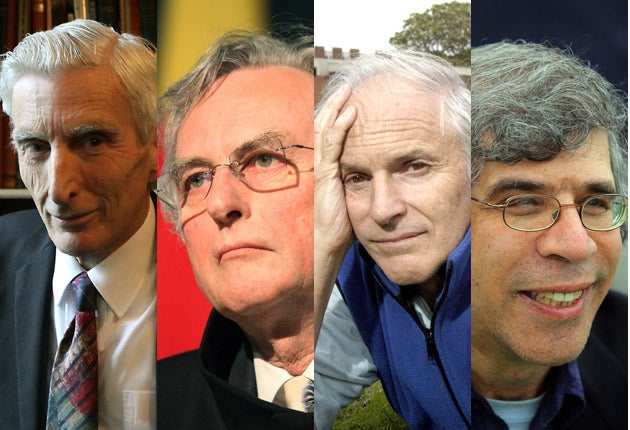
Martin Rees, the former president of the Royal Society and master of Trinity College, Cambridge, was given the award for "exceptional contributions to affirming life's spiritual dimension" through his research and writings on cosmology. Lord Rees of Ludlow, who has said he holds no religious beliefs, defended the prize on the grounds it was awarded by a foundation which has given money to fund important science projects at respectable research institutions, including Cambridge.
"I would see no reason to be concerned because they support a variety of interesting and worthwhile research projects in Cambridge University and many other places," the 68-year-old said. "The fact they have given this award to me, someone who has no religious beliefs at all, shows they are not too narrow in their sympathies. I feel very surprised because I really thought that I didn't have the credentials, but obviously I'm extremely pleased because I'm joining a roll call of distinguished previous winners, including six members of the Royal Society."
The award was established in 1972 as the Templeton Prize "for progress in religion" by the late Wall Street financier John Templeton, who died in 2008, aged 95. Its first recipient was Mother Teresa of Calcutta. The Templeton Foundation is worth about $2.1bn (£1.3bn) and each year hands out about $70m in grants, about half of which goes to scientific fields.
In the 1980s, the Templeton Prize switched its focus more towards science, emphasising the spiritual dimension of research that has a wider significance in terms of explaining the human condition. But this has only infuriated its critics, who believe the prize is a not-too-subtle attempt to inveigle respectable scientists into the sphere of religion.
"That will look great on Templeton's CV. Not so good on Martin's," said Professor Richard Dawkins, of Oxford University, who has been an outspoken critic of the Templeton Foundation.
Harry Kroto, a British Nobel laureate at Florida State University in Tallahassee, was equally scathing: "There's a distinct feeling in the research community that Templeton just gives the award to the most senior scientists they can find who's willing to say something nice about religion."
Jerry Coyne, an evolutionary biologist at the University of Chicago, said the Templeton Foundation is "sneakier than the creationists" by introducing the idea of faith into a discipline where faith is anathema. "Religion is based on dogma and belief, whereas science is based on doubt and questioning. In religion, faith is a virtue. In science, faith is a vice," he said. The philosopher Anthony Grayling, of Birkbeck College, London, also has misgivings about the aims of the Templeton Foundation, which, he believes, should not pretend that questions of religion are on the same level as those of science. "I cannot agree with the Templeton Foundation's project of trying to make religion respectable by conflating it with science; this is like mixing astrology with astronomy or voodoo with medical research," he said.
Nevertheless, distinguished scientists such as the cosmologists Freeman Dyson and Paul Davies have accepted the prize in previous years.
Subscribe to Independent Premium to bookmark this article
Want to bookmark your favourite articles and stories to read or reference later? Start your Independent Premium subscription today.
Join our commenting forum
Join thought-provoking conversations, follow other Independent readers and see their replies