The stars for July

Sign up for a full digest of all the best opinions of the week in our Voices Dispatches email
Sign up to our free weekly Voices newsletter
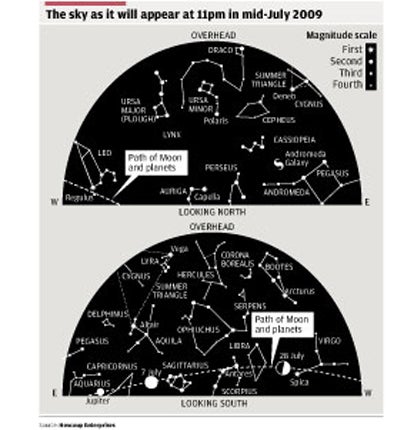
Summer is here, graced with a trio of beautiful bright stars – the "Summer Triangle". Almost overhead you'll find Vega, the fifth-brightest star in the sky. It commands the constellation of Lyra, the lyre – a stringed instrument constructed by the mythical god Hermes.
Some 25 light years away, this beautiful pure white star is nearly twice as hot as the Sun. In 1850, it was the first star to have its photograph taken.
More recently, astronomers have found that Vega is surrounded by a dusty disc of material, which may be a planetary system being born. And Vega will have another claim to fame in about 14,000AD: as a result of our Earth's wobbly motion on its axis, Vega will then be our Pole Star.
Below Vega lies Altair – who presides over the constellation of Aquila. In legend, Aquila was the eagle which transported Jupiter's thunderbolts about the heavens.
Altair's name means "flying eagle". The star is one of the Sun's nearest companions, lying a mere 17 light years away. It spins at a breakneck speed – once every 6.5 hours, as compared to 30 days for our Sun. As a result, it bulges about its equator in a major way. Deneb – in Cygnus, the Swan – is the faintest of the trio, but by far the most important.
The constellation Cygnus features in many constellation legends – notably when Jupiter had a union (disguised as a swan) with Leda, the wife of King Tyndareus of Sparta – which resulted in the birth of the heavenly twins, Castor and Pollux.
Deneb (whose name means "tail of the swan") lies a staggering 3,200 light years away. To appear to be so bright in our skies, it must be truly luminous. We now know that Deneb is over 200,000 times brighter than our Sun – one of the most brilliant stars in our Galaxy.
What's Up
Giant planet Jupiter is lording it over the summer nights. Rising in the south east around 10.30 pm, you can't miss it, shining more brilliantly than any star. Take a peek with binoculars and you'll spot Jupiter's four biggest moons. For those with telescopes, there's an extra treat in store on 10 July as Jupiter passes close to the most distant planet, dim Neptune.
Otherwise, the evening sky is a pretty dull place, with large, dim and unmemorable constellations like Ophiuchus (the serpent-bearer) between the occasional brilliant beacon: Antares and Arcturus in the south west, and the three stars of the Summer Triangle high in the south east.
But you'll find a lot more celestial action if you stay up till the wee small hours. The brilliant "Morning Star" Venus is rising in the east around 2.30am, outshining even Jupiter. At the beginning of July, Venus is canoodling with the much-fainter Mars. But she quickly moves away from the Red Planet, passing under the Seven Sisters (Pleiades) star cluster on 5 July.
And there's a lovely sight in the early morning of 18 July, with Venus on the horizon and the narrow crescent Moon passing in front of the Seven Sisters. Grab binoculars for the best view.
July Diary (all times BST)
4
Earth at most distant point from Sun (aphelion)
7
10.21 am Full Moon
15
10.53 am Moon at Last Quarter
22
3.34 am New Moon; total eclipse of the Sun (not visible from UK)
28
11.00 pm Moon at First Quarter
Subscribe to Independent Premium to bookmark this article
Want to bookmark your favourite articles and stories to read or reference later? Start your Independent Premium subscription today.
Join our commenting forum
Join thought-provoking conversations, follow other Independent readers and see their replies