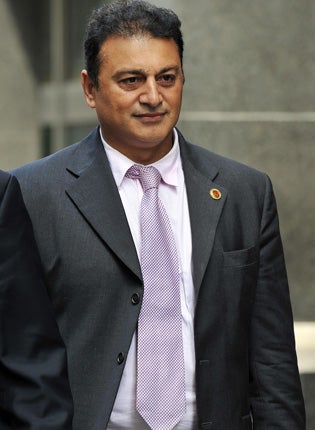
Champagne celebrations at Scotland Yard as 'universally hated' Dizaei is exposed

For free real time breaking news alerts sent straight to your inbox sign up to our breaking news emails
Sign up to our free breaking news emails
The Statement from the Metropolitan Police Commissioner, Sir Paul Stephenson, was suitably sober and contrite.
"Commander Ali Dizaei has been a police officer for nearly 25 years," he wrote. "It is extremely disappointing and concerning that this very senior officer has been found guilty of abusing his position and power."
But behind the scenes at Scotland Yard and the Independent Police Complaints Authority last night the mood was not one of despondency at the shaming of the police's most senior Asian officer. Rather it was one of jubilation: A man they believed was corrupt for more than 10 years had finally been exposed. "The champagne corks are popping," said one source close to the case.
While investigations into colleagues are not generally welcomed by fellow officers, there is no sympathy within the Met for Dizaei. As one officer said: "Ali Dizaei is universally hated. He is not trusted and he is not a nice person. There will be no tears shed for him."
Dizaei's time at Scotland Yard was possibly the most controversy-ridden tenure by a senior police officer in recent times. In his 11-year career in the force, Dizaei was suspended for four of them, faced two criminal prosecutions and was the subject of a host of allegations including using prostitutes, acting as an Iranian spy and misusing his police credit card.
Born in Tehran in 1962, Dizaei was brought up in a family steeped in policing with a father who headed the country's traffic police and a grandfather who was an assistant commissioner. He claimed that police work was his destiny and joined Thames Valley Police in 1986. He was soon marked out as a rising star and was tipped by some to become the country's first Asian chief constable.
He transferred to the Metropolitan Police as a superintendent in March 1999, when the force was badly in need of high-calibre ethnic minority officers. But just a few months later, his problems began. In June senior officers were told of claims that Dizaei was associating with a drugs dealer and had intervened to quash a speeding fine. He was also alleged to have supported the passport application of a man linked to drugs.
An investigation, codenamed Operation Helios, began. It became the biggest investigation ever into a serving police officer. Dizaei was trailed, bugged and filmed, investigated for being a drug-taker, a threat to national security and a friend of traffickers and money launderers. All of Dizaei's phone conversations were intercepted. Undercover officers posed as bodybuilders at his gym and were told to befriend him. His line manager kept a diary of his movements. In all, at least 135 officers were utilised in the investigation into Dizaei. As well as detectives from the Met, other agencies involved in Operation Helios included Special Branch, Beverly Hills Police and even the Canadian Mounties.
But the marathon inquiry ended in ignominy for the Metropolitan Police. When Dizaei was eventually brought to court it was on charges of lying during a police investigation into his car being vandalised. Dizaei claimed that the charges were racially motivated, and when the extent of the police investigation into him was revealed in court he was cleared.
Faced with a public relations disaster the Met reinstated Dizaei, allowed him to write a highly critical book about the failed investigation and placed him on a fast-track promotion scheme. In March 2008 he was promoted to the rank of commander – but his career would be over just six months later.
In June he was accused of misusing his American Express corporate card. It was alleged he spent more than £5,000 on clothes and perfume while on a trip to the US – something he was cleared of late last year.
Then in September 2008 he was embroiled in a second scandal when a newspaper claimed that he had given advice to Shahrokh Mireskandari, a lawyer who was defending a woman charged with causing death by dangerous driving, on how to pick holes in the prosecution case. These allegations are currently being investigated by the Metropolitan Police Authority.
In the same month Dizaei was suspended by the Met for the second and final time. His suspension this time related to the allegations which yesterday saw him jailed.
Even then Dizaei filed another claim of discrimination against the Met. During the trial Dizaei yet again claimed he was the victim of a racist witch-hunt. But, rather than downtrodden victim, the image that was presented in court of Dizaei was that of a domineering bully.
The chief prosecution witness, and victim, in the case, Waad al-Baghdadi, said that Dizaei had first challenged him to a fight and then told him he would "fuck his life" when he falsely arrested him outside a west London restaurant.
The officer added: "You think I do not know what you do in London? I will find every single detail about your life. I will show you what I can do."
He then put on his police cap and falesly arrested al-Baghdadi.
Having been through so much and defeated the Met before, perhaps Dizaei thought he was, in the words of police sources, "untouchable". But, if so, then he was mistaken. In the end it took the jury just two hours to find him guilty of all charges.
Subscribe to Independent Premium to bookmark this article
Want to bookmark your favourite articles and stories to read or reference later? Start your Independent Premium subscription today.