Police used 'unsuitable force' on mentally ill man Sean Rigg who died in custody, jury finds
Family of Sean Rigg accuse Met officers of giving 'misleading' evidence at inquest and reject watchdog's findings

For free real time breaking news alerts sent straight to your inbox sign up to our breaking news emails
Sign up to our free breaking news emails
A mentally ill man died in police custody after officers used "unsuitable" force during an "unnecessarily" long restraint, an inquest jury has ruled.
In a damning verdict, jurors found that unacceptable and inappropriate actions by Metropolitan Police officers contributed to the death of Sean Rigg, 40, in August 2008. The jurors rejected much of the evidence given to the inquest by the constables involved.
Last night, Mr Rigg's family called for criminal charges against the police, who they accused of "at best misleading the jury or at worst lying under oath".They also condemned the Independent Police Complaints Commission over its "inadequate and obstructive" initial investigation that found no evidence of wrongdoing.
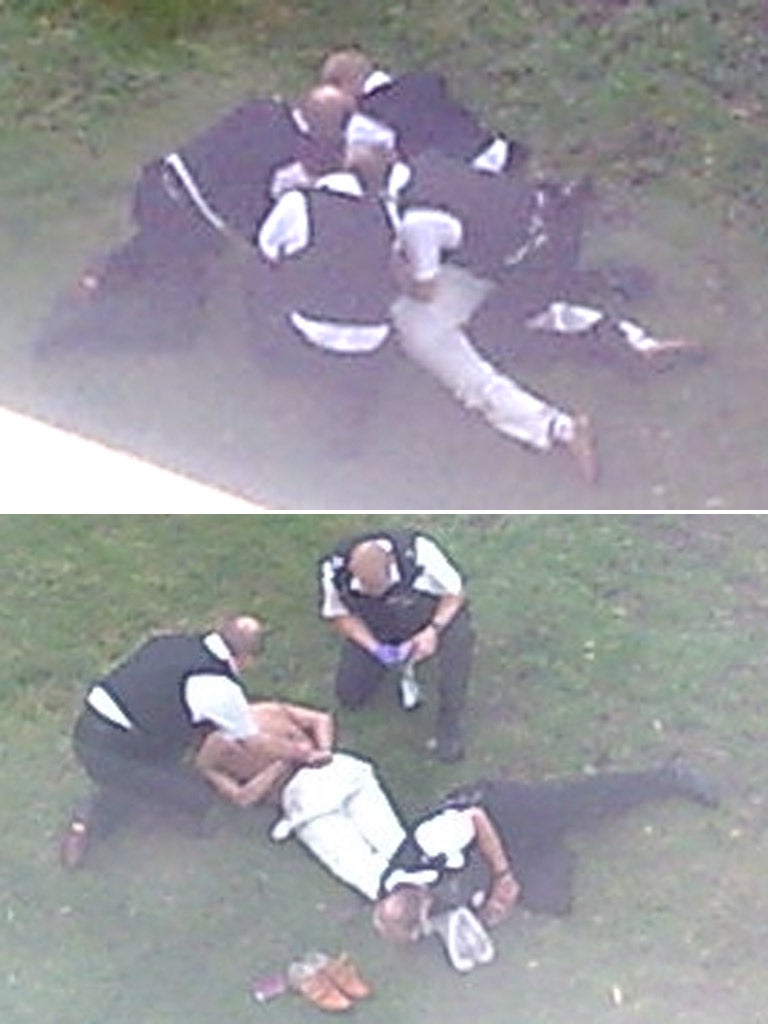
Mr Rigg, a musician and producer, was restrained and arrested after attacking members of the public with karate-style moves on the Weir estate in Balham, south London. He was put in a police van and taken to nearby Brixton police station, where he died later of a cardiac arrest.
Southwark Coroner's Court heard that Mr Rigg had been suffering from a mental breakdown after not taking his medication. The jury returned a narrative verdict, finding that the arresting officers used "unsuitable" force when putting him in the prone position with his face to the ground for eight minutes. Reading out the verdict yesterday, the coroner, Dr Andrew Harris, said: "The level of force used on Sean Rigg whilst he was restrained in the prone position at the Weir estate was unsuitable. The length of restraint in the prone position was therefore unnecessary. The majority view of the jury is that this more than minimally contributed to Sean's death."
Mr Rigg was living at a hostel in Brixton the time of his breakdown. South London and Maudsley NHS Foundation Trust was found to have failed to carry out appropriate mental health assessments, which also contributed to his death. Partial positional asphyxia, as a result of restraint using "unnecessary body weight", was given as one cause of death. The jury also criticised the arresting officers – PCs Matthew Forward, Richard Glasson, Mark Harratt and Andrew Birks .
Mr Rigg's death was the latest in a long line of deaths in police custody of black men and mentally-ill people, and his case highlights the obstacles families face in establishing the truth. Since 1990, 1,433 people have died in custody or following contact with police in England and Wales; there have been no successful criminal prosecutions.
Mr Rigg's relatives criticised the coroner's decision not to allow the jury to consider verdicts of unlawful killing or neglect. The family, who are considering a legal challenge, said: "We call for an urgent public inquiry to establish why the system in this country consistently fails to deliver justice to the many families whose loved ones have died in police custody."
They also called for "fundamental reform" of the IPCC. After an 18-month investigation, the watchdog found that none of the officers involved had a case to answer – in stark contrast to the jury, which had access to much of the same evidence. In February 2010, the IPCC concluded that officers had correctly followed procedures and policies. Yet the jury rejected the evidence given by numerous officers that Mr Rigg was walking independently and breathing normally until he collapsed suddenly in a caged area at the police station.
Jurors concluded that his physical condition deteriorated when he was restrained because his brain was deprived of oxygen. It then worsened on the van journey to the police station, so he was "extremely unwell and not fully conscious" by the time he was "carried" into the cage. The officers' failure to provide him with appropriate care at every stage, and the lack of urgency in their response, more than minimally contributed to his death, the jurors said.
They were shown CCTV footage of Mr Rigg being "stood up" by officers when he was unconscious in the cage, which jurors described as "unacceptable and inappropriate". Leaving him handcuffed when he was unconscious and his heart not beating was "unnecessary and inappropriate", they added. They also said that the failure of officers to recognise and assess Mr Rigg's physical and mental state at any point after his arrest was "inadequate".
The IPCC's conclusions apppeared to be undermined by photographs, 999 calls and CCTV footage presented to the jury, and by inconsistent evidence given by the officers in court.
Mr Rigg, who had a 20-year history of relapsing psychoses and had been sectioned many times, was well known to Brixton police, the inquest was told. Officers failed to communicate and relay important information about his mental health that night.
Around half of all deaths during or following police contact involve a person with mental health problems.
Deborah Coles from Inquest said: "“The individual and institutional neglect uncovered by this inquest should prompt the Home Office and Department of Health to urgently review how the police and mental health providers work together to respond to people in crisis and in conflict with the law... It is frightening that the callous indifference shown by the police to a vulnerable, mentally ill black man may still be replicated today.”
The “unacceptable failure” by 999 call handlers to act appropriately in response to five requests for emergency help by the hostel where Rigg lived was also “unacceptable and inappropriate”.
The damning narrative verdict was delivered by an 11 person jury after hearing evidence from over 60 witnesses over seven weeks, who were applauded at the packed Southwark Coroner’s Court for their diligence and intelligent questioning.
Coroner Dr Andrew Harris said: “If I had a right to choose this jury I would always choose this one.” Two jurors cancelled holidays as the inquest overran rather than drop-out.
Last night, South London and Maudsley NHS Trust apologised to Mr Rigg's family for his inadequate standard of care.
To see the inquisition document for Mr Rigg CLICK HERE
Rigg family statement in full
“Sean was a wonderful, talented and caring brother and son. For years he had lived with schizophrenia. He was under the care of the South London and Maudsley NHS Trust, and known by Brixton police to have mental health issues.
“We have sat through a long and painful seven weeks reliving the final days and hours of Sean’s precious life. This pain has been compounded by officers at best misleading the jury and at worst lying under oath. The evidence we have heard has left us in no doubt that Sean died as a result of the wilful neglect of those who were meant to care for him and keep him safe. If the South London and Maudsley Trust had done their job properly and provided the care and help that Sean urgently needed, he would be alive today. If the police had not ignored repeated 999 calls from the hostel, and taken Sean to the hospital as they should have done, he would be alive today.
“It was perfectly apparent to ordinary members of the public that Sean was having some kind of mental crisis on the 21st August 2008, when the police were called for help. When the police did eventually arrive they restrained him, arrested him for theft of his own passport, put him in the back of a police van, drove him with sirens, not to the hospital for urgent medical care, but to Brixton police station, left him in a perspex cage in the van and finally brought him to the caged area at the back of the station where he died on a concrete floor, surrounded by police officers.
“Sean was a fit and healthy man who died less than an hour after being picked up by the police. Nothing will bring him back but we want to know that justice will be done. We want to know that those responsible will be held to account for Sean’s death.
“We feel utterly let down by the Independent Police Complaints Commission investigation into Sean’s death which was inadequate and obstructive from the start. Until it is fundamentally reformed, the IPCC will remain incapable of exposing the truth when people die in police hands.
“We call for the Crown Prosecution Service to look at the damning evidence that has come to light in this case and demand a prosecution of those responsible for Sean’s death.
“We call for an urgent public inquiry to establish why the system in this country consistently fails to deliver justice to the many families whose loved ones have died in police custody. We want to know why, last year, over half the people who died following contact with the police had mental health issues and why, like Sean, over half died in circumstances involving restraint. We want to know why there was also such a sharp rise in the number of black men who died following police contact. We want to know why our system allows officers to continue in their jobs when someone has died in their care and why not one successful prosecution has taken place in this country since 1986.
“Until we have justice there will be no peace for us or the many other families we stand with.
“We would like to thank all of those who have helped and supported us in our long and hard fight for the truth.
“We will continue to fight for justice for Sean.”
Police: Controversial deaths
Colin Roach, 21, died from a gunshot wound outside Stoke Newington police station in London in 1983. The inquest recorded a verdict of suicide following controversial directions from the coroner. The police were accused of a cover-up.
Ricky Bishop, 25, was arrested in 2001 and taken to Brixton police station in London. Hours later, his mother was told he was in hospital. He had unexplained injuries to his mouth, wrists and legs. Noting he died after swallowing crack cocaine, an inquest recorded a verdict of misadventure, but suspicions remained about missing police evidence.
Roger Sylvester, 30, a mentally ill black man, died in 1999 after being restrained by officers outside his home in Tottenham in London and then on a hospital ward, where he fell into a coma. A jury recorded a verdict of unlawful killing in 2003 but the High Court overturned this after the police appealed.
Subscribe to Independent Premium to bookmark this article
Want to bookmark your favourite articles and stories to read or reference later? Start your Independent Premium subscription today.