Teachers and families enlisted to war on drugs

Get the free Morning Headlines email for news from our reporters across the world
Sign up to our free Morning Headlines email
Primary school teachers, grandparents and employees at benefits offices are being put in the forefront of the battle against drugs. The Government has unveiled a 10-year strategy to reduce the use of class-A substances, which is among the highest in western Europe.
Warning that drug habits often passed down between the generations within families, ministers said they would take earlier action to stop children from becoming addicts in later life.
Primary school pupils will be alerted to the dangers of prescription medicines in the home from the ages of four or five, followed at an older age by warnings over illegal drugs.
Secondary schools will be urged to identify pupils at risk of drug abuse and Ofsted instructed to assess schools for the quality of their anti-drugs education.
Following estimates that 300,000 children have drug-using parents, social workers will be asked to intervene earlier with families where children could face harm because their mothers or fathers are heavy drug users. Parents will be given priority in rehabilitation courses.
Rules on guardianship will be overhauled to make it easier for grandparents to bring up the offspring of their own drug-addicted children, a move expected to cut the numbers of youngsters taken into care. They could also receive special payments to help meet the extra cost of looking after the youngsters. Kevin Brennan, the minister with responsibility for young people, said: "It is a sad fact of substance misuse that grandparents often step in to pick up the pieces."
The Government also confirmed plans to cut benefits for addicts who refuse to complete rehabilitation courses tackling their habit. Vernon Coaker, the Home Office minister with responsibility for crime reduction, said it was no longer acceptable for the state to "continue forking out" to fund drug users' habits.
The 10-year strategy promised to increase help for women and ethnic minorities with drug habits and to improve rehabilitation courses for prisoners addicted to class-A substances. Courts will be encouraged to impose more community sentences with a requirement for offenders to tackle their habit.
The Home Office also plans to change the law so police can confiscate assets from suspected dealers at the moment of arrest. In a move designed to show that crime does not pay, valuables, such as plasma TVs, jewellery and cars, would be seized to deny criminals the opportunity to conceal or sell them before their trial.
In the Commons yesterday, Gordon Brown acknowledged Britain still faced a "major problem" with drug abuse. He said responding to the levels of addiction required "proper education in primary [and] secondary schools", as well as "proper systems for treating those people who are drug dependent".
David Davis, the shadow Home Secretary, said the strategy was an admission of the Government's inability to stem drug abuse. He said: "Far from a coherent strategy, it scrambles together a range of gimmicks."
Chris Huhne, the Liberal Democrat home affairs spokesman, said: "The Government has already been through one 10-year drugs strategy and a failed drugs tsar. But drug addiction is still the most significant contributor to crimes against property, with 35 per cent of those arrested testing positive for opiates."
Martin Barnes, head of the charity DrugScope, said: "We welcome the commitment to improve access to employment and training for problem drug users. But it would be nonsensical to remove benefits if the aim is to break the link between drugs and crime."
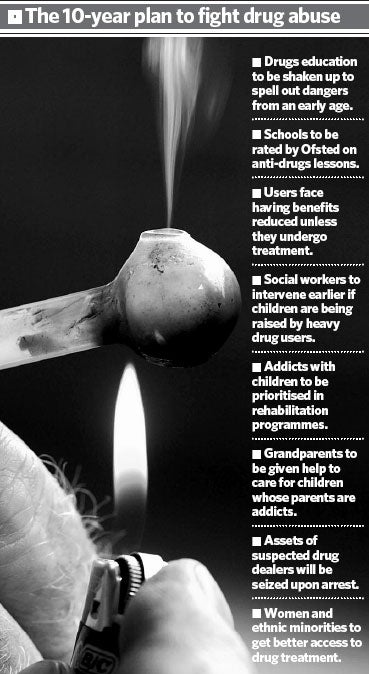
The 10-year plan to fight drug abuse
* Drugs education to be shaken up to spell out dangers from an early age.
* Schools to be rated by Ofsted on anti-drugs lessons.
* Users face having benefits reduced unless they undergo treatment.
* Social workers to intervene earlier if children are being raised by heavy drug users.
* Addicts with children to be prioritised in rehabilitation programmes.
* Grandparents to be given help to care for children whose parents are addicts.
* Assets of suspected drug dealers will be seized upon arrest.
* Women and ethnic minorities to get better access to drug treatment.
Subscribe to Independent Premium to bookmark this article
Want to bookmark your favourite articles and stories to read or reference later? Start your Independent Premium subscription today.
Join our commenting forum
Join thought-provoking conversations, follow other Independent readers and see their replies