Prescott reveals Iraq invasion 'doubts'
Sign up for the View from Westminster email for expert analysis straight to your inbox
Get our free View from Westminster email
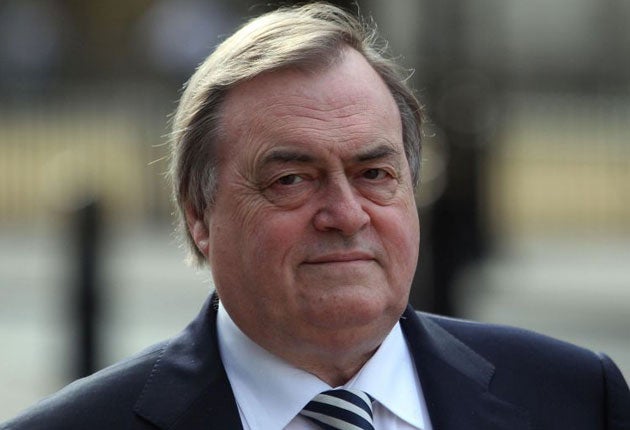
Former deputy prime minister John Prescott privately harboured doubts about the intelligence used to justify the invasion of Iraq in 2003, he disclosed today.
Giving evidence to the final session of the Iraq Inquiry before the summer, he said that many of the reports about Saddam Hussein's supposed weapons of mass destruction (WMD) appeared to be just "tittle tattle".
Lord Prescott also spoke of the intense pressure on the former attorney general Lord Goldsmith, saying that he was "not a very happy bunny" as he agonised over whether military action was legal.
And he revealed that he had complained to the cabinet secretary about Tony Blair's informal style of "sofa government", and that he had regarded the lack of formal cabinet discussion as "dangerous".
Lord Prescott told the inquiry he had been surprised at how insubstantial some of the reports on Iraqi WMD by the Joint Intelligence Committee - the UK's senior intelligence body - had been.
"I kept thinking to myself 'Is this intelligence?' It's basically what you have heard somewhere and what somebody else has told somebody. Presumably that's how intelligence is brought about. So I got the feeling it wasn't very substantial," he said.
"The conclusions were a little ahead, I think, of what the evidence we had. Perhaps that's the way it is. I just thought: 'Well this is the intelligence document, this is what you have. It seems robust but not enough to justify to that'.
"Certainly what they do in intelligence is a bit of tittle tattle here and a bit more information there.
"I didn't totally dismiss it, I didn't have any evidence to feel that they were wrong, but I just felt a little bit nervous about conclusions on Iraq's force that seemed to be (based on) limited intelligence."
Lord Prescott said Lord Goldsmith had found the process of coming to a decision on whether it was legal to invade Iraq without specific authorisation from the United Nations Security Council a difficult one.
"He was not a very happy bunny," he said.
"His demeanour was that he had a lot of weight on his shoulders having to give a decision. Everybody is coming up to him and saying 'hey Peter, is it legal?"'
He said Lord Goldsmith's concern may have reflected doubts that he could have defended his final advice that military action was lawful in court.
"Perhaps he wasn't happy that he could win that case in court. We couldn't wait until a court to find out. We had to make a decision," he said.
He admitted that ministers had been wrong to blame French president Jacques Chirac for the breakdown of negotiations in the Security Council to agree a resolution which would have authorised the use of force.
"I think the poor old French got blamed for a lot of it," he said.
"The French easily come to mind in the Brits' mind when we want to blame people. There is a lot of history for that."
Lord Prescott acknowledged that he had played a central role in the Government, meeting Mr Blair privately two or three times a week to discuss issues like Iraq.
"I was on the sofa all the time," he joked.
Nevertheless he said that in the early days of the Labour Government he had complained to the cabinet secretary Sir Robin (now Lord) Butler about the informal way business was done, only to be told that was how Mr Blair wanted it.
"I began to feel that 'sofa government' where key ministers came to an agreement with the prime minister and then sorted it out at cabinet knowing they had the prime minister on side was not a proper way to get into full discussion," he said.
"I thought that was a very dangerous process."
Despite his regular meetings with Mr Blair, he said that the former prime minister had never told him whether he had given George Bush an assurance that Britain would join the Americans if they did invade.
"He never did tell me if he had come to any agreement," he said.
He dismissed claims by those such as the former British ambassador Sir Christopher Meyer - "I call him 'red socks', I can't think of his name" - who suggested there was a secret deal between the two men.
He described how Mr Blair invited him to sit in on one of his video conferences with the US president.
"He did say to me 'Don't be worried about his language'. I don't think he meant the swearing but the style and aggression that would be involved. I must say listening to it I now know what he means," he said.
Lord Prescott ended his evidence with an impassioned defence of Mr Blair's "true leadership", brushing aside the "fashionable" criticism that had been made of the former premier during the inquiry.
"We have seen a few people gloss over their part in the history of what happened," he said.
Inquiry chairman Sir John Chilcot said they had yet to decide whether to hold a final round of hearings in the autumn when witnesses who have already given evidence could be recalled.
He said the inquiry team hoped to visit Iraq "to see for ourselves the consequences of UK involvement" before publishing its final report around the turn of the year.
Subscribe to Independent Premium to bookmark this article
Want to bookmark your favourite articles and stories to read or reference later? Start your Independent Premium subscription today.
Join our commenting forum
Join thought-provoking conversations, follow other Independent readers and see their replies