Revealed: the story of the spy who led the French Resistance

For free real time breaking news alerts sent straight to your inbox sign up to our breaking news emails
Sign up to our free breaking news emails
Pearl Cornioley's training officer in Britain's wartime Special Operations Executive (SOE) had plenty of doubts about her potential as a secret agent. In 1943, he wrote: "She is so cautious that she seems to lack initiative and drive. She is loyal but has not the personality to act as a leader, nor is she temperamentally suited to work alone."
The officer could not have been more wrong about a woman who would later become known as Agent Wrestler. Within 18 months, Ms Cornioley, then aged 29, was in sole command of 1,500 resistance fighters in western France. In that role she masterminded a campaign of sabotage and guerrilla warfare so effective that the German military put a price on her head of Fr1m (equivalent to £500,000 today).
The full story of Agent Wrestler has been revealed in government documents released at the National Archives in Kew, west London. They detail her transformation from the daughter of an alcoholic who did not go to school until she was 13 into one of Britain's most formidable operatives behind enemy lines at the height of the Second World War. After her discharge, she rejected the award of a civilian MBE in disgust, describing it as "puny" and pointing out her male colleagues in SOE had been given military honours.
Ms Cornioley, who was born in Paris before escaping to Britain with her mother and sisters in 1941, became bored of her wartime desk job and persuaded commanders at the SOE to train her and send her back to France.
After parachuting into the Loire region in September 1943, she worked as a courier for one of the British-backed networks of "maquis" (resistance fighters), while posing as a cosmetics saleswoman, before assuming command of fighters in the Indre region when a senior SOE officer was arrested by the Gestapo.
By the end of her service following the liberation of France in 1944, Major General Colin Gubbins, who led SOE, wrote: "Her control over the maquis group to which she was attached, complicated by political disagreements among the French, was accomplished through her remarkable personality, her courage, steadfastness and tact."
Despite the lukewarm opinion of her SOE training officer, Ms Cornioley had nonetheless shown some early signs of her subsequent success. Described as "very intelligent and absolutely reliable", she was the best shot in her group.
Her arrival in France was also not a glowing success. After two abortive attempts to parachute near the town of Chateauroux, she missed her landing point and lost the suitcases carrying her equipment. After Ms Cornioley was reassigned to train and lead the maquis groups in the Sologne area of the Loire Valley, her "resistants" blew up the Tours-Vierzon railway line, destroyed 60 armoured trains, and ambushed German troops.
The documents also detail how Ms Cornioley was fighting beside a young French lieutenant, Henri Cornioley. They married in October 1944, receiving an £8 postal order from the SOE as a wedding present.
One of her SOE commanders later remarked: "Her story is a true romance and our pride and esteem for this gallant girl is very great."
Sadly they were not sentiments entirely shared elsewhere in the military hierarchy. Despite being recommended by the SOE for a Military Cross, it was decided that Ms Cornioley should be offered a civilian MBE. In a letter to the War Office, she rejected the honour, saying: "The work which I undertook was of a purely military nature in enemy occupied country. When the time for open warfare came we planned and executed open attacks on the enemy. I spent a year in the field and had I been caught I would have been shot, or worse still, sent to a concentration camp. I consider it most unjust to be given a civilian decoration. The men received military decorations. Why this discrimination with women when they put the best of themselves into the accomplishment of their duties?"
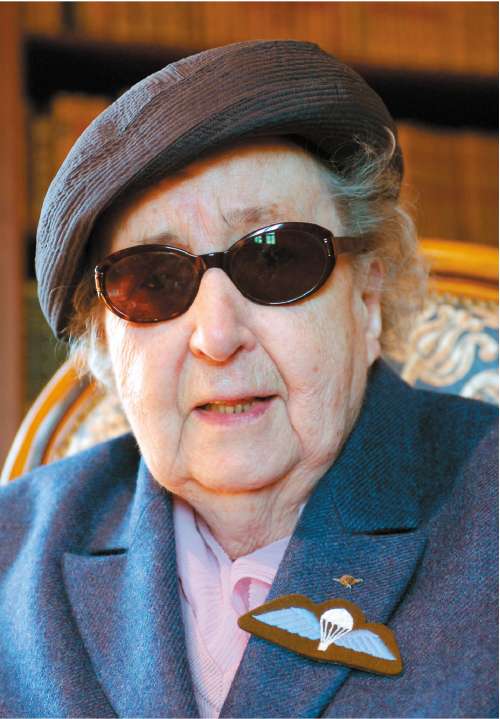
Ms Cornioley was belatedly awarded her parachute "wings" – a badge signifying her status as a military parachutist – at a ceremony in 2006. She died in February this year, aged 93, at her home in the Loire Valley.
Subscribe to Independent Premium to bookmark this article
Want to bookmark your favourite articles and stories to read or reference later? Start your Independent Premium subscription today.
Join our commenting forum
Join thought-provoking conversations, follow other Independent readers and see their replies