Bullet in the post is price of power for an enemy of Mugabe
Threats will not stop the MDC's march to power, Zimbabwe's Finance Minister tells Alex Duval Smith in Harare

For free real time breaking news alerts sent straight to your inbox sign up to our breaking news emails
Sign up to our free breaking news emails
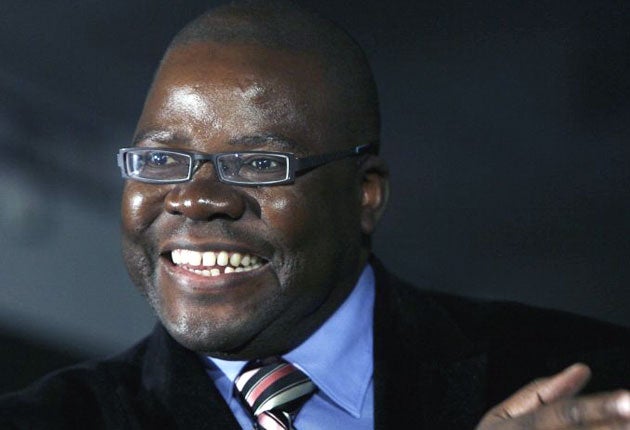
Attempts by President Robert Mugabe's old guard to derail Zimbabwe's democratic progress are mere "sulks from a dying breed", according to the Finance Minister, Tendai Biti.
Mr Biti, who is also the secretary-general of the former opposition, the Movement for Democratic Change (MDC), last week became the most high-profile target of intimidation when he received a 9mm bullet and a death note at his home. In what the MDC describes as a strategy to wipe out its parliamentary majority, 12 of its MPs are facing a range of court cases and one has already been jailed.
Dapperly dressed in a pale grey jacket, matching v-neck and trilby, Mr Biti receives guests in a spartan ante-room to his 6th floor Finance Ministry office in Harare. "There is no doubt that these are engineered prosecutions intended to whittle down our parliamentary majority. The efficiency and speed, the exuberance and energy with which they are being done is not normal," said the former lawyer.
In the violence-marred elections of March 2008, Morgan Tsvangirai's MDC won 100 seats against 99 for President Mugabe's Zimbabwe African National Union – Patriotic Front (Zanu-PF). Ten seats went to the breakaway MDC of Arthur Mutambara and one to an independent candidate. Mr Tsvangirai pulled out of a presidential run-off, leading to months of negotiations and the creation of a unity government. Mr Tsvangirai was sworn in as Prime Minister in February this year.
The unity government remains hidebound and the transition is not running to timetable. Yet Mr Biti insists that he believes in it. "As long as what I am doing is helping Zimbabweans in their pursuit of happiness, I will not allow us to be defeated. Those standing in the way of progress are a dying breed. This is the winter of the long sulks. From time to time, they will try to blow up a landmine. It's irritating but it's not going to work."
Inner-city Harare has an austere feel. In formerly upmarket blocks of flats where residents once used washing machines, women do laundry in basins out of doors. Rosebeds have become kitchen gardens. The finance ministry has intermittent electricity with one working lift (out of six) but Mr Biti's staff, like him, work late nights.
In the past six months he has begun rehabilitating the economy – chiefly by abolishing the Zimbabwe dollar which was being run off the printing presses at a rate rivalled only by the hyper-inflation that it created.
Now civil servants and crucially, the police and army, are paid in US dollars, and have been given a pay rise. "From February until the end of June, everyone was on $100 a month. Now there are grades. The bulk of our teachers are earning $165, minus tax, which makes $155. MPs receive $180 per month after tax and the Prime Minister and President are on $300."
He goes out of his way to point out that everyone earning money on the state payroll is paying tax.
Mr Biti's successes have come as a result of moves that sidestep the authority of the former printer-in-chief, the Central Bank governor, Gideon Gono. But Mr Gono remains in his job, as does the attorney-general, Johannes Tomana. A conference held last month to gather views on a new constitution was halted by chanting and whistling Zanu-PF activists.
In rural areas, there are still reports of MDC supporters being assaulted and Zanu-PF allegedly continues to attempt to control food distribution. Senator Roy Bennett, Mr Tsvangirai's chosen deputy Agriculture Minister, who is facing terrorism charges, is still waiting to be sworn in.
The MDC's strategy focuses on ushering in a new constitution as soon as possible, ahead of elections that it believes it will win. But the constitution will not be enough. "We need to make rural areas independent of the state so they cannot be prone to patronage. We are going to spend $146m (£87m) on seed packs and fertiliser so that rural people can produce up to 2.5 million tons of grain in the coming season.
"The next step, through a land audit, will be tenure rights so that people are working on land they own," Mr Biti said. "White and black Zimbabweans must have equal rights to own land. There will be a need to compensate white farmers but we cannot afford to pay. We need the World Bank to come on board so that no one can keep saying 'The British, the British'. That way we can close the chapter of politicisation of land and graduate to it being an economic issue."
Mr Biti understands the reticence of Western governments to re-engage with the former British colony: "We are sending out mixed signals but I believe European taxpayers will soon be able to look at us and say to their governments 'There's an opportunity for democracy in that country. It's a bankable prospect'. My job is to liquidate the toxic issues and craft a programme that makes the governments want to come on board.
"If by the end of this government we have a new constitution, economic stability, free media and a number of signature infrastructure projects, then I think we will have done very well."
For now, however, it remains all too apparent that Zimbabwe has two centres of power. When it comes to electricity, it is available for some things but not others. Mr Biti uses his ante-chamber for interviews because he fears his office is bugged. If there is high-tech wiring in his office, there is none in the rest of the finance ministry. "I really must get a generator," he says.
Subscribe to Independent Premium to bookmark this article
Want to bookmark your favourite articles and stories to read or reference later? Start your Independent Premium subscription today.
Join our commenting forum
Join thought-provoking conversations, follow other Independent readers and see their replies