Coup leader cements authority as Guineans hail their 'Obama junior'
Former ministers hand themselves in as junta puts back the date of elections

For free real time breaking news alerts sent straight to your inbox sign up to our breaking news emails
Sign up to our free breaking news emails
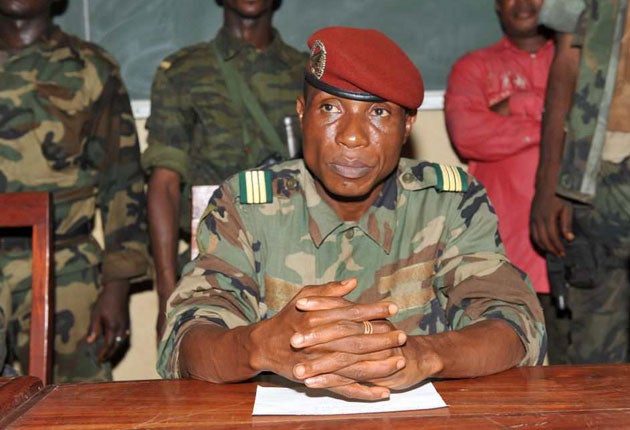
Crowds in the impoverished west African country of Guinea have hailed a young army officer, Moussa Dadis Camara, as President, as coup leaders appear to be unopposed four days after the death of the long-time dictator Lansana Conte.
The junta's growing authority was underlined yesterday as leading members from the dead leader's regime appeared to have stepped down and surrendered at an army barracks.
Mr Camara, the young army captain who first announced the military takeover just hours after Mr Conte's death was made public, has appointed himself the de facto president. Early yesterday he warned the Prime Minister and other ministers to surrender or be hunted down. "If tomorrow arrives without them presenting themselves, we will organise a search across the entire country," Captain Camara said in a radio broadcast.
National radio later carried live coverage of the Prime Minister, Ahmed Tidiane Souare, who had not been seen in public since the coup was declared on Tuesday, handing himself in. "We are at your disposal," the Prime Minister was heard to say.
Early indications were that other leading figures from the Conte government had reported to an army base run by the junta. "Everyone [in government] has gone there," a police source told Reuters.
The junta has already pushed back promised elections and a handover to civilian rule. Initial promises to stage a ballot within 60 days have been delayed. Now the time frame is "within two years".
The coup has been almost universally condemned with the EU, the UN, US and the African Union joining civic leaders inside Guinea in rejecting the takeover. A delegation from the regional west African bloc Ecowas was due to arrive in the country last night.
The leader of parliament, Aboubacar Sompare, who should be in charge under the terms of the constitution, has called on international governments to prevent the coup from succeeding. However, there have been signs in the capital, Conakry, that the junta has significant public support.
On Wednesday Captain Camara, who was a complete unknown, was acclaimed by crowds of Guineans when he toured Conakry with some hailing him as "Obama junior".
"Sompare is a continuation of Lansana Conte," said Cozy Haba, 49. "I recognise that what we are doing instead is jumping into the unknown. But to me that's better than Sompare – who unfortunately I know too well."
Despite having more than half of the world's bauxite deposits as well as vast iron ore reserves and rich agricultural land, most people in the former French colony live on less than a dollar a day. President Conte had been facing increasing unrest and his presidential guard last year opened fire on protest marchers, killing 150 people. The Guinea dictator was one of only two rulers since independence. A notorious chain smoker, and a diabetic, he had well-known health problems for years. Believed to be 74, although there has never been official confirmation of his age, Mr Conte had taken over the country in a bloodless coup following the death through illness of Ahmed Seko Toure.
Both men's governments had been characterised by paranoia, corruption and sliding living standards. The country was a food exporter at independence in 1959 but its 10 million people are now among the poorest in the world. In common with Africa's other remaining "big men" such as Zimbabwe's Robert Mugabe, Mr Conte staged several heavily rigged elections in order to cement his authority.
The former French army officer was due to be buried today in his home village. In a display of its apparent authority Captain Camara said the 32-man junta, which calls itself the National Council for Democracy and Development, would lay on a "grandiose" funeral for the late president. Mr Conte died on Monday night, but there has been no funeral despite Muslim custom calling for burial of the dead within 24 hours.
The dictator's death and the subsequent upheaval has put another question mark over a multibillion-dollar investment by one of the world's biggest mining companies. Rio Tinto had been planning to spend $6bn (£4bn) on the Simandou iron ore project, but postponed work earlier this month as part of a cost-cutting scheme.
The investment was thought to be under threat from the arbitrary way in which the previous government did business. The Conte regime made a habit of unilaterally reordering concessions and awarding stakes in lucrative mining projects to rival consortiums.
Fight for power: The captain behind the coup
*Like so many African coup leaders before him, Moussa Dadis Camara has begun by insisting he does not want the top job in the long term. He has given himself two years before fresh elections will be held and Captain Camara said yesterday that he would not be standing himself in that poll. "I have never had the ambition of power," he told Radio France International. "I do not have the ambition of being a candidate at the presidential elections."
The young army officer's only known qualification for the job he has given himself is a series of well-spoken radio and television appearances. He has railed against the corruption of the former regime, saying it "did not deserve the confidence of the nation".
"I want to warn anyone that thinks they can try to corrupt me or my agents. Money is of no interest to us," Captain Camara said. "I will personally go after anyone that tries to corrupt us."
However, the region has an unhappy history of junior army officers toppling corrupt regimes. In 1980, Sergeant Samuel Doe made similar noises when he took charge of Liberia from the hated oligarch William Tolbert. Ten years later, after one of the most brutal and backward administrations west Africa has seen, rebels rose up against him.
Subscribe to Independent Premium to bookmark this article
Want to bookmark your favourite articles and stories to read or reference later? Start your Independent Premium subscription today.
Join our commenting forum
Join thought-provoking conversations, follow other Independent readers and see their replies