Kenyan opposition leader threatens to call general strike

For free real time breaking news alerts sent straight to your inbox sign up to our breaking news emails
Sign up to our free breaking news emails
Kenya is bracing itself for another week of protests and unrest after the opposition leader, Raila Odinga, vowed to increase the pressure on Mwai Kibaki's embattled government with a general strike and boycott of some of Kenya's largest companies.
The death toll from the country's post-election violence rose yesterday after a second day of opposition-organised protests. Mr Odinga accused police of killing seven people in Kasarani, Nairobi. More than 600 people have so far died, many by police bullets, others during clashes between opposition supporters and tribes which supported Mr Kibaki in December's election.
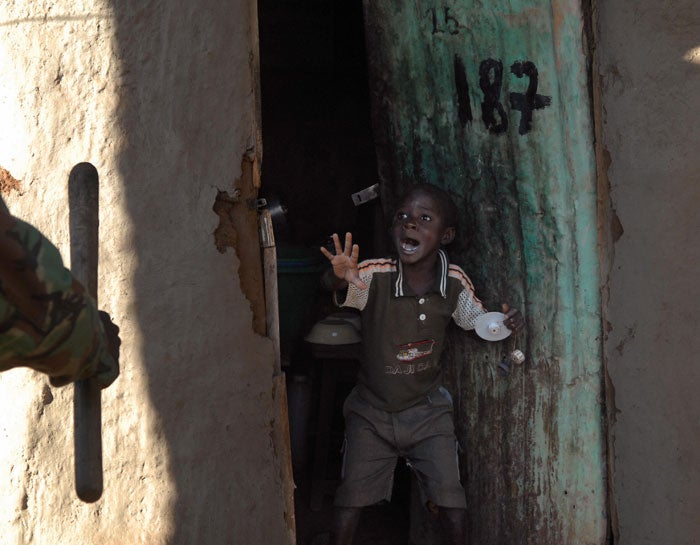
Police have fired teargas and live rounds to disperse crowds in towns and cities across Kenya. In the western city of Kisumu, a local television station filmed a young protester pulling faces at a police officer. The man was shot in the chest, then the officer kicked him as he lay bleeding. The man died. Mr Odinga accused police of being "on a killing spree". The government, he said, has "turned this country into a killing fields of the innocent".
A third and final day of nationwide demonstrations is expected today. Then, Mr Odinga said, the protests would move into "phase two". Kenya's major trade unions, in particular hotel workers and security guards, are to go on strike to further disrupt the country's economy. Mr Odinga also urged Kenyans to boycott companies owned by key Kibaki ministers and allies.
Transport companies such as Citi Hoppa and Kenya Bus Services, Kenya's largest milk company, Brookside, and one of the country's most successful banks, Equity, will all be targeted. Equity Bank is called the "poor man's bank" because it recruits customers normally shunned by the main banks. "Our supporters are their biggest customers," said Mr Odinga. "We will tell them to withdraw their savings."
But despite dismissing the government as "killers and thieves", he said he was still prepared to negotiate a settlement which would result in power-sharing. Mr Odinga said that he was willing to serve as vice-president under Mr Kibaki, provided there were "clearly defined power-sharing arrangements".
Such an arrangement would be only on an interim basis, he said, part of a broader agreement which ideally led to fresh elections. If the agreement was satisfactory, he said, he would be willing to stay in opposition.
He cited the political situation in Germany, where the Christian Democrats and Social Democrats have joined together in a "grand coalition" as an example to follow. But Mr Odinga added: "The world has become very hypocritical. Thieves don't belong at the negotiating table. Thieves belong in jail. When someone blatantly steals an election you should not have to negotiate with them."
Attempts at bringing the two sides together have stalled. Kofi Annan, the former UN secretary general, was to arrive on Tuesday to mediate but had to postpone his trip after catching flu. European and Kenyan election officials described the election result, when Mr Kibaki crept home by 230,000 votes, as deeply flawed. Mr Odinga had won in six of the eight provinces, with Mr Kibaki coming first only in his home province, Central.
In some Central constituencies, EU observers recorded far lower tallies for Mr Kibaki than those announced by the electoral commission. The chair of the commission, Samuel Kivuitu, has since claimed he does not know who won the election and has accused "outside forces" of putting pressure on him to release the results.
Subscribe to Independent Premium to bookmark this article
Want to bookmark your favourite articles and stories to read or reference later? Start your Independent Premium subscription today.
Join our commenting forum
Join thought-provoking conversations, follow other Independent readers and see their replies