How a botched execution revived death penalty debate in America
Confidence in lethal injections is dwindling, thanks to cases such as that of Romell Broom. David Usborne reports
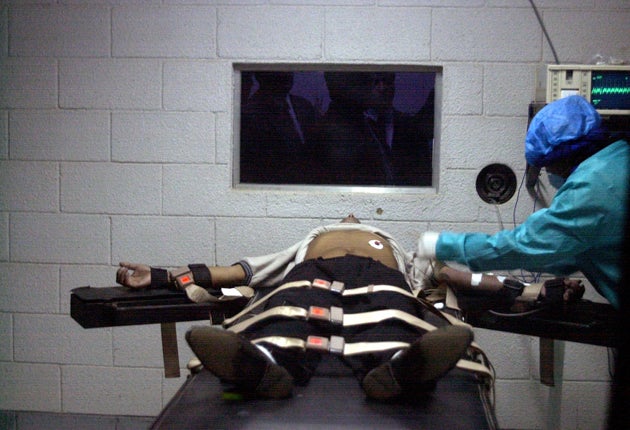
The gruesome botching of an execution in Ohio on Tuesday, when technicians tried but failed to find a vein in a Death Row inmate through which to administer the required mortal fluids, is casting a fresh spotlight on the flaws in America's system of capital punishment system at a time when public support for it may already be flagging.
Lawyers for Romell Broom, convicted in the 1984 rape and killing of a 14-year-old girl abducted in Cleveland, were successful in blocking the state's plans to have a second go at dispatching him by lethal injection in three days' time, for the surreal reason that one week is not enough time for him to recover from his near-death. A federal judge issued a temporary restraining order yesterday, effective for 10 days.
The Broom case is one among several that in recent weeks have galvanised anti-death penalty campaigners. Others have included a grandmother on death row in Texas, Linda Carty, who, though from St Kitts originally, is of British nationality, and of another Texas inmate who, it now turns out, was tried by a judge who was romantically involved with prosecutor.
On Thursday a Texas court rejected the latest appeal by lawyers for 50-year-old Carty, claiming that her defence at trial had been sufficient, and taking her several steps closer to the death chamber. Earlier this month, supporters of Carty broadcast a message to the British public to help her from a loud speaker on a plinth in Trafalgar Square. "Please don't let me die here," said Carty, who maintains she was framed.
"If Texas goes ahead with her execution, Linda will die because she had a bad lawyer, and because the British government was not given the chance to help her at a time when it could have made a difference," Sally Rowen, legal director of the London-based anti-death penalty group Reprieve said yesterday. "Last week the British public listened to Linda from the fourth plinth, but the Fifth Circuit [the US appeals court] doesn't seem to be listening at all."
Broom's case does little to dispel the idea that Carty's end would not necessarily even be a peaceful one. The 53-year-old reportedly tried to assist technicians in finding a vein, at one point lying on his side and sliding the tube up and down his forearm and flexing his fingers. But his assistance did not help. At 2.49pm, according to a timeline compiled by the Cleveland Plain Dealer, Broom "wiped his face with a tissue", and "appeared to be crying". Eventually, the team at the so-called "death house" gave up.
Defence lawyers contended that seven days was insufficient time for their client to overcome the horror of what had occurred. "Even if it never goes away, I think it's wrong to try to do it again so quickly in these circumstances," Tim Sweeney said. A federal judge has meanwhile ordered that Broom be allowed to give a legal deposition on Monday in a broader case brought by the Ohio public defenders' office challenging the practice of lethal injection.
Lethal injection is overwhelmingly the preferred method for carrying out executions. Executions were put on hold nationwide in 2007, however, while the Supreme Court examined the constitutionality of death by lethal injection. While the top court eventually ruled that executions could resume, issues over the use of lethal injection mean they are still on hold in several states.
Confidence in the effectiveness and reliability of the death penalty has been eroding since the beginning of the decade, when Illinois introduced a moratorium that still remains in place. Some states, including New Jersey and New Mexico, have passed laws banning the practice, and support appears to be slipping. Yet a majority of Americans remain opposed to any repeal.
Advocates of an end to executions in the US have had moments to cheer, most recently in August, when the Supreme Court for the first time issued a ruling allowing lower courts to re-open cases where inmates on Death Row seem to have new evidence. It did so in the case of Troy Anthony Davis. Since his conviction for killing a policeman in Georgia, seven prosecution witnesses have recanted their testimonies and appeals for a pardon have come from Jimmy Carter and the Pope.
But as they make steps forward, just as quickly they suffer setbacks. Thus although Charles Dean Hood, also on Texas' death row, was granted a last-minute reprieve in June 2008 when a former district attorney confirmed reports he had had an affair with the judge at his trial, the Texas Court of Appeals this week denied a request for a retrial saying that his defence team had raised the issue too late.
"This decision ... will only add to the perception that justice is skewed in Texas," said Andrea Keilen, executive director of Texas Defender Service, adding that it appears that "obvious and outrageous violations of the constitution are acceptable in death penalty cases". Romell Broom would doubtless agree that his treatment qualified as cruel and unusual. It is not yet clear whether the American legal system – and American public – will ever take the same view.
Ordeal by injection
*5.08am Broom wakes up.
*8.07am Chemicals are delivered to the death house.
*9.31am Preparations on hold while court weighs a last-minute appeal.
*12.28pm Broom eats creamed chicken, biscuits, green beans, potatoes, salad and grape drink.
*12.48pm Court says it will not review the appeal. Execution scheduled to begin at 1:30pm.
*1.24pm First round of lethal drugs is destroyed.
*1.31pm Replacements delivered.
*2.01pm Medical team enters holding cell and begins trying to insert IVs.
*2.30pm Unable to find a usable vein, team leaves cell to take a break.
*2.42pm Team members try again.
*2.44pm Prisons director Terry Collins orders another break.
*2.49pm Broom wipes his face with a tissue, appears to be crying.
*2.57pm Broom asks that his attorney be allowed to watch.
*Around 3pm, Broom's attorney asks Ohio Supreme Court Chief Justice Thomas Moyer to stop the execution on the grounds that Broom is suffering cruel and unusual punishment.
Join our commenting forum
Join thought-provoking conversations, follow other Independent readers and see their replies
Comments
Bookmark popover
Removed from bookmarks