President prepares to cut Wall Street down to size
Republican opposition to reform wanes as public vent fury at bankers' excess

The latest headlines from our reporters across the US sent straight to your inbox each weekday
Your briefing on the latest headlines from across the US
Barack Obama held out a rhetorical olive branch to Wall Street in the home of the US financial industry, secure in the knowledge that his lieutenants on Capitol Hill are close to securing the biggest clampdown on banks since the 1930s.
Republican opposition has crumbled in the face of a package of reforms that will cut the size of banks, crimp future profits and take taxpayers off the hook for the costs of any future financial crises. Democrats are hopeful they will soon be able to hand the White House its second major legislative victory in as many months and boost their prospects in mid-term elections that had previously looked decidedly tough for Mr Obama's party.
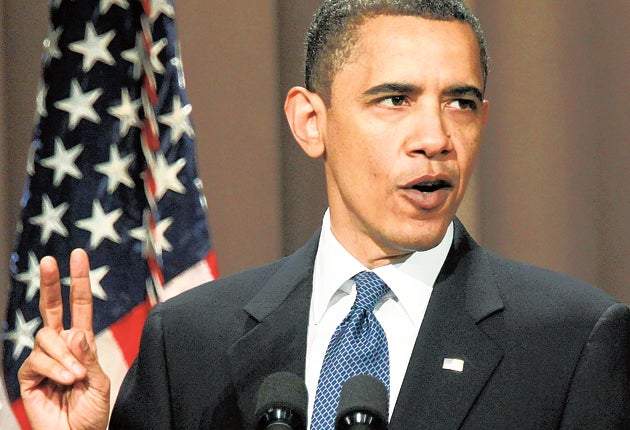
At a speech in New York to an audience that included the chief executive of Goldman Sachs, the US President told Wall Street to call off its lobbyists, who had been working to block or water down the plans, and instead to work with lawmakers to fine-tune the reforms. "The only people who ought to fear the kind of oversight and transparency we are proposing are those whose conduct will fail its scrutiny," he said. "A free market was never meant to be a free licence to take whatever you can get, however you can get it."
Fraud charges levelled against Goldman Sachs last Friday – and the unbridled public joy at the news – persuaded senior Republicans to abandon their opposition to Wall Street reform, and emboldened Democrats to propose sweeping new curbs. The final outcome now appears likely to be similar to the package of measures first outlined by the White House almost a year ago, as the financial sector began to emerge from the credit crisis.
In his speech yesterday, Mr Obama made the case for a slate of reforms that include regulating the multi-trillion dollar credit derivatives market for the first time, and a new process for winding down sprawling financial institutions without cost to the taxpayer, before they can threaten to bring down the rest of the system.
And while many of the reforms draw directly on the lessons of the collapse of Lehman Brothers in September 2008, which dramatically worsened the economic recession, Mr Obama is also close to securing victory for a wide range of other Democratic demands, including giving shareholders greater say over the pay of company executives and tough new controls on how financial products, such as mortgages, are sold to consumers.
"While a few companies made out like bandits by exploiting their customers, our entire economy was made more vulnerable," Mr Obama said. "Unless your business model depends on bilking people, there is little to fear from these new rules."
The measures amount to a top-to-bottom overhaul of the financial system, and the president's speech was crafted to be a "closing argument" as a compromise bill was being put together in the Senate.
Republicans who had said no deal appeared possible just a few days ago, were in negotiations with leading Democrats yesterday, and one Republican senator had already voted in favour of one of the harshest proposals: a new law that would force banks to sell off their credit derivatives businesses entirely. That particular provision is unlikely to survive in the final legislation, and there are also other potential areas of compromise, including whether Wall Street banks should be made to set up a fund that could be used to wind down failing firms.
There are also still significant details to be filled in about which derivatives might be exempted from the tough rules on transparency – details that could make the difference of billions of dollars in profit for individual banks.
However, Wall Street's lobbyists have been losing battles across Capitol Hill in recent weeks, as it remains clear that public opinion favours a vicious clampdown on their activities. The prospects for making major reforms of Wall Street appeared dim while the president remained mired in the healthcare debate, but the eventual passage of a healthcare bill one month ago changed his fortunes.
Since then he has been emboldened to take a tougher line against Israel in the Middle East and made a well-received visit to Afghanistan. Democrats no longer fear being hobbled by his unpopularity in the mid-term elections due in November.
As a result, the president felt no need to mention the charges against Goldman Sachs in yesterday's speech, or even to take the hectoring tone he had used in his speech to the industry last autumn, which was greeted in polite silence by finance bosses. Instead, he struck a healing tone that harked back to his presidential campaign. "Ultimately, there is no dividing line between Main Street and Wall Street," he said. "We rise or we fall together as one nation."
Earlier this week, Goldman Sachs again showed it was king of Wall Street, posting record first-quarter profits and revenues that amounted to $1m every ten minutes, but its executives warned that financial reforms will have an as-yet-unquantifiable effect on its earnings.
The finance industry also faces tough international rules, set to be debated at a meeting of G20 finance ministers this weekend. A consensus is emerging in favour of imposing a coordinated "bank tax", and there may also be new rules that will force banks to limit the risks that banks can take and to set aside more money to protect them from failure.
Subscribe to Independent Premium to bookmark this article
Want to bookmark your favourite articles and stories to read or reference later? Start your Independent Premium subscription today.
Join our commenting forum
Join thought-provoking conversations, follow other Independent readers and see their replies