The Big Question: What does it mean for the US if whites are no longer in the majority?

Why are we asking this now?
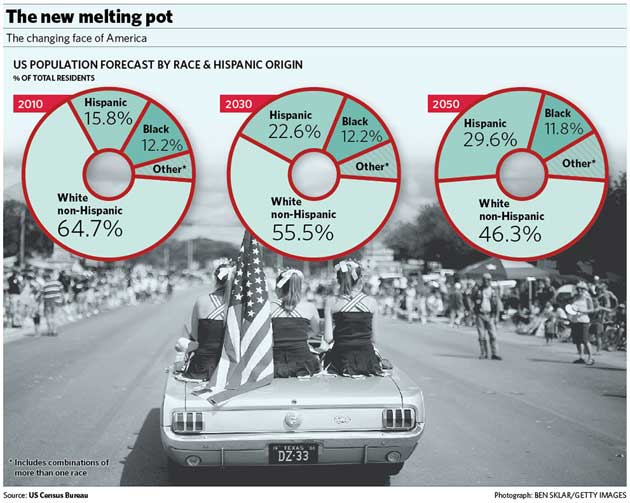
Because the United States Census Bureau has just released a projection – based on current birth, death and immigration rates – which predicts that white people of northern European descent will no longer make up a majority of the country's population by the year 2042.
The white population will begin to shrink from 2031. By contrast, the population of Hispanic Americans, who have a much higher birth rate, will double so that one in three American citizens will be of Spanish background.
Before the mid-century, whites will be outnumbered by a combination of Hispanic, black, Asian, American Indian, Native Hawaiian and Pacific Islanders. Even Alaskan natives are projected to increase. Only the whites will fall in number. The latest figures suggest that these trends are accelerating and will bring about the change eight years sooner than was previously estimated.
What's driving the change in demography?
That is a very political question. The figures show that in 2008, 56 per cent of the three million increase in total US population came from more people being born than dying. The remaining 44 per cent was from immigration. And yet commentators have overwhelmingly greeted the new census data with the pronouncement that three-quarters of the predicted population growth will come from immigrants.
So is it about immigration or birth-rates?
The key factor is that birth rates are higher among immigrant women than white women. There are complex reasons for this. The white population is ageing. The generation who were the baby-boomers are now the grey generation and no longer bearing children. Immigrants, being drawn to move in search of work, tend to be younger, and hence more of them are of child-bearing age.
So the birth rate is falling among whites and rising among Hispanic women, who are averaging slightly more than three kids each. Until the 1990s, there were more Hispanic immigrants than births; in the current decade, there are more births than immigrants. By contrast, fertility is declining among white women, a phenomenon which is accelerated by female education and changes in the workplace: 20 per cent of women in their 30s, 40s and 50s are now childless and likely to remain so. A third of women graduates in their late 30s have no children. Some 80 per cent of women with MBAs have no kids. Childlessness is now a fashionable lifestyle choice. So it is about both immigration and birth rates.
Hasn't the US always been a nation of immigrants?
In 1492, about 96 per cent of the inhabitants of the region were thought to be American Indian and the rest of Polynesian origin. So there were immigrants even then. When the first actual census was conducted in 1790, about 64 per cent of the people counted were white, about half of them of English origin. By 1900, about nine in 10 Americans were white, mostly of northern European ancestry. But the share of Americans who can trace their roots to the countries of northern Europe has been steadily shrinking. Ethnic change has been fairly constant in the American crucible.
What are the political implications?
Considerable. Two things are going on. The white population is getting older and the non-white population is getting younger. By 2030, nearly one in five US residents is expected to be over the age of 65, with the proportion highest among whites. By mid-century the number of elderly people will have doubled. By contrast, by as soon as 2023, more than half of America's children will be non-white.
That means the whites will be pressing on issues like health care and pensions but the Hispanics and blacks will demand more homes and schools. Pressure will grow to de-segregate white areas and to develop enough land to accommodate an estimated 52 million more homes.
Those who are now minority groups will use their greater numbers to mount political and legal challenges to discrimination in housing and jobs. The potential for racial and ethnic tensions could rise as the need for an estimated 36,000 more schools competes with the demand for more medical care by an increasingly elderly population. Already right-wingers are calling for changes in immigration policy to curb the projected annual influx of 1.5 million immigrants (legal and illegal) on which the census figures are predicated. That is not all. At present most menial jobs are done by non-whites. That will change as the children of immigrants – whose parents were prepared to endure high levels of poverty and work in low-skilled, low-paid jobs – become better educated and demand greater opportunities. There will be increasing demands for a more equitable distribution of power.
Will the US change beyond recognition?
Perhaps not so much as you might think. Whites will decline from their present 64.7 per cent of the population. But they will still be the biggest single group, representing 46 per cent compared to the Hispanics' 30 per cent. The whites will still exert a cultural dominance.
There is evidence of that from places like Los Angeles. The San Fernando Valley today looks pretty much like what is predicted for the rest of the country tomorrow. Nearly 42 per cent of the population is Latino. Several states, including California and Texas, have already reached the point where members of minorities are collectively in the majority. But more and more of the Hispanic population, having grown up there and gone to American schools, has grown up speaking English. The Hispanic population will probably become part of the American culture, just like Italians, Poles and Irish did.
History shows that cultural definitions shift. In previous eras Irish, Italian and Eastern European Jewish immigrants were not universally considered as whites. Until the 1960s, Hispanics and Asian Indians were classified by the official census as whites. Some demographers suggest that the proportion of Americans who identify themselves as white, regardless of their ethnicity, will remain largely unchanged.
Those who are most alarmed at the new census figures focus on something else – the sheer size of the predicted population rise. It is projected to increase from 305 million people now to 439 million by 2050. That is 135 million more people – 135 million more Americans who use far more resources, per capita, than anyone else in the world. It could have profound environmental implications for pollution, congestion, urban sprawl and general quality of life, not to mention climate change. The real issue may not be "what kind of people" but "how many".
Does America face fundamental change?
Yes...
* Jobs will less often be allocated on racial lines and white housing will be desegregated
* The worst-educated whites will increasingly take on more menial, low-status jobs
* America's carbon footprint will increase even faster with the rise in population
No...
* The whites will remain the largest ethnic group and their values will remain dominant
* Latinos will integrate into the English-speaking culture as other groups did before
* The large birth rates of minority groups will fall off as their economic prosperity increases
Join our commenting forum
Join thought-provoking conversations, follow other Independent readers and see their replies
Comments