Afghanistan: The war with no end

For free real time breaking news alerts sent straight to your inbox sign up to our breaking news emails
Sign up to our free breaking news emails
British troops have come under attack in Kabul and Nato forces were targeted in two co-ordinated suicide car bombings in which at least four people died.
The attacks took place as ministers revealed that units are preparing to extend Britain's role in Afghanistan when it takes command of the international peacekeeping operation next year.
John Reid, the Secretary of State for Defence, told Parliament that Britain faced a "prolonged" involvement in the country. But MPs warned last night that British troops faced being mired in a long-term military commitment to a country in the grip of a growing insurgency.
They insisted yesterday's extension of Britain's role in Afghanistan, four years after troops first arrived, also reflected the size of the task facing coalition forces in Iraq.
Fears for Afghanistan's future emerged in the wake of suggestions, by the British and Iraqi governments, that British troops could begin pulling out of Iraq by the end of next year. For British troops, however, yesterday's violence in Kabul was a taste of what they will face next year when they deploy to the turbulent province of Helmand as part of a move by Nato to take over security in the Taliban heartlands.
At least four people were killed in the attacks, including one German soldier and an Afghan child, but the implications of the attacks were far wider. The insurgency that has been worsening while the world's attention has been focused on Iraq has now reached Kabul.
Mr Reid said British troops had to open fire to defend their camp in Kabul against "unauthorised entry". Few further details emerged, but Mr Reid said British troops were not targeted in the car bombings.
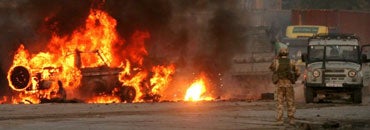
A German soldier died when the Nato vehicle he was travelling in was rammed by a Toyota Corolla stuffed with explosives just after 3pm local time. Two German soldiers and three Afghan civilians were wounded.
An hour later, another Nato vehicle was rammed in a near-identical attack on the same road. Three Afghan civilians were killed, including a young boy, and two Greek soldiers were wounded. The Taliban claimed responsibility for the attacks.
"We have plans for more of the same," Mullah Dadullah, a top-ranking Taliban commander, said by satellite phone from an undisclosed location.
The insurgency in Afghanistan has been largely confined to the Pashtun area in the south and east. Until now, British troops have operated in Kabul and the north, where international forces have been largely welcomed by Afghans who suffered persecution under Taliban rule.
But in the south there is widespread support for the insurgency and opposition to any Western presence in Afghanistan. Helmand in particular is notorious even among Afghans for the ferocity of its tribesmen. British troops are moving into the province under a plan for the Nato-led International Security Assistance Force (Isaf) to take over security in the area. And it was no coincidence that yesterday's attacks specifically targeted Isaf troops in Kabul.
The message from the Taliban was clear: this is what is waiting for Isaf in the south. But the message was also that the Taliban can now strike in Kabul, which until now has been an oasis of stability largely unaffected by the insurgency.
Kabul is home to 3,000 foreigners, most working for NGOs, who live in an city that often seems utterly disconnected from the rest of the country. Replete with bars and expensive restaurants that sell alcohol to foreigners, but not Afghans, Kabul even boasts two designer boutiques for women's clothes. Yesterday another Afghanistan came crashing up against that world. Both car bombings came on the Jalalabad Road, which has long been the scene of the most serious attacks in Kabul.
There was a suicide bombing on that road in September, and there have been countless improvised bombs hidden along it - partly it is because there are several Western and Afghan military bases, and the UN's headquarters, on it. The road runs through a Pashtun suburb of Kabul where the Pashtun Taliban can operate freely. The fact that so senior a commander has claimed responsibility for the attacks is a sure sign the Taliban are stepping up their actions. Known as Dadullah-I-Leng, or Dadullah the Lame, he is known for his part in massacres of Hazara Shias, which have been described as attempted genocide.
One of the main failures of the Taliban's insurgency has been its inability to attract support among other ethnic communities.
Subscribe to Independent Premium to bookmark this article
Want to bookmark your favourite articles and stories to read or reference later? Start your Independent Premium subscription today.
Join our commenting forum
Join thought-provoking conversations, follow other Independent readers and see their replies