Chairman Mao as you've never seen him before (and as the Chinese government would rather you hadn't)

For free real time breaking news alerts sent straight to your inbox sign up to our breaking news emails
Sign up to our free breaking news emails
The younger of the Gao brothers bursts into his studio, explains that he is late because of a car crash, and pulls Chairman Mao's head from a plastic bag. Then he attaches it to the late Great Helmsman's corpulent, kneeling body.
It is quite an entrance. But Gao Qiang, and his brother Gao Zhen, are used to making waves, whether in car crashes or galleries. China's most controversial artists have had their studio raided by police on numerous occasions. That's why they keep the two parts of their sculpture in separate locations. Despite the rational explanation, the moment still has an eerie quality that much of their work shares.
"China has so many stories that they are like a dream. Every story is true, but I try to tell them in a fictional way," said Gao Zhen, 53. He's the older one.
The macabre image of Mao certainly has a touch of fiction about it. It shows him in his declining years, his hand on his heart and his face creased with sorrow as he begs for atonement, in an act of contrition that never took place. Much of what drives the work of Gao Zhen and Gao Qiang, 47, is anger at the events set in chain by Mao, such as the ideological frenzy of the Cultural Revolution in the 1960s and 1970s that killed their father. Their work also confronts modern China and the changes wrought on society by socialism with Chinese characteristics, or capitalism, or whatever you want to call it.
The art of the Gaos is angry, occasionally funny, vital and always confrontational, and can change the way you look at and think about China.
"During the Cultural Revolution I was a child, but I was deeply influenced by what happened, and our work shows many of the things which happened at that time," said Gao Qiang, who is toying with a top-end Canon camera in front of a lithograph-style print of Barack Obama in the café that they use to show their work.
"Obama is a star. We had great hopes at the beginning, though we don't see too much happening now," he added.
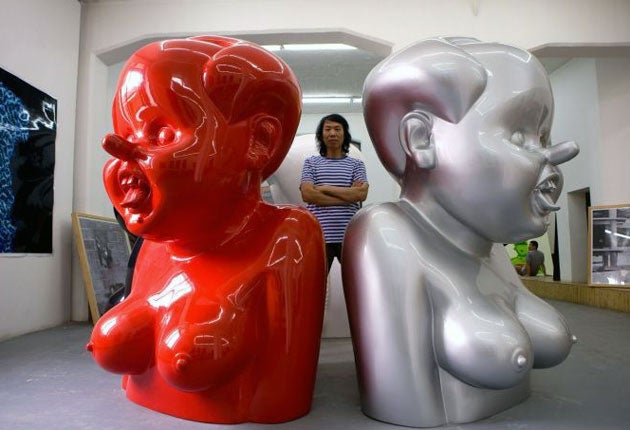
It's a very different representation of Mao than the one you see on the portrait outside the Forbidden City, or the one seen in the propaganda epic The Founding of a Republic, currently on track to be China's most successful film ever, in which he is portrayed as an unashamed hero. The official line on Mao is that he was 70 per cent good, 30 per cent bad. The Gaos expose the 30 per cent bad, and suggest that there was more to this era than the official version admits. In the Gaos' version, Mao's image is deconstructed, sometimes into grotesque, balloonish shapes, such as the "Miss Mao" theme, which is like a Jeff Koons nightmare, and part of a series of large sculptures that give Mao a pair of breasts and the nose of Richard Nixon, who opened diplomatic relations with China.
Satirical that image may be, but this work is also highly personal. During the Cultural Revolution, in which hundreds of thousands died and millions of lives were destroyed, the Gaos' father was labelled a class enemy and dragged away by the authorities. A month or so later, they were told he had committed suicide. But, Gao Zhen says simply: "He didn't commit suicide, he was murdered."
In that context, it isn't surprising that Mao stands out. But he isn't the sole focus of the brothers' work. In one of their most accomplished pieces, The Forever Unfinished Building No 4, there are images of migrant workers, prostitutes, dissidents, Kim Jong-il, police, Nazis, Porsches, Olympic stars, astronauts – basically all the components of the ongoing dialogue about China's metamorphosis, wrought by Gaudi and Jeff Koons, with a splash of Jake and Dinos Chapman.
The piece even features Liu Xiaobo, the leading Chinese dissident, who disappeared many months ago following his decision to print a manifesto of demands for more freedom, called Charter 08, which was signed by many Chinese artists and writers, including the Gaos. "Our major influence is China's current situation," said Gao Zhen, pointing at the petitioners. "We are always together and we talk about ideas. If we both agree, we do it. If one of us disagrees, then we drop it," he went on.
That solidarity has sometimes meant that the two brothers suffer together. They were blacklisted in 1989, the year of the pro-democracy movement, and couldn't get passports until 2004. As a result, they take certain precautions, like only doing interviews with foreign media, as domestic media exposure would lead to serious trouble. During the Olympics, the brothers had two guards outside their studio.
"Few have the honour of the government putting two guards on their house. Of course I'm worried about being arrested, but you need to make sacrifices to be a real person. If they start arresting me, then they really have problems. I am just a little artist, and they have to deal with Xinjiang, and Tibet, and migrant workers losing their jobs. If they start jailing people like me, the prisons will be full very soon," said Gao Qiang.
The brothers say they are tiring of the Mao theme and will move on, but they are committed to the importance of the image seen in Mao's Guilt.
"We can't avoid this image. If he knelt and confessed, like the way the Germans atoned for the Nazi era... we think our Mao thing is over now," said Gao Zhen.
Gao Qiang said the key to the kneeling Mao was symbolic. "It's not him saying sorry, it's a system saying sorry. It's very important for China to reveal the bad things and to understand history and to step into the real world. A lot of people lost out on their lives during the time of Chairman Mao," said Gao – younger or elder. It could equally be either.
Subscribe to Independent Premium to bookmark this article
Want to bookmark your favourite articles and stories to read or reference later? Start your Independent Premium subscription today.
Join our commenting forum
Join thought-provoking conversations, follow other Independent readers and see their replies