Independent Appeal: Sri Lanka's bitter enemies learn to live in harmony
After years of conflict, warring factions now come together in search of solutions, reports Andrew Buncombe from Polonnaruwa

For free real time breaking news alerts sent straight to your inbox sign up to our breaking news emails
Sign up to our free breaking news emails
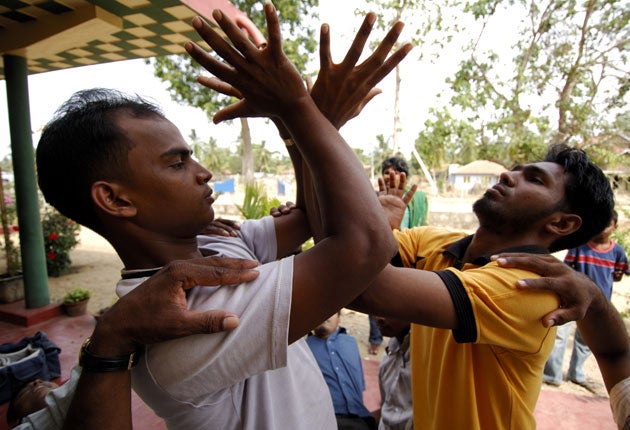
It was the simplest of scenes and yet it was utterly remarkable. In the swimming pool of a Sri Lankan hotel, a dozen or so young men were playing and splashing and generally horsing around. To the casual observer their antics may not have warranted a second glance. Yet the young men laughing together in the pool represented the different religious and ethnic elements that constitute Sri Lankan society, a society that has for decades been torn apart by war, anger and discrimination.
"Before, we never had the chance to mix," said 23-year-old Amila, a Sinhalese Buddhist from Sri Lanka's central province. "I think most of my community will be happy to learn about this and to know we are breaking down barriers."
The young student was one of several dozen young men and women brought to this hotel, set deep in the jungle close to the town of Polonnaruwa, as part of a series of inter-faith and inter-community workshops organised by activists looking to bring about reconciliation and understanding.
The workshops, which have also involved religious leaders from the different communities, Buddhist, Hindu, Muslim and Christian, are designed to try to suggest ways in which they can work together to solve common problems.
It is the most challenging of tasks. For more than three decades, Sri Lanka has been ravaged by a bitter civil war between Tamil separatists and the government, dominated by the Sinhala Buddhist majority. In addition to taking upwards of 90,000 lives, the conflict that came to an end in May with the crushing of the last of the rebels has created considerable barriers between the different communities, isolating some and rewarding others. For many Tamils, the sense of discrimination and suffering is unending.
Many people – including all the young people invited to Polonnaruwa – have grown up knowing nothing but war. They were born in conflict, raised in conflict and their outlooks and opportunities have been shaped by the daily realities of war – of suicide bombers, the deaths of relatives, roadblocks and security checks.
Susantharan, 22, a Hindu Tamil from south of Batticaloa on the east coast, told how the rebels, the Liberation Tigers of Tamil Eelam (LTTE), which once controlled a large swath of the north and east of the country, demanded that Tamil families provide sons and daughters to fight. "Some of my cousins were killed during the conflict," he said.
Amila told how, in turn, the government forces regularly recruited in his district. While there was no conscription, young men were encouraged to sign up. Eight of his friends did so and one was killed. Some of his relatives who became soldiers lost their limbs. "If a soldier was killed, most of the time the body would be brought back to the relatives," he said. "But sometimes the family might just be told he had become a martyr."
The struggle to create trust is being undertaken by the Centre for Peace Building and Reconciliation, a Colombo-based organisation that is supported by Peace Direct, one of the charities for which funds are being raised by The Independent's Christmas Appeal.
Over two years, the organisation has worked individually with the various groups, trying to encourage an awareness of other communities and a realisation that most of the inter-community problems are systemic rather than the result of individuals. In this last part of the process, the different religious and ethnic groups have been brought together, to develop trust and dialogue and finally to work towards solutions. The process has been carried out independently of the government.
The organisation's co-founder, Dishani Jayaweera, said it has stressed two themes – peace and co-existence. Realising its effort can only be a grass-roots process, the group has targeted religious leaders and the youth. She said she hopes that once the participants return home to their communities, they will retain the insights they have gathered
And it is not just young men who are taking part in the workshop. A group of 10 women from across Sri Lanka, Buddhist, Hindu and Christian, reveal how the workshops have given them a rare chance to meet and mingle with other communities.
Shanti, a young Sinhalese Buddhist from Anuradhapura, told how the war had created distrust between neighbours. "In our area there are some villages that have separate communities. There was always suspicion and fear that they [the Tamil community] would be supporting the rebels. But now I think there is a chance to reduce suspicion," she said.
VK Sivapalan Iyer is a Hindu priest from Batticaloa. He said the Hindu Tamil population has suffered as a result of unequal development and educational opportunities. Slowly, however, things have been improving and he says he is impressed by the commitment made by many of the Buddhist monks he has met. "There has been a long link between Buddhism and Hinduism," he said. "We had always hoped they would help us. Now they are doing so."
The position of Sri Lanka's Buddhist monks during the conflict differed from area to area. A tiny number, represented by the high-profile "war monk" Athurliye Rathana, actively encouraged the destruction of the LTTE. The Reverend Dupali is a 51-year-old monk from Matara in the south of the country. He said he hoped the workshop would help build trust between communities to enable a long-lasting peace.
"I have always said that war is not a solution to the problem. If we are true Buddhists we cannot accept that," he said. "Anyone who knows the truth about Buddhism cannot accept violence.
Subscribe to Independent Premium to bookmark this article
Want to bookmark your favourite articles and stories to read or reference later? Start your Independent Premium subscription today.
Join our commenting forum
Join thought-provoking conversations, follow other Independent readers and see their replies