The war heroes forced to live on rice and beans
Britain is accused of betraying the tribe that helped drive the Japanese out of Burma

For free real time breaking news alerts sent straight to your inbox sign up to our breaking news emails
Sign up to our free breaking news emails
The tendons were old, the joints creaking, but the old man's thin arm sprang seamlessly into a smart salute. "For three years I was fighting with the British Army against the Japanese," said 95-year-old Sein Aye, his eyes sunk deep, his whiskery beard having long ago made the journey from grey to white. "We were living in the jungle and fighting ... Sometimes we would hide and then fight."
During the Second World War, Sein Aye was among thousands of Burmese volunteers who joined with British forces in a life-or-death struggle against the invading Japanese. Members of the Karen ethnic minority, these farmers-turned-soldiers had been promised their own homeland if they joined the cause. Yet once the Japanese were defeated, this was a promise the British quickly forgot.
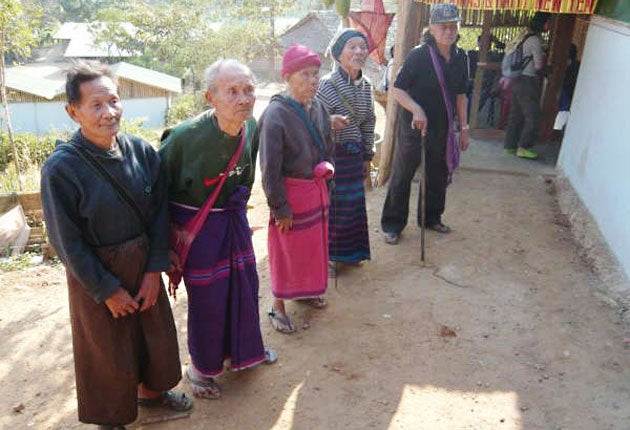
Now, 60 years later, Sein Aye and his comrades feel that they, too, have been forgotten. Lethally persecuted by the Burmese junta and forced into refugee camps, these old soldiers – who were never eligible for any sort of official military pension – have been struggling to survive on rice and beans provided by aid groups. For several years a British charity provided a tiny amount of money that allowed for extras such as the occasional cup of tea or coffee, but those payments have now been stopped. Dignified but impoverished, these veterans feel they have been betrayed. "We get rations from the camp," said Sein Aye, wearing a blue-and-white-striped sweater. "That is the only way we can survive."
The story of Sein Aye (and around 130 other veterans scattered in refugee camps dotted along the Thailand-Burma border) dates to 1942, when Japanese forces drove the British from Burma. Initially, many Burmese – including General Aung San, the father of the currently imprisoned pro-democracy leader Aung San Suu Kyi and the man who would become independent Burma's first leader – sided with the Japanese.
As a result, British counter-measures concentrated largely in supporting insurgent groups among the Karen minority. A British officer, Major Hugh Paul "Grandfather Longlegs" Seagrim, was left behind to organise so-called "spider units" of Karen resistance fighters, only to be executed by the Japanese after he gave himself up in a failed effort to save his men.
When the Japanese were defeated, the British government quickly forgot its promises to those it had fought with. Although Burma secured independence in 1948 there was to be no homeland for the Karen. Reflecting on the affair in a recently published history of the Karen, one British officer who fought with them, Colonel Abbey, said: "I didn't think for a moment we would let them down as we did."
Since then the Karen have faced continuing persecution from the Burmese authorities, something that has drastically escalated in both scale and violence under the rule of the current military junta. Around 150,000 Karen have escaped into Thailand, most of whom are confined to refugee camps of bamboo huts and barbed wire that one regular visitor refers to as "green prisons". Designed to be temporary and yet seemingly fixed, these camps are weighed down by a quiet sadness.
Although the war veterans are advanced in years, to a man they remember the names of the British officers they served under, and reel them off with ease – Captain Bonnie, Major Hoare, Major Milner.
Eighty-three-year-old Thatin, who lives in the Mae La refugee camp, proudly tells of how he was a member of the Spider resistance and how he personally met Major Seagrim, who earned his nickname because of his slim 6ft 4in stature. "The British had to retreat to India but they left Major Seagrim behind. When he was killed, the units were scattered. After [three] years the British came back and started fighting again," he said.
Mr Thatin, frail but remarkably alert, told of his years as a guerrilla fighter when he lived in the jungle, carried a Bren gun wrapped in plastic against the rain and launched ambush attacks on the Japanese. He was given a medal for his services but this was lost when Burmese troops destroyed his village and he was forced to flee into Thailand. He has been in the camp since 2000.
"I expected to get a pension," he said. "I feel very sad about it. I worked very hard for the British and now I have nothing."
Around 50,000 Karen, mainly younger people, have been resettled to 10 nations. The US has taken around 20,000, while Norway, Ireland and Britain have also accepted some refugees. Most of the older ones, including the war veterans and a number of widows, have decided to stay where they are, hoping that the junta in Burma will be ousted and they will be able to return home.
Until then they are dependent on food rations provided by the Thai-Burma Border Consortium, a coalition of aid groups that runs nine camps in the area. Until 2007, the veterans also received a grant of 4,000 baht (around £80) provided by a charity, the Royal Commonwealth Ex-Services League. But that money was stopped after the charity and one its partners, the Burma Forces Welfare Association, decided that the money would be better spent on the veterans still living inside Burma.
A spokesman, Colonel Chris Warren, said its resources were finite, and that while the men in the camps were clearly not living in luxury, those inside Burma were considerably worse off. Col Warren said the charity, which last year distributed around £41,000, was unlikely to resume payments to those in the camps this year. "The people who we are supporting inside Burma have a greater need than those in the camps ... It is about priorities," he said.
Not everyone agrees. Sally Steen runs an organisation called Help 4 Forgotten Allies, which battles to raise funds for the veterans. It was set up after Mrs Steen, an activist, met a veteran in a refugee camp in 2000 who was in ill-health and all but destitute. When she asked the old soldier what she might do to help, he replied: "Please inform my officers."
Mrs Steen said Britain had a moral responsibility to help. "I'm profoundly disappointed that the Burma Forces Welfare Association should even consider discontinuing the small annual grants to the 130 refugees and widows in the camps. These soldiers were among Britain's most loyal allies. It seems to me simply a betrayal to abandon the few remaining veterans and widows."
Many of the Karen are Christian, converted by British missionaries. Pastor Dr Simon Htoo runs a church in the Mae La camp, having left Burma almost 20 years ago. During a recent service at his church made of bamboo and metal sheets, Dr Simon spoke of the confusion for ordinary mortals not understanding God's actions; his word were a clear reference to the fate of Karen, stranded in these camps located barely three miles from the Burmese border.
Afterwards he said: "We need to change awareness. Even though it was under Britain, no one knows about the Burmese or the Karen except these old soldiers. We feel as though they are being betrayed." The Ministry of Defence says the veterans are ineligible for any sort of pension as the first armed forces scheme came into effect in the 1970s. A spokesman said of the old men at Mae La: "It appears that the Burmese veterans were fighting alongside the British Armed Forces, rather than for us. This means that as they were not a part of our own armed forces, they are eligible for compensation for any injuries they suffered through our own war pension scheme."
In such circumstances the old soldiers appear destined to wait out their days fighting a long final battle against impoverishment. Remarkably, despite their insistence that they were let down by the British, the veterans still speak highly of the officers they knew.
One veteran, Duay Maung, 87, said the Karen had been fighting for independence for decades. "If you collected all the blood of the Karen it would be like a stream, if you collected all their bones you could build a mountain."
After he finished talking, Duay Maung suddenly broke into a song. It had been written for a British officer, Captain Brown, who had been stationed in his Karen village but who had then returned to Britain at the completion of the fighting. The Karen troops had sung it the day he left, apparently in tears. "Why have you left us Captain Brown; You said before you would never go but now you are leaving," sang the old soldier, marking time with his walking stick which he rapped on the floor. "How can we live if you leave us, how can we survive?"
Japan in Burma: A brief history
Japan made its first major assault on Burma, then a British colony, in 1942, aiming to defend its flank as it advanced through Malaya (modern Malaysia) and Singapore, and claiming its incursion as a liberating move. As British troops retreated, Rangoon fell in March. At first, the counter attack was confined to guerrilla attacks against Japanese troops in the jungle. Karen fighters made a critical contribution, but the homeland they were promised in return did not materialise. In 1943, after withstanding a siege at the crucial Indian border supply town of Imphal – in large part thanks to the Gurkhas – Japanese forces were repelled. Britain won thanks to its advantage in manpower and in the air; by 1944, Japanese forces were in full retreat. The Gurkhas marched into Mandalay alongside their British counterparts in March 1945, before taking Rangoon two months later.
Subscribe to Independent Premium to bookmark this article
Want to bookmark your favourite articles and stories to read or reference later? Start your Independent Premium subscription today.
Join our commenting forum
Join thought-provoking conversations, follow other Independent readers and see their replies