First the bangs. Then an engine caught fire. 459 lives were on the line
Report reveals frantic efforts to avert disaster on Qantas jet

For free real time breaking news alerts sent straight to your inbox sign up to our breaking news emails
Sign up to our free breaking news emails
Two loud bangs in quick succession alerted the crew – and passengers – of Qantas flight QF32 that something was badly wrong with the Airbus A380 that had just taken off from Singapore, heading to Sydney.
In the cabin, passengers seated over the left wing saw flames streaming from the superjumbo's No 2 engine. In the cockpit, pilots struggled to keep up with the emergency warning messages flooding their computer screen. On the ground, people watched in horror as debris from the plane rained on Indonesia's Batam Island, close to Singapore.
The first detailed account of the events that nearly ended in catastrophe for the 459 people on board the world's largest and newest jetliner was given yesterday by Australian air safety investigators, who identified an oil leak as the probable cause of a mid-air engine explosion on 4 November.
The Air Transport Safety Bureau (ATSB), which released a preliminary report, also revealed how badly the A380 was damaged by the explosion. It was only "the focused and effective action of the flight crew" that enabled it to land safely back in Singapore, investigators said.
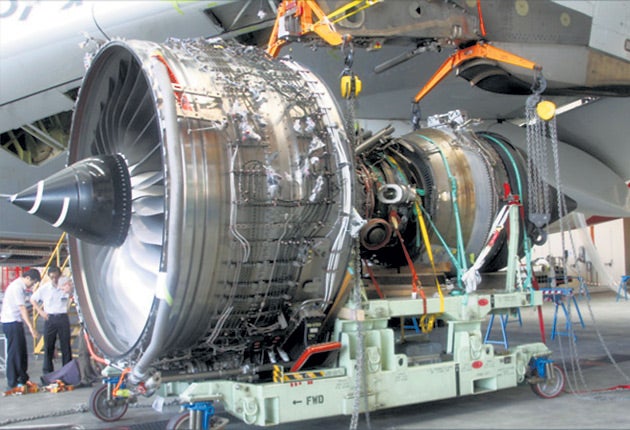
According to the report, fragments of the Rolls-Royce Trent 900 engine – which blew apart at about 7,000 feet – ripped through sections of the wing, puncturing fuel, hydraulic and electronic systems. On their in-flight entertainment screens, passengers saw images – fed from a camera mounted on the A380's tail – of the crippled aircraft leaving a trail of fuel in its wake.
As the plane swayed briefly, the five pilots in the cockpit – with a combined total of 72,000 hours' flying experience – were bombarded with warnings. The No 2 engine was overheating, then on fire. The wing slats were not working, and nor were the auto-thrust and auto-landing systems. There were problems with the brakes and landing gear, and with the anti-ice mechanism. The satellite communications system had failed.
The captain, Richard de Crespigny, shut down the engine and discharged its two fire extinguishers, but received no confirmation they had worked. As the aircraft quickly lost fuel, its centre of gravity began to shift, presenting the crew with another problem. Walking into the cabin, the second officer looked at the damaged engine and saw the wing was leaking fuel.
The No 1 and No 4 engines, meanwhile, had reverted to a "degraded" mode, and were supplying only limited information. More warning messages were streaming in – so many that the pilots spent 50 minutes sifting through and responding to them before they could prepare the plane for landing.
Now came the trickiest part. Only one engine was capable of reverse thrust, which slows a plane down on the runway. The crew could not apply full brakes until the nose wheel was on the ground.
The superjumbo was still 50 tonnes heavier than its maximum landing weight. There was a risk of it overshooting the runway when it returned to Changi Airport. After warning the cabin crew to prepare for a possible emergency evacuation, Captain de Crespigny began the descent.
At 1,000 feet the autopilot disengaged, forcing him to land the plane manually. The jet touched down and came to a stop less than 500 feet from the end of the runway, with four blown tyres and its brakes heated to 900C.
With the aircraft gushing fuel and one engine refusing to shut down, fire crews surrounded it and doused it in foam. Passengers had to wait another nail-biting hour before they were allowed to disembark.
The ATSB said a suspected manufacturing defect in an oil pipe in the engine may have caused the leak and subsequent fire. It recommended fresh safety checks on A380s operated by Qantas, Singapore Airlines and Lufthansa, which are powered by Rolls-Royce engines. Qantas, which only last week returned two A380s to service after grounding its entire fleet for 19 days, completed the new checks on one plane yesterday.
The ATSB's chief commissioner, Martin Dolan, declined to comment yesterday on how close QF32 came to disaster. He noted, however, that when engines explode, "the consequences are very serious".
Subscribe to Independent Premium to bookmark this article
Want to bookmark your favourite articles and stories to read or reference later? Start your Independent Premium subscription today.
Join our commenting forum
Join thought-provoking conversations, follow other Independent readers and see their replies