After 650 years, the wisdom of the Alhambra is revealed
Granada's fortress-palace built by Spain's medieval Moorish rulers, has always fascinated visitors. But what messages do its intricately carved walls hold – poetry, philosophy or piety? Elizabeth Nash reports
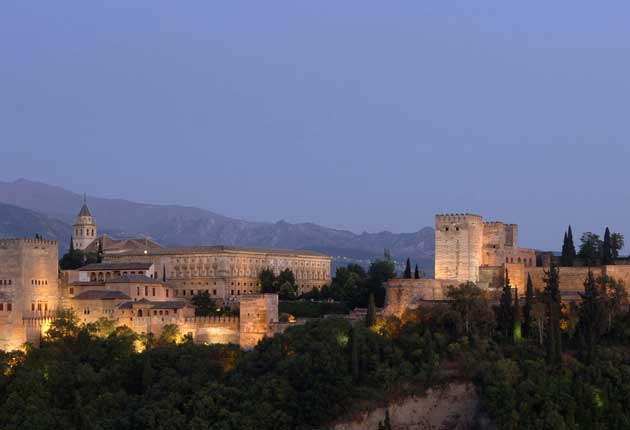
Visitors to the Alhambra fortress-palace in Granada have for centuries fallen into a reverie before its intricately carved medieval walls, wondering at the meaning of the Arabic inscriptions that adorn them from floor to ceiling. The script that winds round the filigree arches and pillared courtyards is so stylised that it's often difficult to disentangle words from images, and few can decipher the classical Arabic in which they are written.
Now, the carvings have been logged and translated, finally answering the question that has perplexed generations of visitors to Europe's jewel of Muslim architecture: "What are these walls telling me?"
Researchers have produced an interactive DVD that decodes, dates and identifies 3,116 of some 10,000 inscriptions carved on the building that symbolises centuries of Muslim rule in Spain and is today the country's top tourist landmark.
"There's perhaps nowhere else in the world where gazing upon walls, columns and fountains is an exercise so similar to turning the pages of a book of poems," says Juan Castilla, from the School of Arabic Studies at Spain's Higher Scientific Research Council, whose team produced this still-incomplete guide.
Arabic artisans, supervised by poets employed in the 14th-century court of King Yusuf I, drew up the decorative plans and planned the spaces where verses – original, or copied – were to be engraved.
So, what do these words say? "There aren't as many as we thought," Dr Castilla confessed. Inscriptions of poetry and verses from the Koran that have inspired generations represent only a minimum percentage of the texts that adorn the Alhambra's walls, despite the mistaken belief that they are smothered in writings of this kind, he said, presenting his study in Madrid.
Instead the motto of the Nazrid dynasty – "There is no victor but Allah" – is repeated hundreds of times on walls, arches and columns. Isolated words like "happiness" or "blessing" recur, seen as divine expressions protecting the monarch or governor honoured in each palace or courtyard. Aphorisms abound: "Rejoice in good fortune, because Allah helps you," and "Be sparse in words and you will go in peace."
Researchers built upon studies begun 500 years ago by the conquerors of the Nazrid dynasty, who ruled the kingdom of Al Andalus and created this fabulous pile. The Catholic monarchs Ferdinand and Isabella ruthlessly purged Muslims from Spain after 1492, but they were sufficiently curious about their vanquished enemy's heritage, or impressed by the Alhambra's unique beauty, to order specialist translators to study the inscriptions that cover every nook and cranny.
For centuries scholars spent half their life, and ruined their eyesight, scrutinising the messages embedded in the geometric tiles or finely carved in the stonework. Among them are verses by the acclaimed Islamic poets Ibn al-Khatib and Ibn Zamrak, some of which describe the place where they appear, such as the Hall of the Two Sisters, which represents a garden: "Moreover we do not know of any other garden/more pleasant in its freshness, more fragrant in its surroundings,/or sweeter in the gathering of its fruits..." wrote Ibn Zamrak.
The ceiling represented heaven: "The hands of the Pleiades will spend the night invoking/God's protection in their favour and they will awaken to/the gentle blowing of the breeze./ In here is a cupola which by its height becomes lost from/sight..." the poet wrote.
Until now, however, efforts to transcribe such verses have revealed only a fraction of the material. With modern technology, including a 3D laser scanner, "we have achieved not so much a discovery as an exhaustive labour that seeks to register all the inscriptions," said Dr Castilla. At the touch of a mouse, everyone from the specialist to the idly curious can now learn the meaning of the ancient words, see exactly where they are located, and how often they are repeated on the walls.
The form of script is also described: angular kufic, whose uprights sprout into decorative foliage, or intertwine; curlicue cursive; or a mixture of forms. In a culture that banned human images, the form as well as the content of the calligraphy was designed to exalt temporal and heavenly rulers.
Kufic is used for quotations from the Koran, which tend to be high up on the walls, while the poetry is nearer the ground – further from heaven, scholars say – in elaborately cursive script.
The DVD takes you on a virtual tour of all the writings, with details (in Spanish only, so far) of when and how each was created. This first volume covers the citadel-palace of Comares. The Palace of Lions, with its renowned courtyard and fountain, follows later this year. The guide is due to be completed, and reissued in one compilation DVD by 2010.
View all comments that have been posted about this article.
Offensive or abusive comments will be removed and your IP logged and may be used to prevent further submission. In submitting a comment to the site, you agree to be bound by the Independent Minds Terms of Service.
- Print Article
- Email Article
-
Click here for copyright permissions
Copyright 2009 Independent News and Media Limited


Comments
Dona Gracia Nasi, a wealthy Jewish woman who was chased out by the Inquisition, eventually found her way to Constantinople, where she was welcomed along with thousands of other Jewish refugees of the Reconquista and Inquisition. She became a trusted ally of Sultan Soliman (Solomon) the Magnificient, on whom she prevailed to wage wars of revenge against her Catholic tormentors in Italy and Spain.
The fundamentalist catholic barbarians who plundered the science of al-Andalus and Sicily eventually ended up using Islamic astronomy for long-range navigation, turning it into a tool for global plunder and genocide, enriching themselves with the gold of Latin America and the spices of the orient and using their wealth to roll back the Ottomans.
Well, here's a different version...
"Nowhere in the oppressive early barbarian catholic realms of Europe did there exist anything near the sophistication, multiculturalism, creativity, learning, scientific inquisitiveness, and pure sensuality that the Moors had. "
True, Islamic architecture was more 'sophisticated' than that of Christian Europe at the time (with the notable exception of some of the early Gothic cathedrals, of course, which arguably overshadowed most Islamic architecture in their engineering genius and sheer scale).
But the claim that Islam was more 'multicultural' is a rather questionable one, as the native peoples of the countries that the armies of Islam INVADED and OCCUPIED in the Middle East, North Africa and Southern Europe did not enjoy the same rights as their Muslim overlords, and while those who practiced a different faith - e.g. Jews - were 'tolerated', this 'toleration' usually took the form of treating all non-Muslims as 'dhimmis' - second-class citizens - and requiring them to pay special taxes in order to be allowed to follow and practice their faith, amongst many other unjust and discriminatory practices.
As for the 'learning' and 'scientific inquisitiveness' of medieval Islamic societies, while it is true that certain elements of medicine, astronomy, mathematics and science can be attributed to the original work of Islamic scholars, it is also true that much of the knowledge that Islamic societies passed on to Christian Europe was not Islamic in origin, but came from ancient Greece, or from India or China, and was simply acquired, second-hand, by Islamic societies as their merchants visited far flung places and brought back ancient books and accumulated learning of those cultures. To this extent, many Islamic 'scholars' merely performed the roles of librarians, translators and museum curators, preserving and propagating the knowledge of older civilizations (a role which was nevertheless vital, and for which they should be given due credit). The so-called 'Arabic' number system is a case in point; it was not Arabic originally, but from the ancient Hindu civilization of the Indus valley in India; Muslim merchants discovered it and brought it back to the Islamic Empire, which adopted it and claimed it as its own (or, at least, when Fibonacci introduced it to Christian Europe, and perhaps wrongly called it 'Arabic notation', Muslims scholars were happy for this attribution to remain uncorrected).
(cont)
Ah, so the Moorish Empire fell because they departed from the ascetic moral purity of their religion and became too fat, lazy, decadent and 'European', eh? Bollocks! The Moorish Empire fell because, after centuries of comparative religious moderation and relatively peaceful coexistence with their neighbours, they suddenly rediscovered religious fanaticism - and the xenophobic intolerance and aggressive military expansionism that inevitably went with it. In short, after centuries of being more-or-less civilized, they reverted to their true barbaric, warlike nature. And their Christian neighbours became so pissed off with their endless border raids, and their persecution of non-Muslims, and so alarmed at the threat of a Muslim invasion of Northern Europe, that they decided to do something about it. And the rest, as they say, is history. And it is history that modern-day Islamists would do well to heed...
"The fundamentalist catholic barbarians who plundered the science of al-Andalus and Sicily eventually ended up using Islamic astronomy ,..."
...Science and astronomy much of which Islamic culture had plundered from earlier, non-Islamic cultures, as I have said...
"for long-range navigation...turning it into a tool for global plunder and genocide, enriching themselves with the gold of Latin America and the spices of the orient..."
Whereas the Ottomans had previously committed plunder and genocide across a vast swathe of North Africa and the Middle East, and bits of Southern Europe, and similarly enriched themselves (why else would they have settled in Al Andalus, after all?). The fact that Europeans later did the same on a global scale is simply down to the fact that we built better ships, and were better sailors and more adventurous explorers. I am not condoning the genocide of the Conquistadors in South America, of course; I am just pointing out that, regarding plundering and genocide, the Ottomans did it first - as they did slavery, incidentally (from Europe to Africa, rather than from Africa to the New World, as we later did).
"...and using their wealth to roll back the Ottomans."
Which, given what might have become of Europe - and ultimately large parts of the world - had they not succeeded (e.g. no Renaissance, no Enlightenment, no Industrial Revolution, no Reformation, no religious tolerance, no freedom FROM religion, no democracy, etc., with millions of people living in perpetual dhimmitude under their Muslim overlords in a global Caliphate) is probably no bad thing, I tend to think. In fact, if European Christians hadn't stood up to them, we'd probably all be living on Planet Taliban now. (Of course, you might like that idea, but then you'd clearly be a delusional lunatic...)
In that respect, the fact that there are Christian churches that still do not ordain women as priests is evidence for the notion that the West is precisely the same as it was 650 years ago.
Nonsense, right?
It has become fashionable to denigrate Islam without any knowledge of what you are talking about, just as those on the right continually reference every liberal position as "like X in 1939", "like Chamberlain" etc. It is not debate, but a facile replacement for knowledge, repeating what has been spoonfed you.
Just admit it, you hate Muslims, you hate Islam, but you also know nothing about it. 9/11, right? 7/7, right? Whatever CNN or the BBC told you, right?
Please list your educational attainments that permit you to pronounce aspects of the culmination of an entire epoch as "pretty boring". You can also point us towards your own improved design of a palace, with your own poetry inscribed on its wall, should you so wish. It should prove fascinating to behold.
"Also, do not exaggerate the importance of The Alhambra. It is not the only historical building of interest in Spain,"
You show me one of equal any where else on earth.
--
"Please, don't be so romantic about Al-Andalus."
If we were to forget about all the Roman and Greek crap that we are unable relate to, and study what happened to Al-Andalus,
we might just have a chance to save the Western Civilization from the self-destruct mode it is in. but then how can a worthless Muslims teach us.
In that single phrase you betray your naked pro-Islamic/anti-European prejudice, and your ignorance of, or contempt for the TRUE origins of European civilization.
The Greeks were the greatest mathematicians, scientists, philosophers, poets and playwrights of the ancient world. Western scientific rationalism and democratic ideals can be traced directly back to them.
The Romans were brilliant engineers, architects, administrators and military strategists, and once ruled the largest empire the world had ever seen, prior to the British Empire.
Granted, it was the Romans who destroyed the more ancient civilization of the Greeks (and how different the world might have been had they not...), and who inflicted Christianity (specifically, Catholicism) upon the world, but they also pulled the more primitive societies of Northern Europe up by their bootstraps, and their legacy endures in all European - and many Middle Eastern and Asian - countries to this day.
"we might just have a chance to save the Western Civilization from the self-destruct mode it is in. but then how can a worthless Muslims teach us.
"
I do not see that Western Civilization is in 'self-destruct' mode (though many people, such as yourself, no doubt wish that was the case). On the other hand, looking at the political turmoil and resurgent religious fundamentalism in many (in fact, most) Islamic countries (e.g. Pakistan), it is easy to believe that the Islamic world is close to imploding. And some of us think that can't happen soon enough...
"The Greeks were the greatest mathematicians, scientists, philosophers, poets and playwrights of the ancient world. Western scientific rationalism and democratic ideals can be traced directly back to them."
Absolutely true, can't disagree with that at all sickofstupidity. But this was a society that got it wrong on the four homours scientifically, Galen believed in bloodletting as a medical practice. Aristotle one of the greatest Greek philosophers this is what HE SAID ABOUT WOMEN "Again, the male is by nature superior, and the female inferior; and the one rules, and the other is ruled". And remember women did not have the vote. This is a society that believed in slavery. The Spartans left deformed children to die in the open and would regularly go on a killing spree on the semi-slave society of helots just to keep their fighting skills sharp.
Yes and then the Romans!
Yes they were brilliant engineers, architects, administrators and military strategists.
Yes this was a great civilisation that produced all of the above - but it also had slavey, the arena (gladiators, lions & tigers eating prisoners for live entertainment - very civilised)and meglamaniacs like the emperor Nero.
Again marriage laws were in favour of men. Roman law allowed men to commit adultary but a man could legally kill his wife if she committed adultary, under certain circumstances. The 'pro-family' Emperor Augustus made it permissible for fathers to kill their daughters who committed adultary and their partners. And husnabds were obliged to divorce their wives if they committed adultary.
Also about the bit about how the Romans pulled the more primitive societies of Northern Europe up by their bootstraps, and their legacy endures in all European.
One of the reasons the Romans gave for invading other countries was that they were bringing civilisation to the barbarians. Well we all know history is written by the victor. Recent archaeological discoveries are begining to prove that the ancient north European societies were not so primitive as Roman propoganda will have us believe. For example bronze and gold jewellery from pre-Roman times have shown the cratftmanship of these pre-Roman civilisations. The Celtics were far less primitive then the Romans later stated they were.
Lets look at Julius Ceasar - brilliant military strategist. I loved particularly how he conquered Gaul. The Gauls were safely secure in their massive fort. So he built a wall around the fort, he soldiers did this in an amazingly short time. He starved the people out until they eventually surrendered. By the end of his conquest of Gaul
Ceasar was directly responsible for the death of one third of the population of Gaul, and he boasted about it in his letters to his wife.
Hey I think the Greek & the Roman civilisations were great.
By the way lets not forget the Egyptians in our ancient civilsations, - Pyramids, Sphinx - lots of mathematics involed here. And they were pretty good at astronomy I hear.
"But [Greek] society...got it wrong on the four homours scientifically, Galen believed in bloodletting as a medical practice. Aristotle one of the greatest Greek philosophers this is what HE SAID ABOUT WOMEN "Again, the male is by nature superior, and the female inferior; and the one rules, and the other is ruled". And remember women did not have the vote. This is a society that believed in slavery. The Spartans left deformed children to die in the open and would regularly go on a killing spree on the semi-slave society of helots just to keep their fighting skills sharp."
I never said the Greeks were perfect, but they were still centuries ahead of their contemporaries in other cultures in their scientific knowledge and philosophical sophistication. And their admittedly questionable attitudes on certain things - such as slavery and the place of women in society - were probably no worse than any of their contemporaries.
"Yes [the Romans] ...were brilliant engineers, architects, administrators and military strategists.
Yes this was a great civilisation that produced all of the above - but it also had slavey, the arena (gladiators, lions & tigers eating prisoners for live entertainment - very civilised)and meglamaniacs like the emperor Nero.
Again marriage laws were in favour of men. Roman law allowed men to commit adultary but a man could legally kill his wife if she committed adultary, under certain circumstances. The 'pro-family' Emperor Augustus made it permissible for fathers to kill their daughters who committed adultary and their partners. And husnabds were obliged to divorce their wives if they committed adultary."
I didn't say the Romans were perfect, either. But, again, they were probably no worse than any of their contemporaries in most of the areas you listed. And I had already alluded to two of their greatest failings - their adoption and propagation of the Christian faith (I am an atheist, you understand, so I regard all forms of religious belief as dangerously delusional and harmful to human progress), and their destruction of Greek civilization and the closure of its philosophy schools, which probably caused the stagnation of intellectual inquiry and scientific progress for centuries.
"One of the reasons the Romans gave for invading other countries was that they were bringing civilisation to the barbarians. Well we all know history is written by the victor. Recent archaeological discoveries are begining to prove that the ancient north European societies were not so primitive as Roman propoganda will have us believe. For example bronze and gold jewellery from pre-Roman times have shown the cratftmanship of these pre-Roman civilisations. The Celtics were far less primitive then the Romans later stated they were."
Indeed, I am already aware of this, but your point is nevertheless well made. However, the architecture, military logistics and tactics, administrative bureaucracy and large scale engineering projects (such as their system of continent-spanning roads, their aqueducts, etc.) of the Romans were still centuries ahead of even the most advanced Northern European civilizations, which is why they managed to conquer them.
"In that single phrase you betray your naked pro-Islamic/anti-European prejudice, and your ignorance of, or contempt for the TRUE origins of European civilization."
You just don't get it.
(BUT MY GAWD!!! What is going on with the other people on here? Why disappointment that it's repetitious? For heaven's sake! Quite literally.... Painstaking research is carried out to unlock the mysteries of a splendid, famous building, and it turns into feminists having a moan, someone waffling on about the Ancient Greeks.... what's the matter with you bunch of plonkers?)
As someone said - what was the position of woman in the west in the 14th Century?. She couldn't inherit if she had a brother, once married all her property became her husbands. Adultary laws were in favour of men. Henry VIII even banned women from reading the bible.
Women writers in early Islam? To be honest don't know many on the top of my head. Just I don't know many western women writers from the 13th century on top of my head.
I do remember that there were female Muslim scholars in early Islam who particpated in debates with their male counterparts. Some had male students. There are 4 main Sunni Muslim schools of thoughts after 4 scholars. I know one them studied under a female scholar. I can't provide any evidence of this because I don't carry this information around with me or the books I read this in. I think I should now.
I do know that approximately 25% of hadiths in Sunni Islam come from a woman, the Prophet's wife Aisha. Muhammad's other wife Hafsa played a role in the collection of the first Qur'anic manuscript. Sharia law is based the Qoran but also most signifgantly on the hadith, sayings of the Prophet Muhammad.
And before anyone says it let me just say it, the treatment of women in Muslim countries today is bad, dismal, terrible etc etc. Like many other things this is something the west has overtaken the Muslim world in.
Er....as you did when you were critiquing the societies of ancient Greece and Rome in your reply to me, thekhan_52? Why is it okay for you to condemn ancient Grecian and Roman societies when judging them 'through today's eyes', and yet not okay when we critique early Islam using that same modern perspective? What is sauce for the goose is sauce for the gander. And, I might add, the reason it is possible to condemn so much of 'contemporary' Islam by modern standards is that Islam, unlike other contemporay societies, is still stuck in the 14th century, and still preserves and perpetuates the same practices and attitudes that were prevalent then. The rest of us have actually evolved and progressed somewhat since the 14th century.
"Sharia law is based the Qoran but also most signifgantly on the hadith, sayings of the Prophet Muhammad."
This is irrelevant to the debate. To non-Muslims - and especially to rational atheists such as myself - the Qoran is a work of fiction (just like the Bible and the Torah), and the hadiths simply record the delusional ramblings of someone who believed he was in telepathic communication with an imaginary being.
"And before anyone says it let me just say it, the treatment of women in Muslim countries today is bad, dismal, terrible etc etc. Like many other things this is something the west has overtaken the Muslim world in."
You cannot be serious! Name ONE non-Islamic country that treats women as appallingly as they are treated in any devoutly Islamic state under Sharia Law. Just ONE, please.
As for Islam and Science - well there are 3 theories
- the first one someone already mentioned, the Muslims produced nothing original themselves, it was mainly Greek and some Indian knowledge (the numbers). And as someone has already pointed out the Muslims were just librarians.
- the Muslims were great scientists, discovered many things, were way ahead of the west etc etc. This point is usually made by ardent and biased Muslims
- the third theory is in half-way between the two. Yes the Muslims inherited much of ancient Greek knowledge but you know the Greeks didn't get it right on everything, look at the Greek theory of the 4 humours. The Muslims built on what they learnt and did produce original works. For example Ibn al Nafis (1213-1288) he studied human anatomy, was a propenent of experimental medicine and postmortem autopsy but for the purpose of the point I am making he also developed his own own new Nafisian[10] systems of anatomy, physiology, psychology and pulsology to replace the Avicennian and Galenic doctrines, while discrediting many of their erroneous theories on the four humours. This chap was first physician to describe the pulmonary circulation,[1] and the capillary[2] and coronary circulationswhich form the basis of the circulatory system, for which he is considered the father of circulatory physiologand "the greatest physiologist of the Middle Ages, this was long before the British chap William Harvey.
Yes it was India that gave the zero to the world that changed the face of mathematics, but the Muslims were very much involved in the change of mathematics that the revolution of the zero created.
I take your point, fair enough on one had I am asking people to "just read this stuff for what it is" and then write all that stuff about Rome and Greece.
To be fair I didn't think I was being critical of Roman and Greek civilisation. I knowledged and accepted your statements that both civilisations were brilliant, I acknowledged everything you said. What I was doing was pointing out the other aspects of these civilisations.
For example yes the Romans were great engineers and builders but they did love their brutal gladitorial fights or seeing people eaten alive by lions. The 'primitive' north European societies may not have been able to build the coluseum or bridges or took regular baths etc but in other ways they had aspects which were more civilised. For example the Celtic and Germanic tribes had a concept that their chiefs were first among equals and their society was more egalterian then Roman society. Women had more equality in Celtic societies IN COMPARISON to Roman society. One of the things that outraged the Romans so much about Boudicia's revolt in Britain revolt was that she was a woman.
My point was exactly as you have pointed out sickofstupidity, that so many people seemed to be critiquing Islamic socities 'through today's eyes'and so yes I did the same to Roman and Greek civilisations. I was making a point that if people were going to do this then every ancient civilisation or empire could also be critiqued through todays eyes and no one would come out looking perfect.
The Alhambbra is a great building, architecturally, from this article it also seems to have had poetry engraved into its walls. I am fine with people critiquing Islamic societies past and present. But is not possible for people to marvel at the architecture and the poetry that this light-hearted article is going on about without bringing up whatever positive or negative perceptions they have about Islamic societies. Look at the very first comment - it said nothing about the building - just about women's rights.
As for Islamic science - abosultely not I don't claim that the European renaissance was completly due to the Islamic world. I believe there was a contribution but the the renaissance very much took a life its own. Some delusional muslim propagandists do claim this but I think thats just them having a psychological need to deal with why the Muslim world is so behind the west. At the same time I must admit that it annoys me when I see comments by 'western propogandists' who state that Muslims societies in the past produced nothing of importance, it was all Greek and Sanskrit material and the Arabs produced nothing themselves. I believe one comment here called the Arabs just good librarians of Greek and ancient Sanskrit knowledge.
sickofstupidity I must disgaree with you on your point that Islam is stuck in the 14th century when all other societies that evolved. I think thats harsh, I would say that Islamic socities became stuck around the 18th century (you may think I am splitting hairs here) From a point in the 18th Century the west raced ahead. It was during the next two centuries that womens rights developed and the industrial revolution took place.
Finally sickofstupidity this is what I actually said about women's rights in Muslim countries:
"And before anyone says it let me just say it, the treatment of women in Muslim countries today is bad, dismal, terrible etc etc. Like many other things this is something the west has overtaken the Muslim world in."
To reinitiate what I have said above is that Muslim countries have a poor record on women's issues. So I am not sure what you mean by your comment below, I think we actually agree on this issue:
"You cannot be serious! Name ONE non-Islamic country that treats women as appallingly as they are treated in any devoutly Islamic state under Sharia Law. Just ONE, please".
Though I have to say that your remark "I must disgaree with you on your point that Islam is stuck in the 14th century when all other societies that evolved. I think thats harsh, I would say that Islamic socities became stuck around the 18th century" made me chuckle. I think that's what is known as 'damning with faint praise' :o)
And I must disagree with your apparent implication that it was only the Industrial Revolution that allowed European civilization to out-evolve Islamic civilization, and that we are therefore only a couple of hundred years more advanced. I think we started to out-evolve Islamic civilization with the Renaissance, and the pace of evolution increased with the Enlightenment. The Industrial Revolution, and then, later, what might be termed the Democratic Revolution - the transition from unelected monarchies to elected systems of government, was simply the culmination of this long processes of intellectual and social progress. By contrast, Islamic civilization has never had its Renaissance, nor its Enlightenment, nor, needless to say, its Industrial or Democratic Revolutions. And this is why I maintain that it is still stuck in the 14th century (i.e. the pre-Renaissance era).
Regarding your last point, I now understand what you meant by "Like many other things this is something the west has overtaken the Muslim world in." I had previously read this to mean that our mistreatment of women exceeded (i.e. 'has overtaken') that of Islamic societies, which is why I took issue with it. I am glad that we are also agreed on that point.
There is a sort of mythology of a golden age with a 'king of the three faiths' but, on examination, it turns out to be a pipe-dream. Ultimately, economics not theology determined the nature of the regime.
Indeed, it was Economics which built the al Hambra- itself is associated with both a message of tolerance and one of uncompromising zealotry- and Economics which caused the eclipse of its glories.
At present, Al Andalus has a special position in Islamist thought- it is the focus of a sort of irredentism- one which has as powerful an appeal in Pakistan as it does in North Africa. This is because unlike Bosnia or Chechnya, al Andalus still has a reputation for the beauty of its women and the lusciousness of its fruit.
Also, economically the Spaniards are doing pretty well- so all in all a worthy object for jihad.
Now, if only the Brits would hand over Gibraltar...
The 'primitive' north European societies may not have been able to build the coluseum or bridges or took regular baths etc but in other ways they had aspects which were more civilised.... Women had more equality in Celtic societies IN COMPARISON to Roman society". There is a tendency to consider mostly the built environment, but civilisation implies customs too. Equality and lack os servitude is more important on a moral basis.
One builiding as great as Alhambra? Just look to India and other Arab countries--to mention those of similar character. If you can appreciate Romanesque and Gothic architecture turn your eyes to Europe. Or, in modern times, the great Church of Transfiguration in Keralia, made totally in timber. A question of preferances.
Also remind you, again, that Spain is not only the Mediterranean country you seem to think of in your postings.
