Cheers! The best wine in the world (and it only costs £30)
Forget Ptrus or Montrachet: in a blind tasting of 15,000 wines from around the world, an unheralded label from the Rhone valley came top. John Lichfield raises a glass to Clos des Papes

For free real time breaking news alerts sent straight to your inbox sign up to our breaking news emails
Sign up to our free breaking news emails
In the lower Rhône valley, there is a vineyard so cluttered with smooth, oval stones that it might be a pebble beach. It is difficult to imagine anything much growing here, let alone "the best wine in the world".
The vineyard's name Clos des Papes has long been respected by wine buffs, especially British ones. One bottle in every seven is sold in Britain, at around 30 a bottle. Expensive? Maybe, but rather cheap for what has just been declared by a prestigious US wine magazine to be the best wine available anywhere in the world in 2007.
Clos des Papes does not count (yet) among the aristocracy of wine labels, such as Ptrus or Margaux in Bordeaux or Romane Conti or Montrachet in Burgundy or Screaming Eagle, the cult vineyard of the Napa Valley in California. It is made from relatively unsung grape varieties such as Gren-ache, Mourvdre, Syrah and small doses of three others.
All the same, in a recent, mass, blind tasting of 15,000 wines from all over the globe by the American magazine, Wine Spectator, it was the relatively unknown Clos des Papes 2005, a red wine from Chteau-neuf-du-Pape, near Avignon, in the Rhône valley, which came out on top. Value for money was taken into consideration but also sheer quality (98 marks out of 100) and a subjective element labelled simply "excitement".
The result is intriguing for several reasons. It suggests that the finest French wines do not necessarily come from Burgundy or Bordeaux. It also suggests that despite the many obituaries written for the French mass or middle market wine industry even the small, family vineyards of France are still capable of producing wines of exceptional quality and extraordinary value.
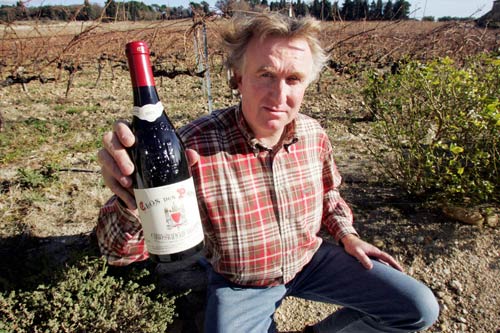
Clos des Papes is not engineered by a "star", globe-trotting wine-maker, with the tastes of a rich clientele in mind. It is made according to local and family tradition by its proprietor, Paul-Vincent Avril, 42, whose family has been growing wine at Chteau-neuf-du-Pape since the early 1600s.
M. Avril is a modest, open-minded, level-headed sort of man. He attributes the quality of his wine mostly to the terroir the qualities of soil, sub-soil, micro-climate and slope that he inherited from his ancestors. He also uses rigorous methods for growing, and selecting, the finest grapes, learnt when he worked as a young man in Burgundy, Bordeaux and (unusually for a French vigneron) Australia.
However, he also admits to a great deal of help from an unexpected and, possibly unreliable, source: global warming.
"I have to say that, for us, so far, climate change has been a big help," he said. "We've had a run of exceptional vintages since the start of the century. The summers have been even hotter and sunnier than usual, giving the wine great strength and depth. Rain has been scarce but that has not been a great problem so far.
"It wouldn't matter much if it became still hotter but a prolonged drought, well, that would be another question."
Bottles of M. Avril's 2005 Clos des Papes are already changing hands at up to 230 (166) each on the internet auction site, e-Bay. He has no more of the 2005 vintage to sell. All 7,500 cases were sold, to 35 countries, at 38 a bottle wholesale, before the Wine Spectator announced the results of its annual competition.
M. Avril will of course be cashing in and jacking up his prices next year. Won't he?
"No. Not at all. Why should I do that? I will sell at roughly the same price," he said.
"I regard this prize as a reward for the work done over many years by my father and my grandfather but it is also a reward for the trust shown by our regular clients all over the world. They buy Clos des Papes every year, whether we win a prize or not, whether we have an exceptional vintage or not.
"In a couple of years, the excitement surrounding this honour may have died away but our regular clients will still be our regular clients. To be placed first in the world is astonishing. It is an extraordinary recognition of our work and a source of great satisfaction to me. But I also have to think of the long term."
M. Avril did not enter the competition. No one did. The Wine Spectator chooses the entrants from wines which are available to the general public. In any case, M. Avril says that he has no time for the trend towards special cuves or blends for wine-tasting competitions. He produces only two kinds of wine: red and white.
The Wine Spectator is the great rival to the Wine Advocate, the organ of the hugely influential and controversial American wine critic, Robert Parker. The two magazines are sometimes blamed by wine traditionalists for imposing a kind of uniform, American taste on the international wine market.
M. Avril insists that he makes his wine blending six different kinds of grapes, grown on 24 different pieces of ground to fulfil his own "instinct" for how to "express" the qualities of the grapes, the terroirs and the year. He is not trying to produce a "Parker" wine or a "Spectator" wine but a Clos des Papes.
"There is no great mystery in the wine-making. Ninety per cent of the work is done by the grapes. No great chef could be a great chef consistently without buying the highest-quality ingredients. It is exactly the same with wine. We make sure that only the best bunches of grapes are kept. We keep the yield low (21 hectolitres of wine per hectare, compared to the average of 35 in Chteauneuf-du-Pape). We use no artificial fertilisers."
M. Avril says, however, that he learnt a great deal as a young man in Burgundy about how to give delicacy and finesse to a wine. During a long spell in Australia, he says, he learnt to appreciate the professionalism and rigour of the so-called "New World" approach to wine-making which is often decried by French traditionalists. "The problem with many French producers is that they only ever drink their own kind of wine," he said. "I have scores of different kinds of wine in my cellar, from all over the world. You can only judge how good your own wine is if you know the best of what is happening elsewhere."
The Wine Spectator already gave M. Avril its second prize in 2005, for his 2003 vintage. This year, the magazine said that he had managed to combine the traditional explosive impact of a Rhône wine with great "elegance" and depth. A run of exceptional wines in the past five years, the magazine said, had made him one of the "leading growers" of the Rhône valley.
"The 2003 shows a racy core of supercharged cassis [blackcurrant] fruit thanks to an exceptionally hot growing season, while the 2004 shows more finesse than power.
"The 2005 combines the best of both worlds, displaying an enormous core of fruit and minerality along with massive structure. It's a wine that should easily age for two decades."
M. Avril says that his wines should be kept for at least six to eight years before they are drunk. He is selling his 2001 vintage now ready to drink at 50 a bottle. Although the 2005 is all sold, he reckons the 2006, to be bottled in the new year, and the 2007 are equally good, "if not better". Eighty per cent of his wine is sold abroad, including 15 per cent to Britain, the biggest buyer outside France.
He sells to the Richards-Walford importing company, which supplies several of the leading retail wine companies in the UK. If you shop around, you might still find some Clos des Papes 2001, to drink this Christmas or New Year. It would go down fine with turkey but, according to M. Avril, is best of all with lamb.
Chteauneuf-du-Pape is the third largest town or village appellation in France. It was, in fact, the area that created the idea of establishing boundaries and rules for local, as opposed to regional, wines in the early 20th century. Vines were first planted here by the popes who abandoned Rome and made their base in Avignon in the first part of the 14th century. The ruined castle at the summit of the village of Chteauneuf-du-Pape was once a papal holiday home. The original part of M. Avril's Clos des Papes domaine was part of the papal vineyard, established 700 years ago.
The soil is clay, covered by a rash of flat, oval pebbles, called galettes. The pebbles act like storage heaters, accumulating warmth during the day and distributing it gently among the vines during the sometimes chilly Provenal nights.
In the second half of the 20th century, the reputation of Chteauneuf-du-Pape wines declined. The local Grenache grape variety which forms the bulk of most southern Rhône wines but only 65 per cent in the case of Clos des Papes was regarded as blunt and unsubtle compared to Merlot or Cabernet (the great red Bordeaux grapes) or Pinot Noir (Burgundy). Many Rhône growers, although not all, decided to go for strength and quantity rather than elegance and quality.
The reputation of all Rhône wines, and especially Chteau-neuf-du-Pape, is now recovering rapidly. There were four different Chteauneuf labels in the first 20 in this year's Wine Spectator list. This compares with only three each for Bordeaux and Burgundy in the top 100. Overall, France took 24 of the first 100 places: not bad for a country which is said to be losing its grip after decades of effortless domination of the wine world. The recovery of Chteauneuf-du-Pape may have something to do with global warming and hotter summers. It is also a tribute to the work of younger producers, such as M. Avril who have introduced new thinking in the service of old traditions.
Often the "new" thinking involves a return to old methods: such as banning pesticides and artificial fertilisers to preserve the purity of the terroir. There is much here that might be copied elsewhere in France.
On the wider problems of the French wine industry the surplus of some appellation wines, in Bordeaux, Beaujolais and the Loire M. Avril is reluctant to give lessons.
He accepts that wine buyers often find the sheer profusion of French labels 466 appellations before you start on chteaux or domaines or vins de pays daunting and confusing. More effort is needed, he says, to copy the best of the simpler, New World marketing techniques.
"But in end, I don't accept that there is 'too much' competition in the wine world," he said. "If you have character and if you have quality, competition does not matter much."
Despite its rarity, and the abrupt demand for his 2005 vintage, M. Avril insisted on uncorking one of his few remaining bottles for The Independent. Without even making allowances for youth, Clos des Papes 2005 is an extraordinary wine: a wine of enormous power and enormous subtlety, a ball-playing centre-forward among wines, a Didier Drogba among wines.
A pity it is all sold but the 2006, and 2007, are on their way.
Subscribe to Independent Premium to bookmark this article
Want to bookmark your favourite articles and stories to read or reference later? Start your Independent Premium subscription today.
Join our commenting forum
Join thought-provoking conversations, follow other Independent readers and see their replies