Medvedev promises new era for Russian democracy
President uses State of the Nation address to deliver damning verdict on country and unveil blueprint for reform

For free real time breaking news alerts sent straight to your inbox sign up to our breaking news emails
Sign up to our free breaking news emails
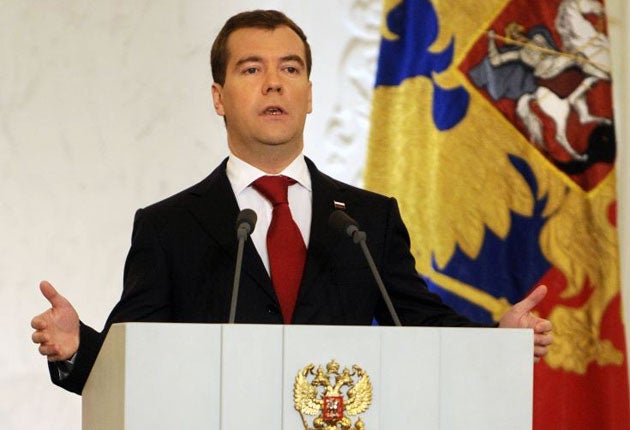
In his biggest speech since taking office yesterday, President Dmitry Medvedev laid out a harsh critique of the state of Russia and unveiled a blueprint for its reform.
The way forward for Russia was for its economy to become modern, hi-tech and innovative, the President said in his annual State of the Nation address. He promised to jail corrupt officials and promote innovative businesses that would be the catalyst of modernisation. Russia had fallen behind, he said, due to its over-reliance on the export of natural resources.
He admitted that Russia had been harder hit than most by the global financial downturn, and insisted that this was partly Russia's own fault. "We need to admit that in the previous years we didn't do enough to overcome the problems we inherited," Mr Medvedev said, in what many will interpret as veiled criticisms of his predecessor, Vladimir Putin. Now Prime Minister but arguably Russia's most powerful politician, Mr Putin received a standing ovation when he entered the Kremlin hall for the address.
There was no direct criticism of his mentor during the 100-minute speech, but Mr Medvedev did attack some areas of the former president's legacy, including the huge state corporations he created, deriding them as outdated and ineffective. He said they would have to reform into commercial companies in the coming years. "We need to launch modernisation and renovation of the entire industrial base. Our nation's survival in the modern world will depend on that," Mr Medvedev said.
Since taking over from Mr Putin in a carefully stage-managed transition of power last year, the President has often appeared to strike a more liberal tone and has frequently stated that the ruling system should become more liberal and flexible.
In September he published an online article entitled "Forward, Russia!", which surprised many with its frank assessment of Russia as a country struggling with an ineffective economy and beset by corruption. Mr Medvedev invited readers to write in with comments and suggestions on how to modernise their country.
However, critics doubt his ability to implement such wide-ranging reforms, and question how much power he actually wields, with most key decisions seemingly taken by Mr Putin.
His speech yesterday was short on concrete policies although he did in-clude plans to build a "Silicon Valley-style centre of innovation" and attract Russian émigré scientists back to the country. He chided authorities in the troubled North Caucasus region for being corrupt, and promised that officials pocketing cash would be imprisoned. In the political sphere, Mr Medvedev had little radical to offer. He has introduced mild reforms to the party political agenda which opposition parties say have made little difference. Regional elections last month were so dominated by Mr Putin's United Russia party that even the parties of mild opposition that are usually happy to play the Kremlin's games staged a walkout of the Duma.
Mr Medvedev proposed abolishing the current requirement for parties wanting to register for elections to collect a large number of signatures in support, which has hampered small parties. He also said that parties not represented in the Duma should still be allowed to gain audiences with the ruling powers. However, the President made it clear there would be no time for the radical opposition. "Attempts to rock the situation with democratic slogans, to destabilise the state and split society will be stopped," he said.
Analysts were sceptical about the President's vision. "Except for a couple of phrases, most of the speech was just wishful thinking and unfounded promises," said Vladimir Pribylovsky, a Moscow-based political analyst.
Changing times: PM promises to cut Russia's 11 time zones
One of the more surprising initiatives unveiled by Dmitry Medvedev yesterday was a plan to reduce the number of time zones in the world's largest country. Russia sprawls over 11 time zones, from the Kaliningrad enclave that borders Poland in the far west, to the volcanic Kamchatka peninsula in the far east.
When government officials arrive for work in Moscow, those in Kamchatka, nine time zones away, are already leaving the office. This creates obvious problems for efficient government and communications, but it was unclear how a reduction in time zones could be implemented without a significant proportion of Russia's population having to wake up in the dark.
Mr Medvedev promised to set up a commission to investigate whether retaining daylight saving time was a good idea for the country, something which, bizarrely, received one of the largest rounds of applause during his whole speech.
It may not seem like a major issue, but some Russian politicians do not appreciate having to change their watches twice a year.
Subscribe to Independent Premium to bookmark this article
Want to bookmark your favourite articles and stories to read or reference later? Start your Independent Premium subscription today.
Join our commenting forum
Join thought-provoking conversations, follow other Independent readers and see their replies