Sarkozy vs the spy
President pursues vendetta against Chirac clan by suing former spy chief over diary accusations

For free real time breaking news alerts sent straight to your inbox sign up to our breaking news emails
Sign up to our free breaking news emails
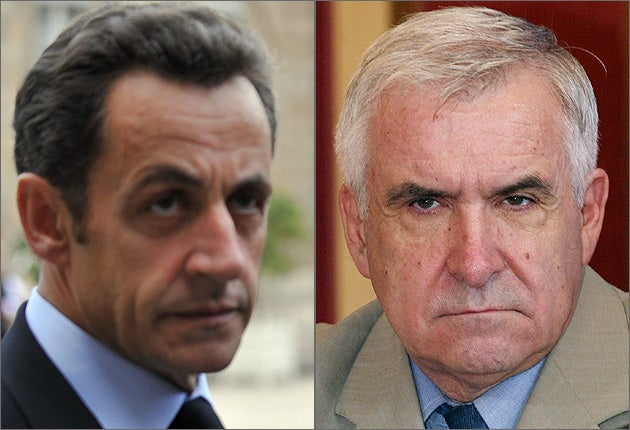
President Nicolas Sarkozy has taken the unprecedented step of suing the former chief of a French internal intelligence service, pursuing his long, vicious quarrel with the clan of the former president, Jacques Chirac.
The President has accused Yves Bertrand, the former head of the Renseignements Generaux (RG), of "invasion of privacy, malicious accusation and forgery". This follows the publication of extracts from note-books kept by M. Bertrand between 1998 and 2003, which mingled private dentist's appointments and shopping lists with lurid rumours about the sexual and financial activities of French politicians, including M. Sarkozy.
M. Bertrand, 64, a protege of former President Chirac, was the head of the RG – which sprawled over some of the duties covered in the UK by MI5 and Special Branch – for 12 years from 1995. His notebooks were seized by magistrates in January as part of a criminal investigation into the Clearstream affair, a tangled saga of personal hatreds and alleged dirty tricks at the highest levels of the French state.
Extracts from M. Bertrand's notebooks were published last week by the magazine Le Point. They imply that the security chief acted for many years as a kind of sponge for damaging gossip about President Chirac's political rivals on the left but also within his own centre-right camp and, especially, gossip on the fast-rising M. Sarkozy.
The notebooks contain repeated references to the alleged sexual escapades of "Sarko" and "NS". The future President is reported, in one note, to have had an affair with the wife of a parliamentarian who went on to become a minister in the present government. They also contain references to alleged, dubious financial dealings by M. Sarkozy, allegations which appear to be entirely without foundation.
M. Bertrand has admitted that the notebooks consisted mostly of "tittle-tattle and rumours", 80 per cent of which proved to be untrue. He said that it was his job, as head of the RG, to be aware of such rumours "before anyone else". They were nothing but "rough notes" for his eyes only, he said yesterday. How, he asked, could he be responsible for the publication of these "rough notes" in a respectable centre-right magazine, nine months after they were "pinched" from his home by examining magistrates?
French journalists and independent lawyers are asking much the same question. Why, they ask, has President Sarkozy taken the dramatic, but legally dubious, step of suing M. Bertrand but not bringing any action, so far, against Le Point? The tone of the magazine's coverage was actually more damaging to the Chirac clan than to M. Sarkozy. In particular, Le Point drew attention to the frequent meetings in 2001-02 between M. Bertrand, the intelligence chief, and Dominique de Villepin, then head of President Chirac's private office, but later Prime Minister and the potential Chiraquian stumbling block to the presidential ambitions of M. Sarkozy.
M. De Villepin's hopes of running for president were wrecked, among other things, by evidence linking him to the Clearstream affair. In 2004, fake lists of alleged holders of off-shore accounts handled by the Luxembourg bank, Clearstream International, were leaked to the French press. Scores of French politicians and other figures were alleged to hold secret bank accounts, illegal under French law. The names included that of M. Sarkozy.
A lengthy criminal investigation by two magistrates has examined, amongst other things, suggestions that M. De Villepin encouraged the leaking of these documents, knowing them to be false. The investigation wrapped up last month and appeared to find no conclusive evidence against M. De Villepin. But the public prosecution service decided last week to charge him with "complicity in libellous denunciation". The former prime minister has protested his innocence and suggested that M. Sarkozy may have intervened to ensure he went through the humiliation of a trial. The day after M. De Villepin was charged, the extracts from the Bertrand notebooks – implying he was M. Chirac's malicious gossip-monger-in-chief – appeared in Le Point.
M. Bertrand is a career police officer, who spent most of his working life in the RG until he was forced into retirement in 2006 by the then interior minister, Nicolas Sarkozy. Although broadly equivalent to Special Branch or MI5, the RG was long considered a "political police" force, manipulated by politicians in power.
After M. Sarkozy came to power last May, he abolished the RG and merged it with the counter-espionage agency, La Direction de la Surveillance du Territoire. France now has only one internal intelligence service, the Direction Centrale du Renseignement Intérieur.
Subscribe to Independent Premium to bookmark this article
Want to bookmark your favourite articles and stories to read or reference later? Start your Independent Premium subscription today.
Join our commenting forum
Join thought-provoking conversations, follow other Independent readers and see their replies